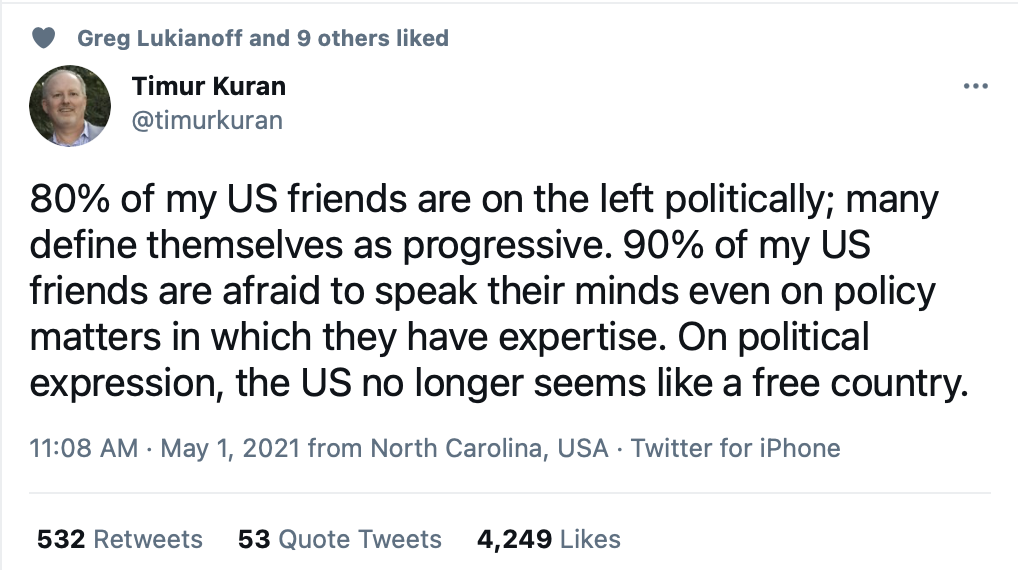
Long Form Podcasts as a Remedy for Tribal Thinking

A friend is quite perturbed at me for (as I view it) not adopting the top-to-bottom progressive platform. The friend found it disturbing that I would get some of my information from sources that the friend considered to be the other team. I told this friend: "You are the 1,000th person to get frustrated with me for wanting to get my facts straight without reference to the prevailing narratives of political tribes. I am prepared to die on this hill."

I am wired to make sense of things as best I can, letting the chips fall, regardless of whether I offend people in the process (with rare exceptions).  I was prepared for this way of learning during a childhood where my father force-fed me buckets of religious dogma, resulting in this five-part essay.

I am willing to get useful information from anyone who has information that seems useful.  I'm working hard to not divide the world into "good" people and "bad" people.  Good people often say untrue things and bad people often say things that make sense. Everyone has a batting average. Everyone is flawed. It is my act of faith that we need to listen to all of it and then pretend that we are emotionally detached Martian anthropologists in order to decide what is accurate. In other words, we need to pay close attention to John Stuart Mill, who is as relevant as ever.

Hence, I reject any Manichean outlook. I fear that our two main political tribes and their respective news silos (amplified by social media) are poisoning our national dialogue. In fact, ruining our national dialogue to the point where, truly, our de facto national motto is getting to be "Fuck e pluribus unum!"  It's gotten to the point where people are hating other people for ideas, whereas I think we can hate the idea but must always love the person. I am not religious, but I think that Jesus' "Love your enemy" is one of the most radical, brave and brilliant things ever said.

We need to listen to people that others call the "enemy" because sometimes they are right--sometimes it takes years for it to become apparent that they are correct. I have long been ridiculed for listening "to the enemy." That is, and will forever be, my plight, because the world is complex, not a cartoon, and no tribe has it completely right. We need to actively listen to each other and test each others' claims without feeling like this is a threatening thing to do, in order to make good sense of our world. Without each other, we are all prone to become ideologues who "win" all of our arguments because we refuse to consider competing views (and in fact many of us actively work to muzzle competing views). Hard earned, carefully distilled facts first to prepare the way for meaningful opinions, is the only way to make sense. Whenever we do the opposite, indulging in thinking and opinion-vomiting as a team sport, we are poisoning all dialogue and shutting down human flourishing.

I believe that real conversation (not the pundits barking at each other on CNN, or regular folks on the street, imitating the pundits) will dissolve many of the differences we see in each other. That brings me to an inspiring dialogue I recently heard: a discussion involving Joe Rogan and Glenn Greenwald. This is an odd couple in many ways. At the beginning of the show they both admitted that, in prior years, they weren't each others' favorite people. But they reached out, sat down for three hours and had a riveting conversation that covered many issues, including whistle-blowers, corruption in Brazil, Hunter Biden. My favorite part is where Joe and Glenn discussed the importance of reaching out to people who think differently in order to understand them and to better understand yourself.

Rogan and Greenwald both tout the long-form podcast as one of the best ways to dissolve the pundit-coating that people construct around themselves and to then get down to some interesting conversation--the kind of conversation where people learn interesting things about each other and about themselves. You can be a politician for a short session on FOX or NPR, maybe even 30 or 40 minutes, but you can't hide it for several hours. Rogan mentions that he stumbled upon this powerful revelation because he was too lazy to edit his long podcasts, but then he started to appreciates incredible power of the long-form podcast to reveal who people really are.  This conversation between two wide-open complex minds is pure gold, and I invite you to listen to the entire podcast, but especially from 118 min mark to the 140 min mark.  You can also read along here (beginning at 2:01:38).
Continue ReadingLong Form Podcasts as a Remedy for Tribal Thinking

John McWhorter Discusses Anti-Racism with Bill Maher

Linguistics Professor John McWhorter sat down with Bill Maher on a recent episode of Real Time to discuss "anti-racism." McWhorter describes himself as someone who is hearing things that don't make sense and his quest is to try to obsessively make sense of things like "anti-racism."  The interview was as intense as it was fast-moving. Several take-aways:

A) "Anti-racism" condescends to people who identify as "black," infantilizing them.

B) There is a great diversity of thought among those who identify as black, almost two-thirds of whom are middle class (or even higher earning), the majority of whom do not live in ongoing fear of being harassed or shot by the police,

C) None of this is to suggest that there isn't still racism, which needs to be addressed.

D) Wokeness is a religion where "whiteness" functions as "original sin" that afflicts even babies, a religion where Robin DiAngelo's misguided book, White Fragility is mistakenly being treated as "research" instead of second-rate literature that advocates for victimization;

E) People pretend to "atone" for "white privilege" by posting on FB that they are "doing the work." This solves nothing.

F) White Fragility is not representative of "the general black view of things."

G) There is no one "black view" of things - Also, "'Yes we can't'" has never been the slogan for black America and it's not now."

H) In the religion of Wokeness, advocates pretend that "racism has never been worse" than today, even in the 1960's and even during the 1850's. These are palpable untruths to any person who knows even a tiny bit of history. "Why is it un-black to address degree?"

I) It is childish for anyone to shut down opposing views to protect themselves from never being told that they are wrong. This "cathartic" approach will never change anything. We need meaningful engagement.

J) Social media has everyone "peeing in their pants," afraid to defer even minimally from Woke orthodoxy, which is making "mendacity" ubiquitous.

K) The fear of being honest and the fear to even tell a joke is "becoming almost everywhere. The only exceptions are people who are "weird like us and you don't mind being hated. But most people are not going to have that disease, and so we are stuck where we are."

If you'd like to follow John McWhorter, you can find him on his own Substack Website, It Bears Mentioning.   Also, McWhorter often joins Glenn Loury for conversation at The Glenn Show on Patreon. 

Continue ReadingJohn McWhorter Discusses Anti-Racism with Bill Maher

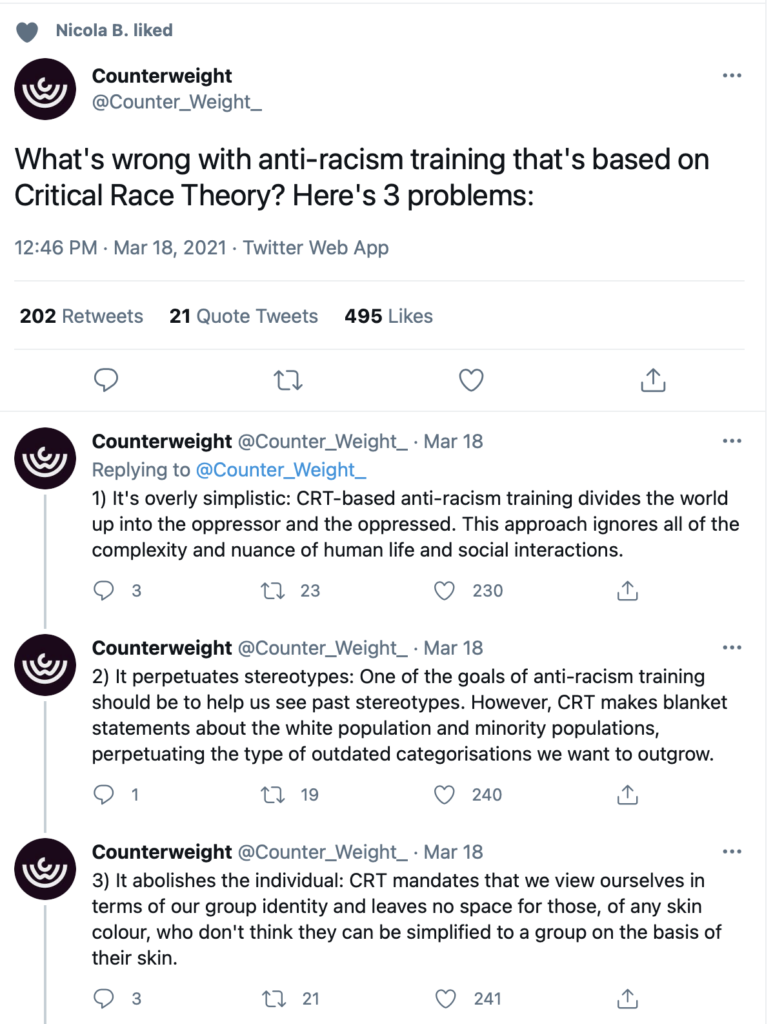
Counterweight: New Organization Helps Individuals Fend Off Impositions of Critical Race Theory

One of my favorite writers, Helen Pluckrose, is one of the founders of a promising new organization called Counterweight. The mission is to help individuals resist the imposition of Critical Social Justice (CSJ) in their day to day lives. Here's one of the organization's first Tweets: What is wrong with anti-racism training that's based on Critical Race Theory?

Continue ReadingCounterweight: New Organization Helps Individuals Fend Off Impositions of Critical Race Theory

Stop Being a Dupe: The Danger of Almost Completely Polarized “News” Media.

What happens when the Venn diagram of "news" coverage by outlets on the political Left and Right have almost no overlap? What happens when our "news" outlets become singularities, where people on the political Left rarely tune into Right-leaning "news" outlets and vice versa?  What happens when consumers of the "news" become too trusting, too obedient, too subservient to the carefully crafted political narratives of their favorite news outlets?  It is at that point that news consumers become dupes. Worse, they become agitated dupes who don't want to hear about their blind spots. People on both the political Left and Right insist that they are well informed merely because they get their "news" from the A, B, C outlets.  In the meantime, John Stuart Mill is spinning in his grave over our collective self-induced sickness.

This is the current state of news media and its most rapacious consumers. Matt Taibbi explains the main danger: the lack of informational course-correction. It is now common that blatant errors of fact take root and live on indefinitely. Here is an excerpt from Taibbi's latest article at TK, where he offers many examples (you will be pummeled with examples beginning at the 6-minute mark of Taibbi's video, below). You can find this article at Matt's Substack website. The title his article is "The Bombhole Era":

This technique of using the next bombshell story to push the last one down a memory-hole — call it Bombholing — needed a polarized audience to work. As surveys by organizations like the Pew Center showed, the different target demographics in Trump’s America increasingly did not communicate with one another. Democrats by 2020 were 91 percent of the New York Times audience and 95 percent of MSNBC’s, while Republicans were 93 percent of Fox viewers. When outlets overreached factually, it was possible, if not likely, that the original target audience would never learn the difference.

This reduced the incentive to be careful. Audiences devoured bombshells even when aware on a subconscious level that they might not hold up to scrutiny. If a story turned out to be incorrect, that was okay. News was now more about underlying narratives audiences felt were true and important. For conservatives, Trump was saving America from a conspiracy of elites. For “liberal” audiences, Trump was trying to assume dictatorial power, and the defenders of democracy were trying to stop him.

A symbiosis developed. Where audiences once punished media companies for mistakes, now they rewarded them for serving up the pure heroin of shaky, first-draft-like blockbusters.

In the above video, Taibbi explains that the "news" media now operates like a Ponzi scheme, promising yet failing to pay off. Here is a quote from the one-minute mark:

You've heard of a Ponzi scheme? You promise guaranteed returns using money from the new suckers to pay off the old ones and nobody ever finds out you are bankrupt all along. The bombshell era is a journalistic ponzi scheme you sell every scandal as the biggest ever you stoke audience expectations with words like "historic," "unprecedented," "treason," "Watergate," "concentration camp," "reichstag" and BOOM! You dismount into dramatic predictions before moving on to the next mania.

Continue ReadingStop Being a Dupe: The Danger of Almost Completely Polarized “News” Media.