
Greg Lukianoff’s Analysis of “Critical Race Theory” in the Classroom

Attorney Greg Lukianoff of FIRE (Foundation For Individual Rights in Education) has written a detailed legal analysis regarding a disturbing and divisive method of "teaching race" in the classroom (which many have referred to as "Critical Race Theory") (and see here and here).  This trend in the classroom is divisive because many teachers think it's a good idea to categorize there students as "colors" and to divide them into these "colors," sometimes physically.  It disturbing because the main job as a teacher is to teach students how to think, not what to think. The title of his article is "13 important points in the campus & K-12 ‘critical race theory’ debate." Below, I've included an excerpt from Point 8 of Lukianoff's 13 points:

Each side’s distorted impression of the goals of the other side, and of what’s actually in the bills, has been an unfortunate side effect of the media coverage. Those listening to left-leaning outlets and pundits could be forgiven for thinking that the bills outright ban discussion of slavery. Those listening to right-leaning outlets and pundits could be forgiven for having no idea of the breadth and vagueness of a lot of the clauses in these bills, and the chilling effect they may create with teachers making good faith attempts to comply. The media coverage of these bills has been largely lacking in deep-dives into the actual text of the bills, instead relying on broad characterizations of their intent and the motivations behind those introducing them.

As I’ve already gone into many of the good points made by the critics of these bills, I would like to pay some attention to the valid concerns that the bills were meant to address. With the exception of the vague kinds of clauses mentioned above, most of what these bills prohibit are speech or patterns of behavior by teachers that even many of the critics of these bills would find problematic, and arguably would already run afoul of laws prohibiting racial discrimination and harassment. For example, North Carolina’s HB 324, mentioned above, prohibits public K-12 schools from “promoting” the following concepts:

(1) One race or sex is inherently superior to another race or sex.

(2) An individual, solely by virtue of his or her race or sex, is inherently racist, sexist, or oppressive, whether consciously or unconsciously.

(3) An individual should be discriminated against or receive adverse treatment solely or partly because of his or her race or sex.

(4) An individual’s moral character is necessarily determined by his or her race or sex.

(5) An individual, solely by virtue of his or her race or sex, bears responsibility for actions committed in the past by other members of the same race or sex.

(6) Any individual, solely by virtue of his or her race or sex, should feel discomfort, guilt, anguish, or any other form of psychological distress. […]

These bills are a reaction to legitimately concerning documented cases of K-12 students being singled out due to their race and made to participate in exercises that are, arguably, racially discriminatory. I was disturbed to read some of the examples in my co-author — and FIRE colleague — Bonnie Snyder’s forthcoming book Undoctrinate: How Politicized Classrooms Harm Kids and Ruin Our Schools—And What We Can Do About It, such as:

A biracial high school student in Las Vegas was allegedly singled out in class for his appearance and called derogatory names by his teacher. In a lawsuit, the student’s family alleges he was labelled an oppressor, told denying that status was “internalized privilege,” and told he needed to “unlearn” the Judeo-Christian principles imparted by his mother. When he refused to complete certain “identity confession” assignments, the lawsuit claims, the school gave him a failing grade. He has had to attend counseling.

Third grade students in California were forced to analyze their racial and other “identities,” rank themselves according to their supposed “power and privilege,” and were informed that those in the “dominant” culture categories created and continue to maintain this culture to uphold power.

Parents in North Carolina allege that middle school students were forced to stand up in class and apologize to other students for their “privilege.”

Buffalo public schools teach students that all white people perpetuate systemic racism and are guilty of implicit racial bias.

Elementary children at the Fieldston School in Manhattan were sorted by race for mandatory classroom exercises.

A head teacher in Manhattan was caught on tape acknowledging that the curriculum at his school teaches white students that they’re inherently “evil” and saying, “we’re demonizing white people for being born.”

While there is some debate to be had over how widespread the phenomenon is, some students are being made to feel, in class, that their mere existence is problematic and requires an apology or explanation. These bills, wise or not, are intended to address this problem. If your argument against these bills is that they’re much ado about nothing, or a solution in search of a problem, I think you should look deeper and think more critically about what proponents of these laws are worried about.
Continue ReadingGreg Lukianoff’s Analysis of “Critical Race Theory” in the Classroom

Don’t Take the Bait by Arguing About the Proper Meaning of “Critical Race Theory”

Robby Soave makes his case at Reason. First of all, what does Critical Race Theory seem to mean? I've gathered many pronouncements. Soave offers this:

Critical race theory is the idea that structural racism is embedded in many U.S. institutions. Slavery was the reality when the country was founded, and segregation endured for a century following the Civil War. It would thus be naive to assume that supposedly race-neutral policies are actually race-neutral—there's nothing neutral about America and race. Working from this assumption, adherents of critical race theory tend toward a kind of progressive activism that views post-Enlightenment classical liberalism and its notions of equal opportunity, the prioritization of individual rights over group rights, and colorblindness with hostility.
Here's how the bait and switch is playing out, with a money quote by Ibram X. Kendi:

Now that critical race theory is under attack, Kendi has denied being an adherent of it, saying in a statement, "I don't identify as a critical race theorist." MSNBC host Joy Reid used this as a gotcha moment during a segment with Christopher Rufo, a senior fellow at the Manhattan Institute and the foremost anti-CRT activist. But this is semantics: Kendi also told Slate that CRT was "foundational" to his work:

I've certainly been inspired by my critical race theory and critical race theorists, the way in which I've formulated definitions of racism and racist and anti-racism and Antiracist have not only been based on historical sort of evidence, but also Kimberle Crenshaw intersectional theory, which is she's one of the founding and pioneering critical race theorists who in the late 1980s and early 1990s said, you know what, black women aren't just facing racism. They're not just facing sexism. They're facing the intersection of racism and sexism. And it's important for us to understand that. And that's foundational to my work

What should this thing be called? Soave comments:

We could have called this thing intersectionality (my preferred term), or progressive antiracism, or even cultural Marxism (remember that whole debate?), but instead, we're calling it critical race theory. Oh well.

Regardless of what we call it, what is the solution? We should not prohibit the teaching of any idea, only the preaching. That's where many legislative attempts go awry. Soave offers a two-fold solution:

First, foes of critical race theory should spend their time more productively by working to ban racial discrimination in schools. Tinkering with the curriculum is usually a local issue, but states can prohibit race-based hiring and admissions systems. Bar elite public high schools from requiring white and Asian students to score higher on entrance exams, and from segregating students by race. David French is also correct that civil rights law already provides a potential avenue for students to sue school districts that have fostered a racially hostile and discriminatory climate. If the thinking behind "aspects of white supremacy culture" is put into practice in schools, those schools can be sued.

Soave's article is titled: "Critical Race Theory Can't Be Banned. It Can Be Exposed, Mocked, and Avoided: The semantics battle obscures reasonable objections to antiracist diversity seminars."

For more on David French's criticism of most of the legislative attempts to prevent CRT from being "taught" in schools, with which I agree on legal grounds, here is my comment on the conversation involving David French, Christopher Rufo and Bari Weiss.

Continue ReadingDon’t Take the Bait by Arguing About the Proper Meaning of “Critical Race Theory”

Bari Weiss Discusses the Importance of Publicly Airing Disagreements

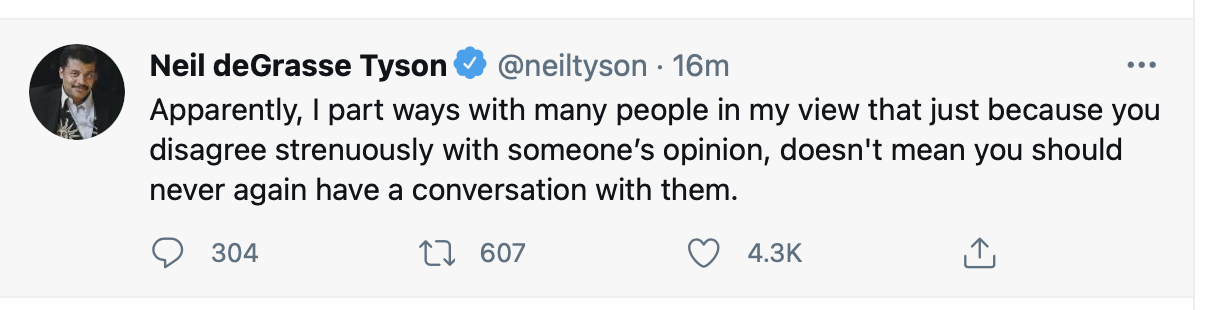
On FB I have repeatedly posted on the need for free and robust speech. Often, someone will post a comment that I must be a conservative, that conservatives are full of shit, that only true ideas must be heard, that censorship is OK for the bad guys and "You seem to have fallen off the rails." I try to respond to these comments, but it takes a lot of patience and some days my patience runs low. Bari Weiss definitely gets it. I support her writings at Substack and recommend that you check our her articles. Here's an excerpt from her most recent article, "The Books Are Already Burning: The question is only: How long will decent people stand by quietly and watch it happen?"

You do not need to agree with [Abigail] Shrier about whether or not children should be able to medically transition genders without their parents’ permission (she is opposed), or for that matter with Weinstein and Heying’s bullishness about ivermectin (I had never heard of of the drug before they put it on my radar). That’s not the point. The point is that the questions they ask are not just legitimate, they are of critical importance. Meantime, some of the most powerful forces in our culture are conspiring to silence them.

That is precisely the reason it is so important to stand up and say: no. To say: progress comes only when we have the freedom to disagree. To say: It is outrageous that tech platforms are censoring such debates and that some journalists are cheering them on. To say, in public: enough. In my case, that means making sure to publish those voices who have been shut out of so many other channels that ought to be open to them.

Continue ReadingBari Weiss Discusses the Importance of Publicly Airing Disagreements

Alternatives to “Likes” on Social Media

Most social media platforms invite users to reply "Like" a Tweet, Post or Photo. It might be fun, for instance, when a dozen people "Liked" a photo of my salad. As argued, in "The Social Dilemma," however, piles of like can serve to steer people into tribes. This can happen when people post conclusions rather than thoughtful discussions.  It can happen when people make ad hominem attacks on their least favorite politicians and simplistic cartoons of complex social issues, such as immigration.

What is social media for?  That's a good question and it might evoke ten different answers from ten people.  Is it for cat videos and photos of one's children or is it appropriately used for discussing critically important social issues?  The suggestion that I'm about to make is for those of us who see social media as an opportunity to engage in serious conversations about important issues of the day with others in our network. Those not interested in serious discussions are invited to continue sharing cat photos.

I would suggest that in addition to the "Like" option, we add a few other options, including the following:

  • Your post merely parrots a talking point of one of the two political parties.
  • You are making an ad hominem attack on a person, not providing me with useful information.
  • You are engaged in a [cognitive bias] [logical fallacy].
  • Your post caused me to think about a topic in a new way.
  • Your post made me less certain of an opinion that I had.
  • Your post made me realize that this topic is more complex than I realized.
  • Your post states the facts fairly, but I still disagree with you.
  • You provided me with new intriguing information that I appreciate.
  • Your post made me angry, but I am glad you read it.
  • Your post irritates me, I disagree with you, but I value you as a friend.

I'm sure there are others that should be considered.  The main question is whether we are satisfied hoot panting for each other to display tribal loyalties or whether we want to be challenged to understand out world better . . .

Continue ReadingAlternatives to “Likes” on Social Media