
New Model Code of Student Conduct by FIRE: A Guide for College and University Administrators
FIRE (FOUNDATION FOR INDIVIDUAL RIGHTS IN EDUCATION) recently released its "Model Code of Student Conduct," a guide for college and university administrators for governing student life while protecting student rights. I've read through the entire Code and I'm impressed. Much thought has gone into this code. FIRE has done a good job of striking balances among the rights and duties of the many parties affected by this Code at colleges and Universities.
Here is FIRE's description of the CODE:
FIRE’s Model Code of Student Conduct is a guide for college and university administrators for governing student life. Its provisions are a distillation of FIRE’s experience and expertise gained through over two decades of studying college and university disciplinary systems and responding to daily requests for assistance from students, faculty members, and administrators nationwide.
In sum, this Code is an embodiment of FIRE’s belief that protecting student civil liberties is a necessary prerequisite for preparing our democracy’s next generation for successful leadership and engaged citizenship. FIRE looks forward to discussing these principles and assisting educational institutions in adopting the Code’s provisions.
Let’s Apply the Drunk Driving Argument to This Pandemic Pool Party
Take a look at this crowded bar Memorial Day weekend at Lake of the Ozarks.
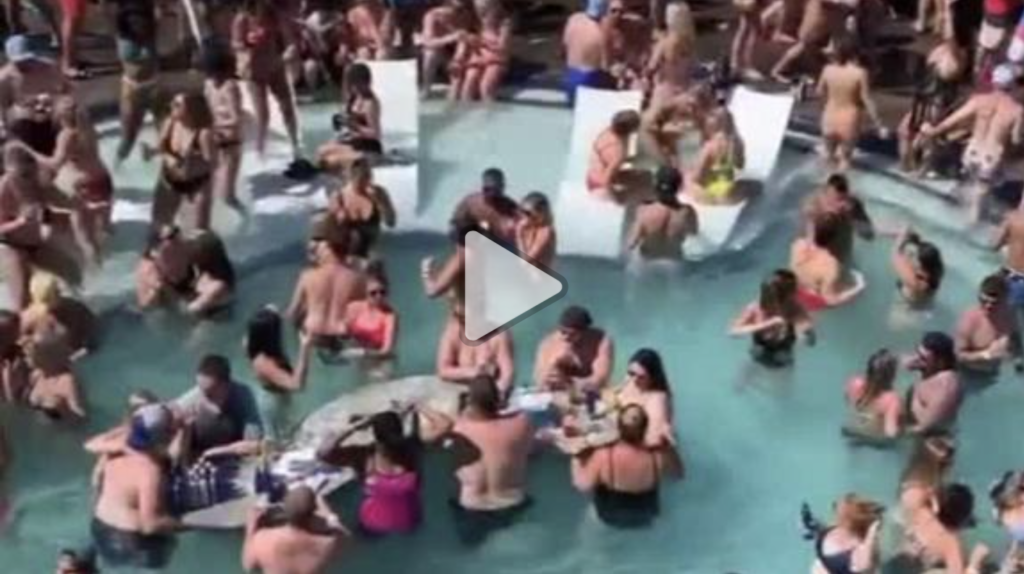
I’m going to assume that most of the people in this picture are drinking. I’m also going to assume that some of the people in this picture will leave this party intoxicated yet believe they’re ok to drive. I’m going to assume every single person in this picture arrived home safely.
What would your conclusion be if all the above were true? Would you conclude that because none of the intoxicated people in this crowd got into a car wreck afterward, that drunk driving is ok? Would you think that maybe we don’t need laws forbidding drunk driving? Or, would you conclude that the intoxicated drivers were damned lucky, because intoxicated driving clearly increases your chances of causing an accident and killing yourself and others?
Here’s another possible outcome: One of the men driving home was pretty hammered. After getting onto the highway, he realized that he shouldn’t be driving. He kept losing his focus and had some trouble staying in his lane. When he arrived home, he breathed a sigh of relief. No harm, no foul. Unbeknownst to this man, a woman driving in the lane next to him on the highway was trying to get home from her shift at the hospital. She was a nurse tired from another long day. When his car drifted over into her lane, she was forced to swerve, causing her car to roll down an embankment. She is severely injured and may not survive.
The man who is breathing a sigh of relief that he got home safely, he has no idea what his actions caused. He may never know.
Now let’s look at this picture again, knowing this photo was taken during the pandemic. It’s entirely possible that everyone left this bar feeling good and that all of them continue living a healthy happy life. It’s quite possible, however, that two or three of these people at the bar were infected but had no symptoms. It’s also entirely possible that one of these asymptomatic people talked to three other women while waiting in line in the crowded ladies’ room. As they laugh about the goofy bartender, some infected droplets spray from her mouth and onto the others. After they go home, two of them get sick. Before one of them had symptoms, she visited her elderly mother a few days later. Her mother ended up on a ventilator and died a week later.
I keep hearing, “everyone is going to die of something.” That’s 100% true. A lot of people die in car accidents, with or without intoxication involved.
But the reason we enact laws for public safety is to reduce the risk of harming or killing other people. Wearing a mask in public during a pandemic is as practical and important as NOT drinking and driving, or taking the keys away from someone who drank too much.
Wearing a mask in public is like taking the car keys away from someone who drank too much.There’s an even more compelling reason to social distance and wear a mask. The man who got home safely, may wake up the next morning and recognize how lucky he is. He may vow to never again drink and drive. Should that happen, he will never have or cause a wreck due to intoxication.
The woman who unknowingly passed the virus to the ladies in the restroom may see how quickly it’s spreading in her community and decide she’s now going to be more careful. She vows to keep a social distance, wear a mask in public, and do what she can to keep others safe. Even if she does that starting now, the people she infected last night can continue spreading the virus, exponentially. The two people she infected can spread it to four, and those four can spread it to eight and so on.
So why would we intervene to prevent death by drunk driving but not intervene to prevent death by social distancing and wearing masks in public? https://crashstats.nhtsa.dot.gov/Api/Public/ViewPublication/812864 In 2019, “only” about 10,000 people died as a result of drunk driving, but most of us feel compelled to strictly enforce the law to prevent those needless deaths. No one complains about the government violating their constitutional rights by enacting drunk driving laws.
As I finish writing this article, ten times as many people, more than 100,000 people, have died as a result of COVID-19 in just few months, with many other people barely hanging on. It’s far more deadly than drunk driving.
--
The above video is on Snapchat in the Lake of the Ozarks? Unreal. What are we doing?
— Max Baker (@maxbaker_15) May 24, 2020Contemplating the COVID-19 Pool Party at Lake of the Ozarks
This image of the COVID-19 era pool party in Missouri's Lake of the Ozarks is deservedly viral.These are stunning and disturbing images for me.
I'm struggling to get inside of the heads of these people. Are they extroverts suffering from living in isolation? Are they simply in denial of the danger? Are they innumerate, not appreciating the meaning of exponential? Are they succumbing to incessant pressures of their in-group. to conform. Are they doing expensive signaling to impress each other? Have they attempted any sort of moral calculus in their minds, or have they simply declared themselves to be mini-Fiefdoms, self-legislating that it's time to move on, the consequences be damned? I'm working hard to pull myself out of any Manichean matrix that might tempt me to see the world in terms of "good" people and "bad" people.
I prefer to think of these people are ordinary flawed people, just like the rest of us, except that they are making a bad decision here.
Jonathan Haidt Describes Today’s Conservatives and Liberals
I've closely followed the writings of Jonathan Haidt. His conclusions are closely tied to scientific findings. He crosscuts the current American political divide. He is hopeful that we will find our way as a country.
In this recent article at The Atlantic, "Jonathan Haidt Is Trying to Heal America’s Divisions: The psychologist shares his thoughts on the pandemic, polarization, and politics," Haidt explains what has gone wrong with many of those who consider themselves to be liberals and conservatives. What they have in common is authoritarianism populism:
Haidt laments the state of contemporary American politics, believing that on both the right and the left we’re seeing populism that responds to real problems but in illiberal ways. “On the right,” he said, “the populism there is really explicitly xenophobic and often explicitly racist … I think we see strands of populism on the right that are authoritarian, that I would say are incompatible with a tolerant, pluralistic, open democracy.”
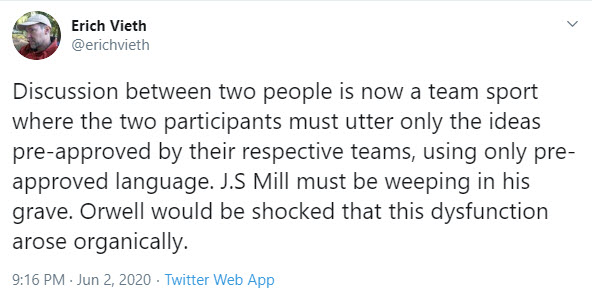
Looking in the other direction, Haidt says, “we’ve messed up the word liberal and we’ve used it to just mean ‘left.’ I’ve always thought of myself as a liberal, in the John Stuart Mill sense. I believe in a society that is structured to give individuals the maximum freedom to construct lives that they want to live. We use a minimum of constraint, we value openness, creativity, individual rights. We try hard to maximize religious liberty, economic liberty, liberty of conscience, freedom of speech. That’s my ideal of a society, and that’s why I call myself a liberal.”
But on the left, Haidt said, “there’s been a movement that has made something else sacred, that has not focused on liberty, but that is focused instead on oppression and victimhood and victimization. And once you get into a framework of seeing your fellow citizens as good versus evil based on their group, it’s kind of a mirror image of the authoritarian populism on the right. Any movement that is assigning moral value to people just by looking at them is a movement I want no part of.”
Haidt went on: “I think this is a very important point for us to all keep in mind, that left and right in this country are not necessarily liberal and conservative anymore. On the left, it’s really clear that there are elements that many of us consider to be very illiberal; and on the right, it’s hard to see how Trump and many of his supporters are conservatives who have any link whatsoever to Edmund Burke. It’s very hard for me to see that. You know, I would love to live in a country with true liberals and true conservatives that engage with each other. That, I think, is a very productive disagreement. But it’s the illiberalism on each side that is making our politics so ugly, I believe.”
The key quote from the passage above: "Any movement that is assigning moral value to people just by looking at them is a movement I want no part of.” This is a modern version of MLK's classic advice that is scorned by many modern day "liberals": "I have a dream that my four little children will one day live in a nation where they will not be judged by the color of their skin, but by the content of their character. Why has this beautiful sentiment become so difficult today?
- Go to the previous page
- 1
- …
- 13
- 14
- 15
- 16
- 17
- 18
- 19
- …
- 51
- Go to the next page