Bill Gates, COVID, Epstein, Greed, Lying, Etc
No need for a lie detector on Bill Gates.
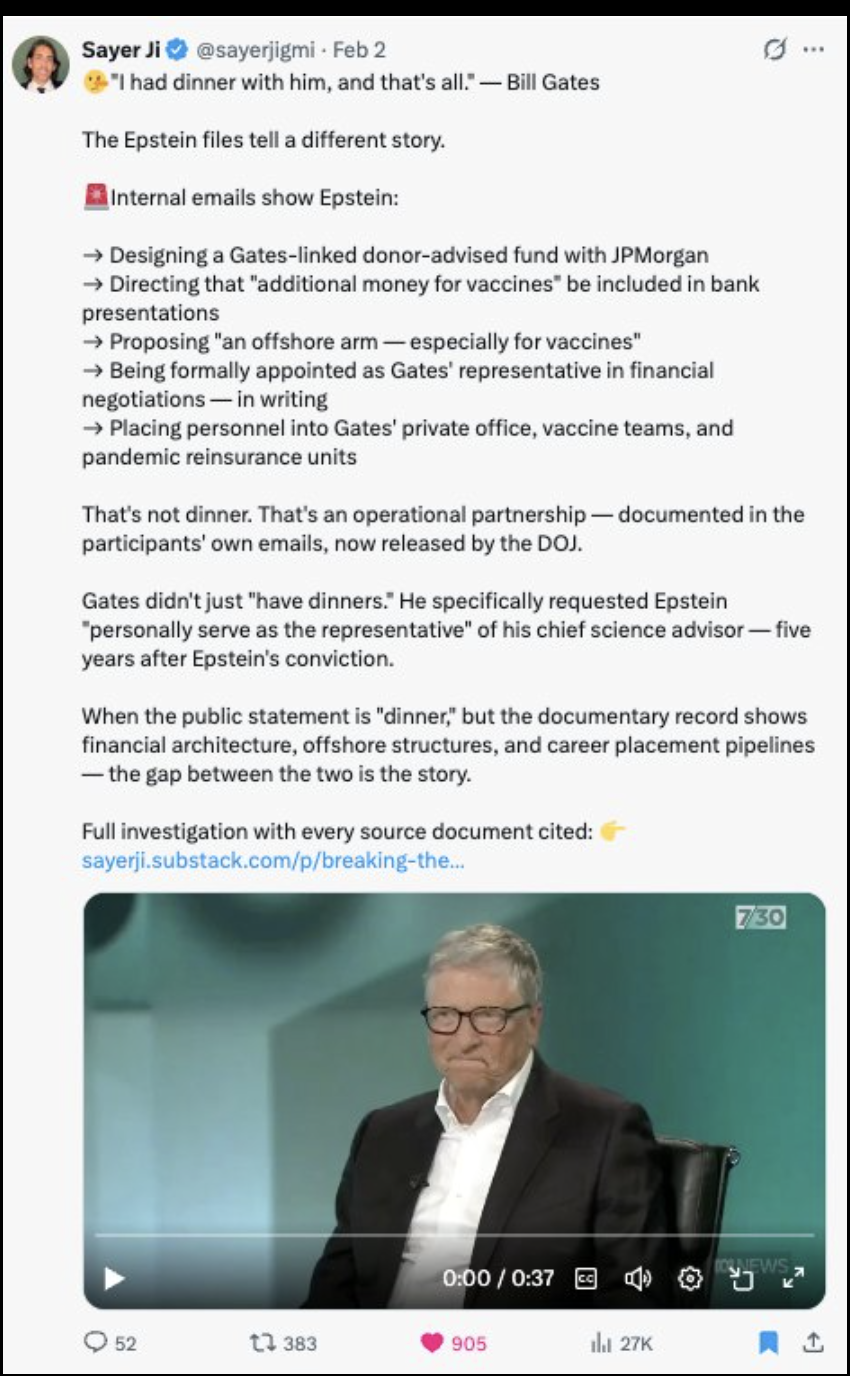
"Abject Lie" is written on his forehead. Just dinner. "That's all." You might think my venom is due to his attempt to surreptitiously slip antibiotics to his wife after surreptitiously exposing her to venereal disease caused by his adventures with Jeffrey Epstein. No, that's merely the tip of the iceberg.
Sayer Ji lays it out. Go to Sayer Ji's article, "BREAKING: The Epstein Files Illuminate a 20-Year Architecture Behind Pandemics as a Business Model—With Bill Gates at the Center of the Network: Inside the JPMorgan–Gates–Epstein Pipeline: Donor-Advised Funds, Vaccine Finance, and the Architecture of Pre-Positioned Profit."
Also visit Ji's recent posts on X. Start here:
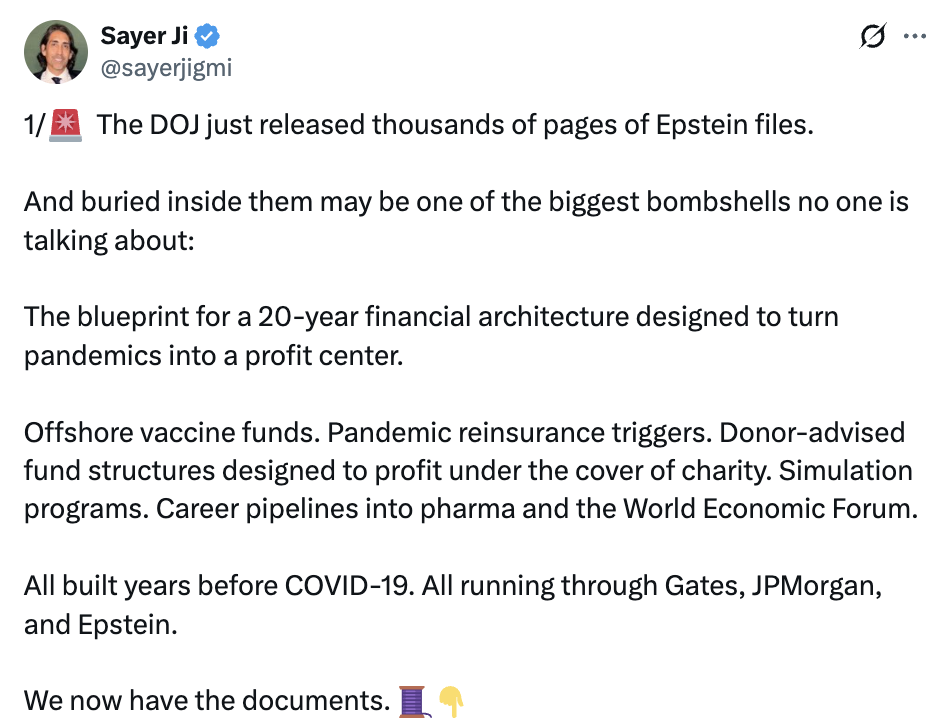
Dig into this post and the posts that follow for images of documents and links to many other documents that substantiate all of this).
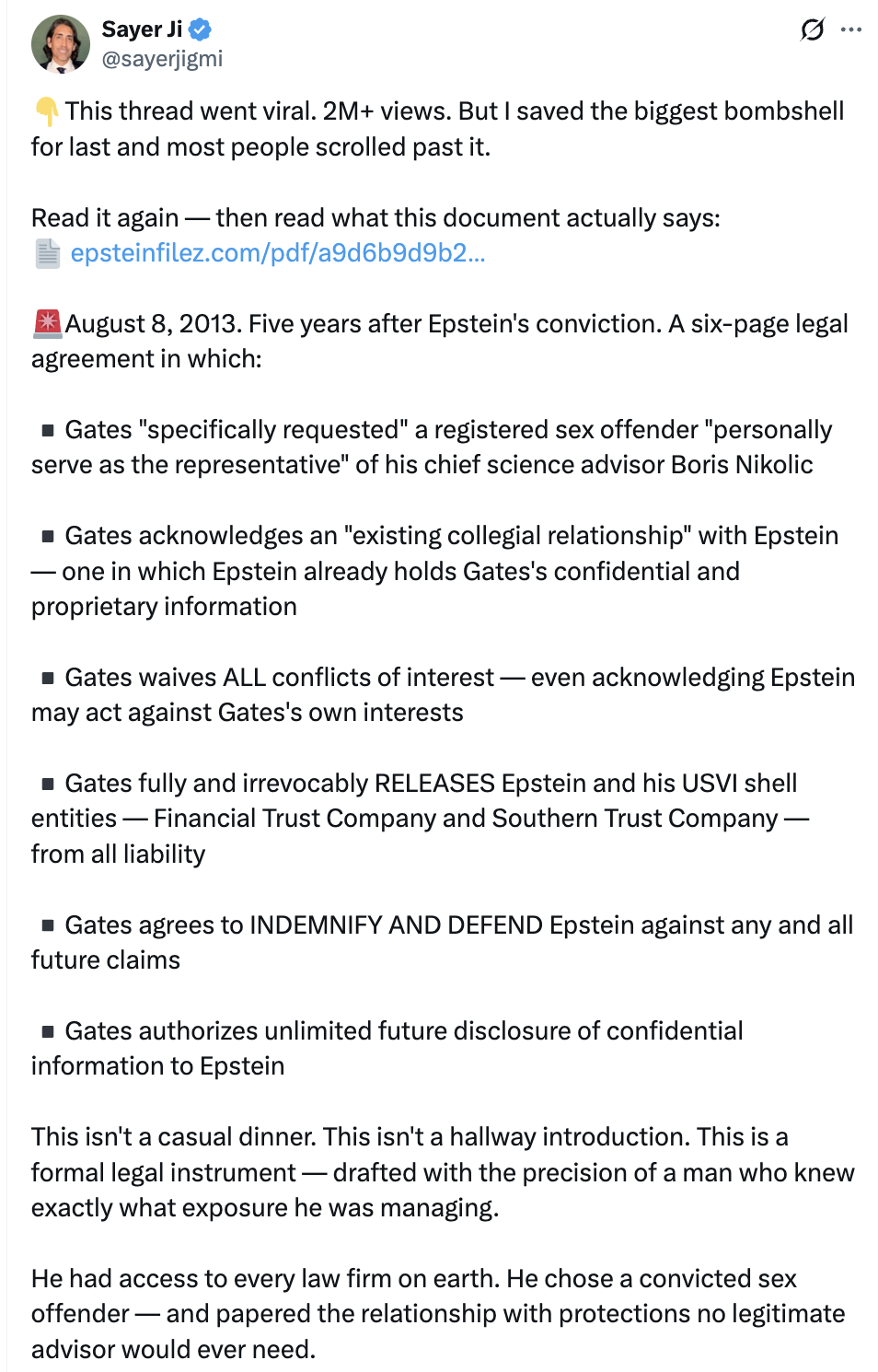
We thought we have been electing the people who govern us, but George Carlin was so very correct when he said: "They own you," and he was speaking of the "Big Club," people like Bill Gates and Jeffrey Epstein, people we did NOT elect and whom we would never have elected. Yet this is just one example (out of millions) of what corrupt people can do to mold a 'democracy" in their own image and likeness. Eric Weinstein reacts:
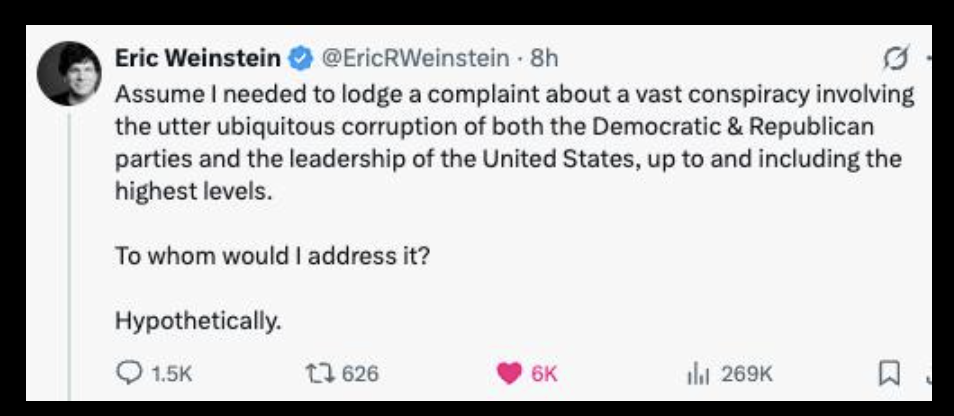
Weinstein continues in the comments to his own post:
[More . . . ]
EU Wages Vast Censorship Attacks Against US
Under no circumstances, should we allow EU countries to determine what American citizens should and should not say by levying existential fines on social media companies. There are a lot of important things going on right now, but I consider this the most important. Michael Shellenberger has been reporting on this threat for many months.

Mike Benz elaborates on this threat:
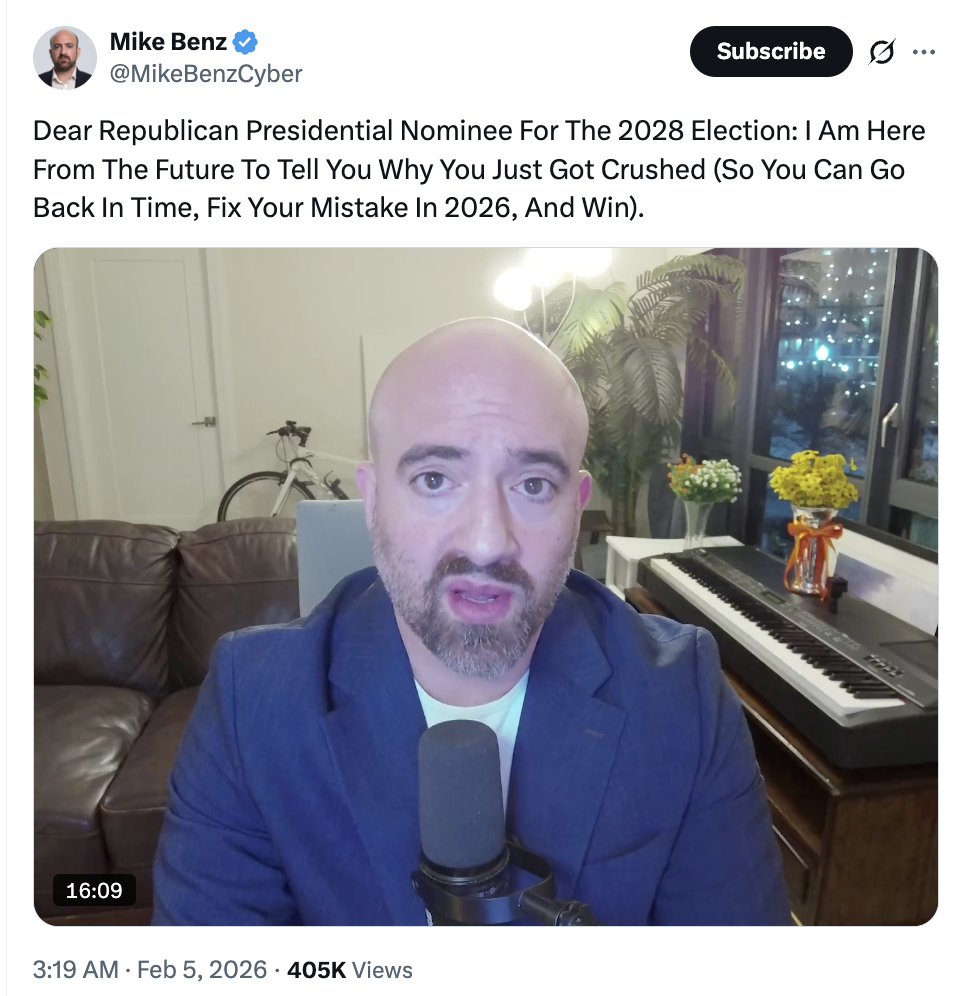
This is an issue on which the two political parties fundamentally differ. On the conduct of the Biden administration, a president, Harris would have invited this censorship. We won't now see how strongly President Trump can fight it. Success is by no means guaranteed here, as Benz explains.

Investigating Truth versus Speaking One’s Truth
Stephanie Tyler has written "The Problem with “Speaking Your Truth," pointing out a disconnect I see in many of the comments to my posts on Facebook. For many people on FB, it is not OK to consider competing perspectives, facts that run counter-narrative or even competing interpretations of facts, even when dealing with factually complex situations. Instead, one is expected to jump up and embrace tribally reinforced emotional reactions as though they are morally-infused self-evidence. Whenever someone who is careful and sincere fails to immediately take a knee, people who are decorated with enough credentials that they should know better launch barrages of ad hominems. They will loudly proclaim that they are "good" people you are not. In the end, there will be only heat, no light. Though there might be more words, there is no real conversation. Excerpt from Tyler's article:
"I spent years inside women’s and gender studies classrooms, where language like “lived experience,” “the personal is political,” and “my truth” wasn’t just common, it was foundational. These phrases weren’t offered as rhetorical flourishes, they were treated as epistemology, as a way of determining what counted as knowledge. Experience wasn’t something you brought into the room to be examined alongside evidence, history, or competing explanations. It was something closer to authority. And once it was invoked, questioning it wasn’t framed as inquiry, it was framed as harm.
At the time, I accepted this framework without much resistance. It felt humane, or corrective, like a long-overdue response to voices that had been ignored. Only later did I realize something important had been smuggled in along the way: the idea that subjective experience and shared reality belonged to the same category. They don’t.
Subjective experience is real and it matters. It shapes how people interpret the world and move through it, but it’s also internal, private, and non-transferable. It tells you how something felt to someone, not necessarily what happened, why it happened, or what it means at scale. Shared reality is different. It’s external, it’s negotiated, it’s the space where claims are tested, compared, revised, and sometimes rejected. It’s the reason disagreement exists at all. It’s the thing we argue over precisely because none of us owns it outright.
When those two domains collapse into one another, empathy starts doing work it was never meant to do. And when that collapse becomes moralized, conversation stops working altogether.
Empathy, properly understood, allows you to understand another person’s inner state without surrendering your capacity for judgment. It’s a bridge, not a verdict. But increasingly, empathy is treated as a moral command with only one acceptable conclusion. You aren’t being asked to understand someone else’s perspective, you’re being asked to adopt it fully, or risk being cast as deficient, cruel, or dangerous!
This is where Gad Saad’s idea of suicidal empathy becomes useful, not as a provocation, but as a diagnosis. The problem isn’t that people care too much, it’s that empathy has been detached from reality-testing and limits. When that happens, it stops functioning as a human skill and starts functioning as an epistemic shortcut. Emotional alignment replaces argument and becomes the standard for legitimacy, and feeling the right way becomes proof that you’re right.
Once empathy is used this way, disagreement no longer needs to be answered. It only needs to be pathologized."
The World Changed, Not Me
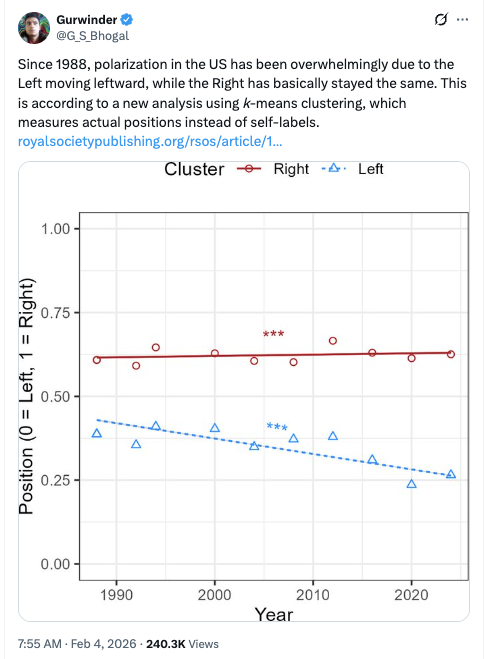
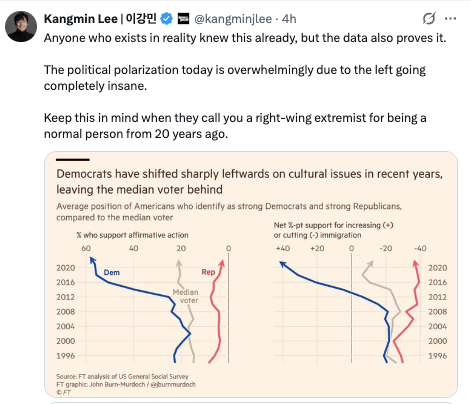
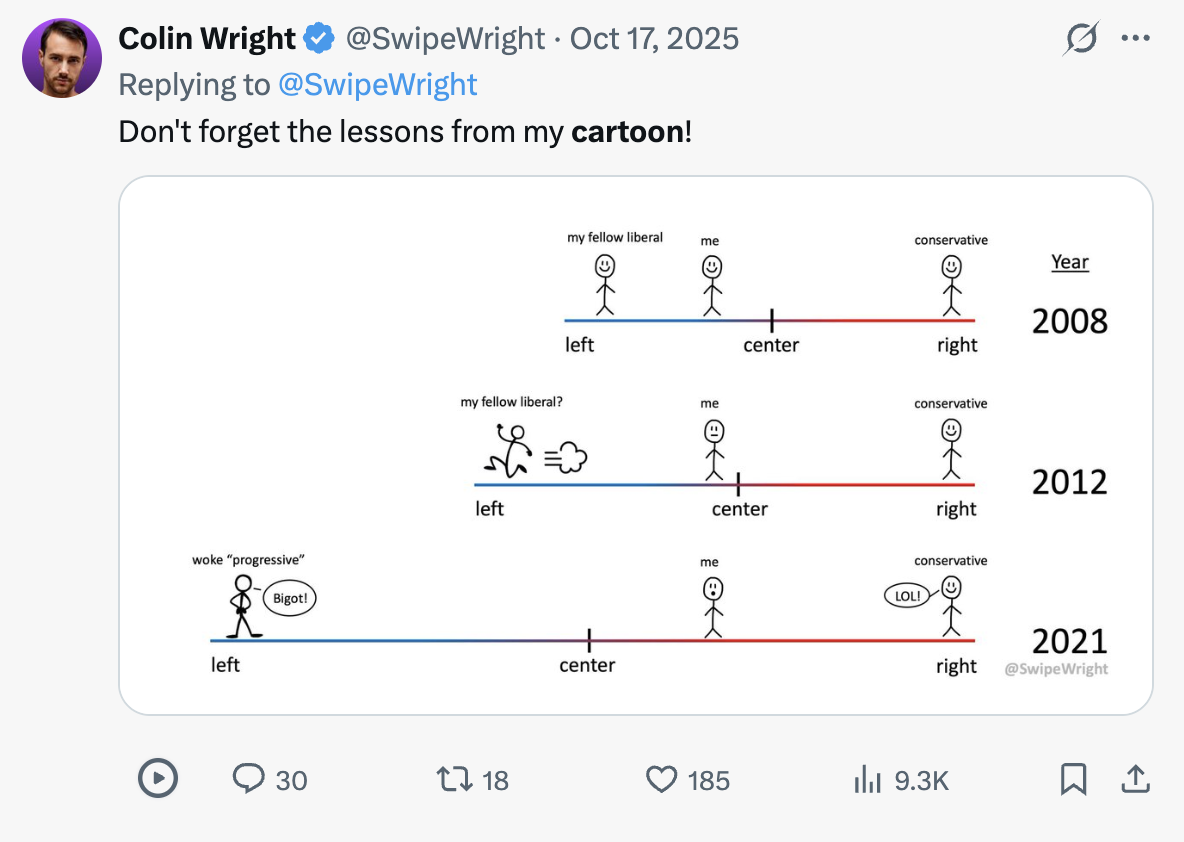
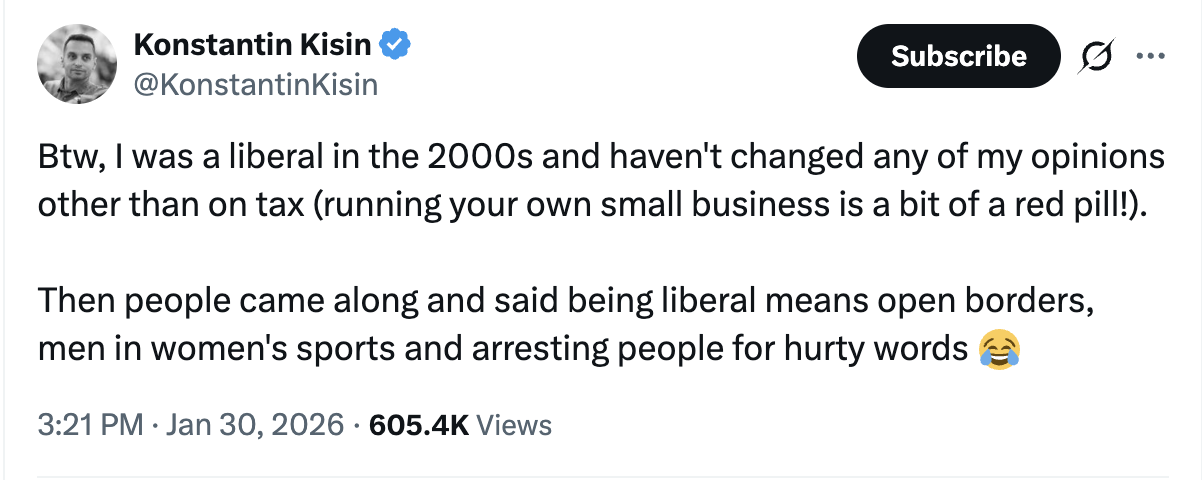 My experience is similar. I was considered liberal for decades. I voted for Obama twice, then for Hillary and Joe Biden. I canvassed for Bernie and Hillary. Then unknown people/entities pummeled all of us with propaganda/censorship causing most "liberal" people I knew to flip without any explanation and often without any concern for the contradictions based on their former recent positions. Such a bizarre thing to witness. For the most part, I'm not the one who changed.
Colin Wright illustrated it well with this simple cartoon:
[Supp Feb 4, 2026]