The Problem with Anonymous Wikipedia Accounts
This is Larry Sanger, co-founder of Wikipedia:

I posted on Sanger's concerns previously.
Perhaps in response:
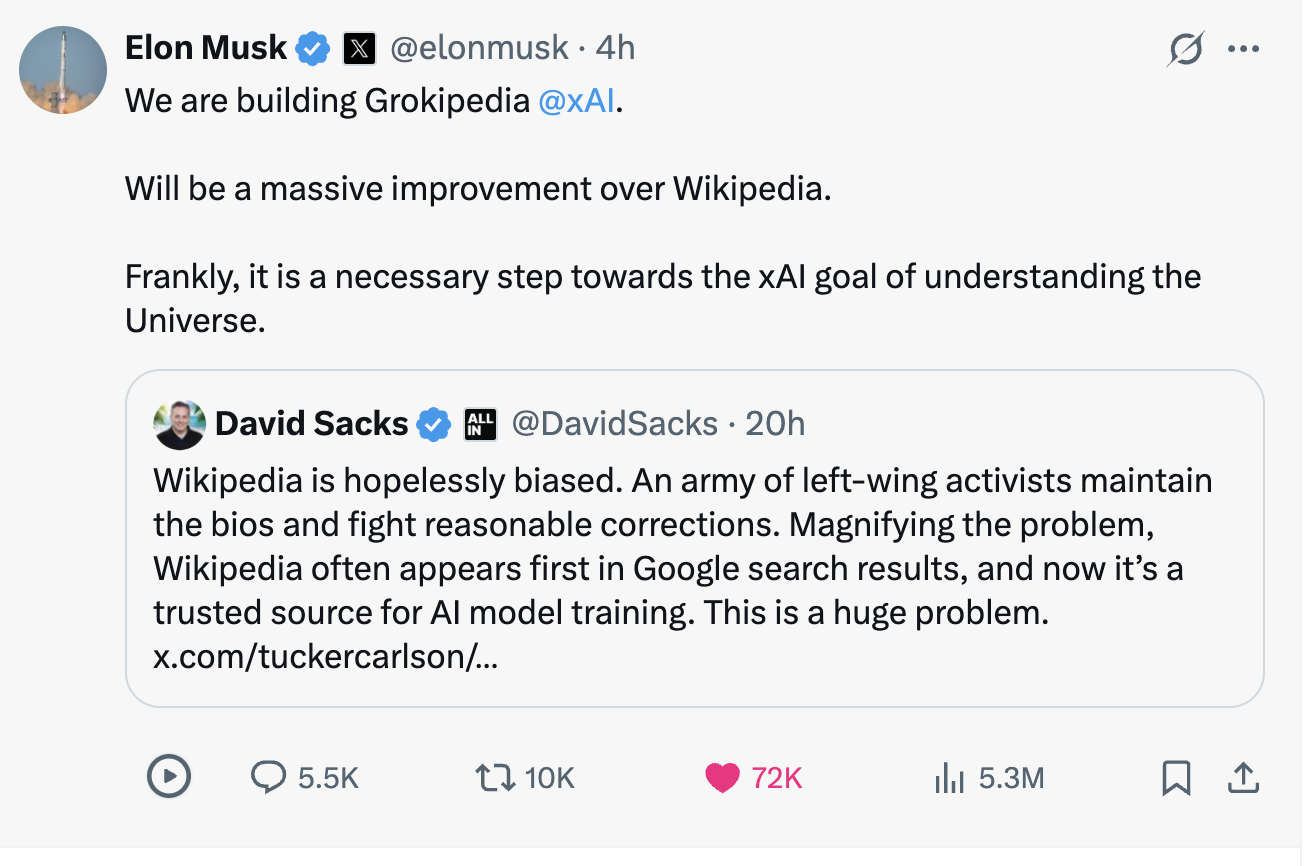

This is Larry Sanger, co-founder of Wikipedia:
I posted on Sanger's concerns previously.
Perhaps in response:

In this interview with Bret Weinstein, Rogers discusses safety concerns regarding mercury and aluminum adjuvants in vaccines, focusing on a surreal study regarding four rabbits.
"Kat A" summarizes the video on X:Having spent the last decade studying the causes of autism, Dr Tobey Rogers was mortified to discover FDA/CDC approval for the use of aluminum in vaccines was based on a study of 4 rabbits.
The results were a disaster. With aluminum found in the brain, kidneys, liver, heart, lymph nodes and bone marrow.
‘It’s beyond kafkaesque in its absurdity because the science is so terribly bad that anybody who reads that study would not want to inject their children with aluminum adjuvanted vaccines.
And that’s just one ingredient amongst hundreds in these vaccines.’
Trump is right to have it removed.
Tobey Rogers is an American political economist and writer known for his work on public health policy, particularly the intersections of regulatory capture, pharmaceutical industry influence, and chronic childhood illnesses like autism. He serves as a Fellow at the Brownstone Institute for Social and Economic Research, where he contributes articles on health policy and industry corruption.
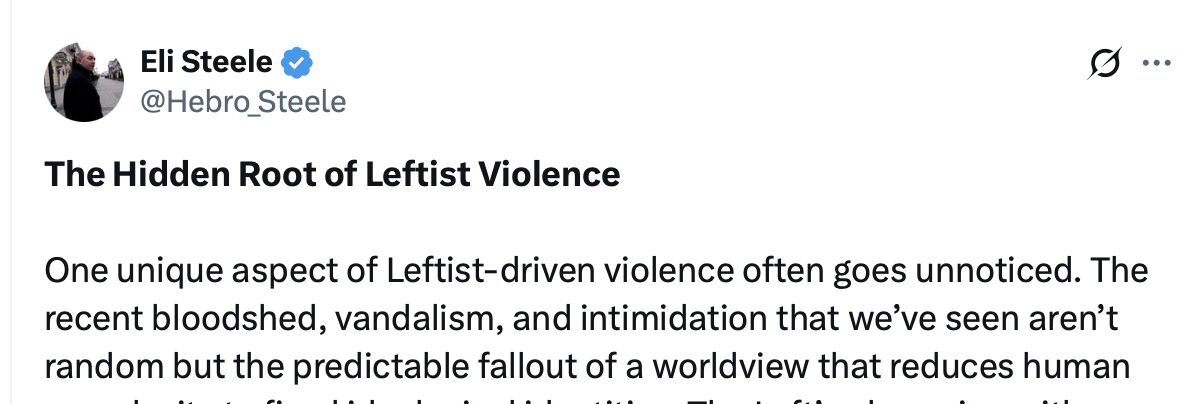
I'm concerned that Eli Steele has correctly pointed out a problem that has no obvious solution. Certainly no quick fix:
One unique aspect of Leftist-driven violence often goes unnoticed. The recent bloodshed, vandalism, and intimidation that we’ve seen aren’t random but the predictable fallout of a worldview that reduces human complexity to fixed ideological identities. The Left’s obsession with immutable traits -- race, gender, sex -- creates a victimhood hierarchy where dissent feels like an existential threat. When challenged, responses spiral into denial, defensiveness, or even violence from those unable to defend their dogma. This isn’t mere political disagreement, but the grim consequence of a belief system that rejects the Enlightenment’s focus on reason and individuality for rigid orthodoxy.
Recent events expose this pattern. The assassination of Charlie Kirk by Tyler Robinson, radicalized through Leftist politics and his transgender partner’s identity struggles, shows how loyalty to identity can turn lethal when faced with opposing views. School shootings like Audrey Hale’s 2023 Nashville attack and Robin Westman’s 2025 Minneapolis shooting reveal how issues with or challenges to gender identity can ignite rage. Elias Rodriguez’s 2025 murder of two Israeli Embassy employees, accompanied by cries of “shame on Zio-Nazi terror,” reflects a worldview -- shared by many pro-Hamas supporters -- that reduces Jews, Israeli or not, to whites and oppressors. The decade-long wave of Black Lives Matter protests, grounded in claims of systemic racial oppression, fueled riots that caused billions in damages, claimed lives, and pressured countless American institutions into adopting reductive racial identity politics as dogma.
Beyond violence, this ideology breeds intimidation, silencing dissent with threats of job loss or social ostracism. Rooted in identity determinism, this intellectual dead-end leaves no room for nuance or growth, increasing the potential for violence among those trapped in its logic -- a logic now taught to young minds through ethnic studies in K-12 schools.
If we cannot force the Left to retreat from its fixation on identity politics through the ballot box and all legal means, this ideology will only sow ever-increasing division and violence. This challenge is daunting because it demands stripping people of their very identities grounded in immutable characteristics and showing them their worth lies elsewhere -- their character. They will fight with everything they have.
To break this cycle, we must reject the notion that immutable traits dictate moral worth and recommit to reason and individuality. Until the Left abandons its dogma, it will continue to fuel conflict—a stark reminder of what happens when ideological orthodoxy drowns out dialogue.
One way to reject the notion that immutable traits dictate moral worth would be to make sure we remove all financial and social status incentives for enshrining immutable traits. But I am pessimistic that that we can make any headway by engaging in conversation. Where to start?
Bret Weinstein explains that there are three types of vaccines and none of them are completely safe.
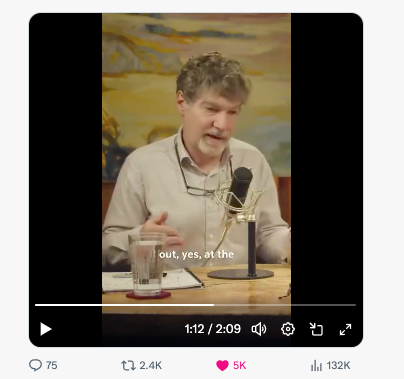
Camus summarizes Weinstein's short presentation:
1. Live Attenuated Vaccines: The risk here is unpredictability and evolution. A virus weakened for one person may cause a serious infection in another. Crucially, it can revert to a pathogenic, transmissible form—a "contagious vaccine." The historical case of the oral polio vaccine causing numerous polio cases stands as a stark warning.2. Inactivated Virus/Fragments (with Adjuvant): The problem is immune misdirection. A dead virus alone is unconvincing, requiring an "adjuvant"—a chemical alarm bell. This non-specific signal causes the immune system to "freak out," not just at the target antigen but at anything present, like pollen or gut bacteria. Indiscriminately triggering a systemic immune response is a dangerous gamble.
3. mRNA Technology: The danger is haphazard biodistribution. The mRNA instructions travel unpredictably, instructing cells anywhere in the body to produce the foreign antigen. The immune system then rightly identifies these cells as infected and attacks them. This random destruction of healthy tissue—for instance, in the heart—is an unacceptable and fundamentally unsafe mechanism.
I sometimes ask people their opinion: What percentage of things that people in the world say in a given day is true and accurate. I've heard numbers all over the board, from 20% to 80%. Andrew Huberman relates a story about the medical textbook version of this question: