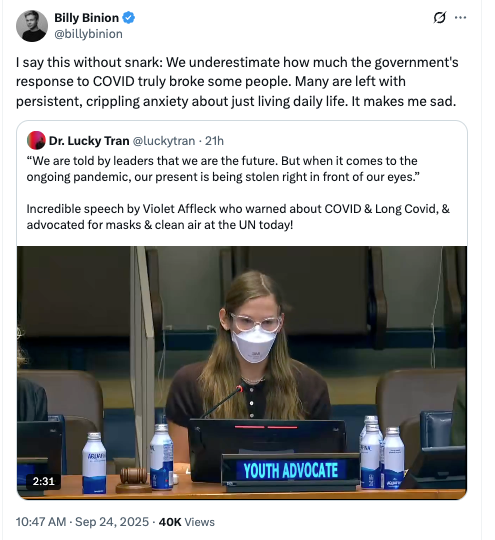
COVID Panic in 2025

Wow. And I know other people like this too.

Billy Binion:

I say this without snark: We underestimate how much the government's response to COVID truly broke some people. Many are left with persistent, crippling anxiety about just living daily life. It makes me sad. Some people also seem to really thrive—over 5 years later—off of the purpose & identity they get from being a COVID purist. It's very human to want to fight for something. But the world is not going to stop for you anymore. It is time to find a new cause.

Continue ReadingCOVID Panic in 2025

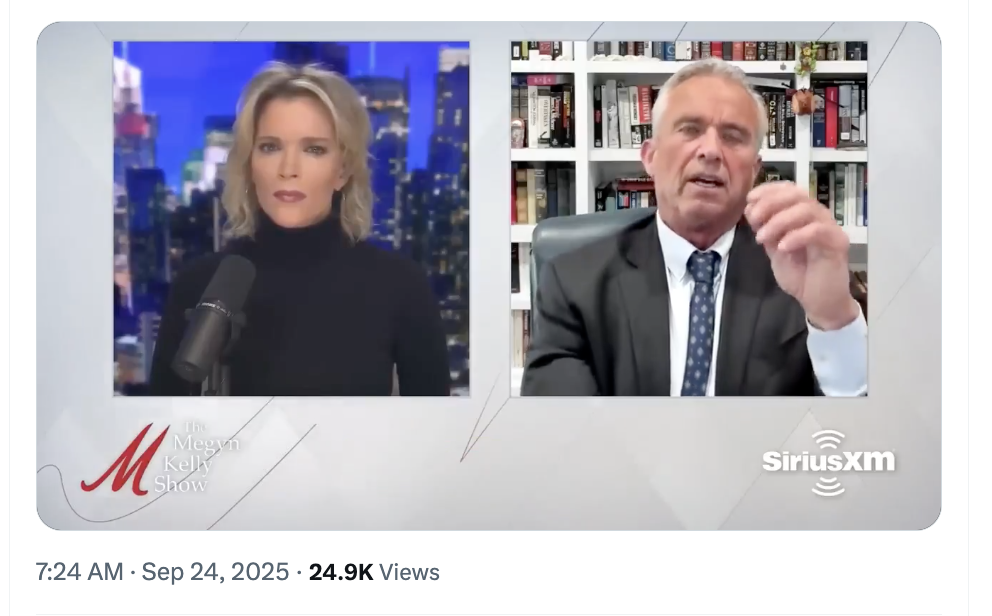
RFK, Jr. Describes Pharma World

RFK, Jr. described Pharma World:

It's between between Fauci (NIAID) and Gates (Gates Foundation) and Jeremy Farrar (WHO), who is up to his neck in Wuhan. They provide 64% of the biomedical research on the planet. If you are a young researcher, a scientist, a professor in a medical school, they have the capacity not only to make your career, but also to ruin it, and that's the way that they control not only the scientific studies that get done, but also the outcome of all those studies across the planet.

What Fauci has done--he's supposed to do, that kind of study. Instead what he does, he spends the bulk of his budget developing medications, which they then farm out to the university to do phase one, phase two and phase three trials. And the university could make $100 million in one of those trials, plus it gets royalty rights to the drug they're developing. Then, the NIAID takes royalty rights. University takes royalty rights. The principal investigator, who is the professor at the university who's running the clinical trial recruiting the, you know, the volunteers. He may get $15,000 a volunteer in grant money, and then he gets royalty rights, and then the pharmaceutical industry comes in for the phase three, and they then own the bulk of the patent, but they're sharing royalty rights with all these other players. So everybody is now corrupted. Everybody is making money on this drug, and the people who are supposed to be telling us "Was the drug actually benefit people, or is it just making money for Pharma?" Those people don't exist.

Continue ReadingRFK, Jr. Describes Pharma World

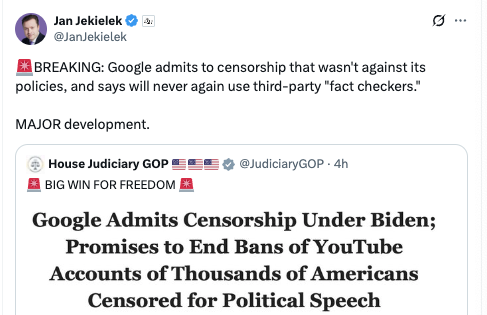
Youtube Falls on the Sword. Admits Biden WH Coerced Censorship

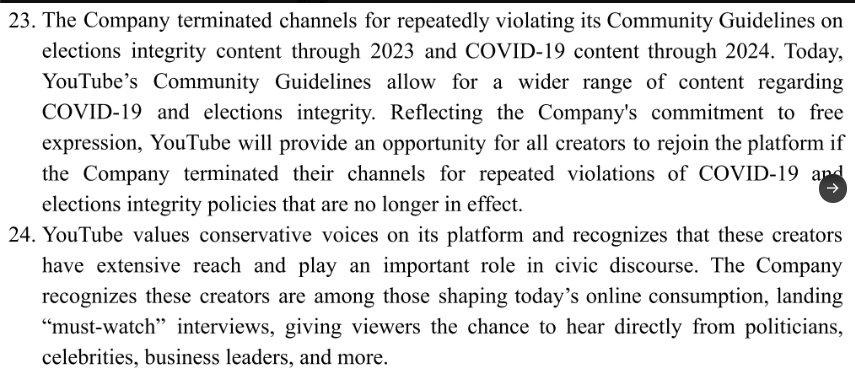
Youtube announcement today will be of special interest to those who keep insisting that the Biden WH did not engage in censorship. Youtube has agreed to invite ALL creators who previously kicked off YouTube due to political speech violations to return to Youtube. This is a major reversal of a reprehensible policy that silenced many important voices since 2020.

Youtube:

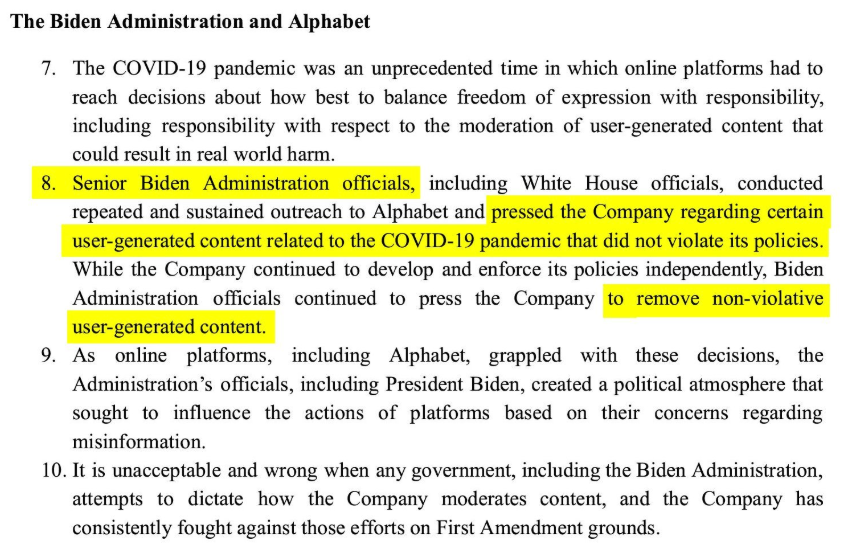
-Admitted that the Biden Admin censorship pressure was “unacceptable and wrong”

-Confirms that the Biden Admin wanted Americans censored for speech that did not violate YouTube’s policies

-Details when YouTube began rolling back its censorship policies on political speech: after @JudiciaryGOP began its investigation

-States that public debate should NEVER come at the expense of relying on “authorities” -Promises to NEVER use third-party “fact-checkers”

-Warns that Europe’s censorship laws target AMERICAN companies and threaten AMERICAN speech.

You can read Youtube's announcement for yourself at the link.

Michael Shellenberger adds:

Finally! Google admits 1) that the Biden White House demanded censorship of legal content, and 2) that the European censorship law (DSA) could require it and other tech companies "to remove lawful content" both "within and outside of" the EU. The US must stand up to EU censors! Had the above letter from Google, and the below letter from Meta, been sent before the Supreme Court received filings on Missouri v. Biden, the ruling may have gone the other way, as they demonstrate direct White House bullying of tech firms to censor legal content.

Continue ReadingYoutube Falls on the Sword. Admits Biden WH Coerced Censorship

Therapy that Cannot Stand the Pain

In talking with some acquaintances and viewing videos of people who are clearly struggling to cope, I'm often distracted by their use of language that abstracts away from human-to-human conflict. Their focus has been repackaged into sterilized abstruse terminology. It's as though the emotions and suffering have been packed away into the basement and they are trapped upstairs in a nonstop web of psychological chatter that is facilitated by their therapists.

Freya India points out the increasingly common problem of therapy buzzwords in a communication to Ayishat Akanbi, a writer:

I’m very skeptical of therapy-speak, unconvinced it even helps us open up. More often I think it actually closes down our ability to have honest conversations.

But you got to the heart of what bothers me about it, the insincerity. If someone tells me about their “fearful-avoidant” attachment style or how they are learning to “hold space” for others, I find it hard to feel anything. But if they tell me about their hurt and heartbreak, or how they are trying to be less selfish, I’m listening. We are talking human to human now.

As you write, “We’re encouraged to describe even ordinary interpersonal conflict in the language of pathology and melodramatic categories. So we start treating every slight like persecution because exaggeration is the only way to make pain legible.”

But I’ve been wondering lately if two things are happening at once. On one hand, we have this therapeutic group-speak, this exaggeration of suffering. But on the other hand, I think we are also losing the ability to talk about actual pain.

The writer Samuel Kronen, in a piece about chronic illness, put it like this: “There still appears to be a lot of unrewarded suffering in the world and our culture can seem pretty cruel and callous toward the vulnerable…If anything, I think our screen-addled, instantly-gratifying, digitally-intoxicated culture actually makes people less sensitive and conscious of suffering in certain ways, contributing to a more casual cruelty.”

I think he’s right. We might pathologise ordinary feelings and exaggerate small slights, but we also seem unwilling to accept genuine suffering. We can’t seem to cope with it. It’s hard, for example, to have a sincere conversation about something like family breakdown. I hear so many young women talking about their attachment styles, about “reparenting” themselves and healing their inner child, but not so much about the pain of divorce. I think this is why, as a culture, we have ended up with so much therapeutic advice and so little wisdom. Because we aren’t speaking about our problems in any recognisably human way. Maybe we are trying to make things easier on ourselves. If you phrase your problem as “anxious attachment”, you need a therapist. If you phrase it as your parents’ divorce, you need a difficult conversation with your dad.

As I read India's email to Akanbi, I was reminded of a book I read in college: The Myth of Mental Illness (1961), by Thomas Szasz. I think Szasz overstated his case in his book, but he did draw necessary attention to whether metaphoric terms like "mental illness" been literalized to unduly justify psychiatry's authority, turning common problems of living into impenetrable diagnoses, often harming individuals by stripping them of agency and responsibility for their actions.

Continue ReadingTherapy that Cannot Stand the Pain