
Conservatives Defending Traditional Liberal Values

How did it come to be that conservatives have become the most vocal defenders of traditional liberal values? At Public, Michael Shellenberger describes the challenge facing those of us who embrace traditional liberal values:

For most of the post-war period, liberalism in the United States was defined around freedom of speech, the needs of the working class, and the fight against racism and sexism. It was liberals who defended the right to burn the American flag, and of neo-Nazis to march through a neighborhood of Holocaust survivors. It was liberals who fought against corporate power and for the rights of working people. And it was liberals who fought to end racial segregation and to protect girls and women, including in sports.

All of that has changed. Today, it is conservatives who are fighting the racial re-segregation of classrooms and workforces by Diversity, Equity, and Inclusion (DEI) administrators in thrall to Critical Race Theory (CRT). It is conservatives who are defending the right to freedom of expression online from progressives demanding greater censorship by Big Tech and the government. And it is conservatives who are defending the rights of girls and women to female-only spaces and sports from natal males...

A similar dynamic occurred with the natural environment. After World War II, both liberals and conservatives, Democrats and Republicans, supported industrialization, economic development in poor nations, and nuclear power. Starting in the 1960s, the radical Left turned against industrialization, and started romanticizing peasant life in poor nations, while opposing nuclear energy in rich nations. The result was that Republicans were left holding positions that were once mainstream liberal ones...

As a result, conservatives find themselves in the paradoxical position of defending traditional liberal values like free speech and racial equality from progressives.... A big part of the reason as to why it has been left to conservatives to defend liberalism is because the radical Left, or what is sometimes called the Woke Left, had already defeated traditional liberals, first in major societal institutions and then in Congress, many years and some cases decades ago. [Christopher] Rufo attributes much of the radical Left’s success to its ability to manipulate language and emotions.

Traditional liberals didn’t understand who they were dealing with. The liberal university presidents, the newspaper editors, and the heads of various professional associations were committed to civil dialogue and democracy; the radical Left insurgents were not. The radical Left didn’t hesitate to use illiberal means, including making false accusations of racism, sexism, and homophobia, against their opponents...

Readers of Public know that I believe that the radical Left’s power stems from being able to offer a complete Woke religion to fill the vacuum left by declining belief in traditional religions ... Into the spiritual void emerged a new religion: victim ideology, or Wokeism.
Continue ReadingConservatives Defending Traditional Liberal Values

Substitution as a Lazy Narrative-Preserving Technique (Using Gays Against Groomers as an Example)

What are the policy positions of Gays Against Groomers? Many people won’t know because corporate media on the left (I checked the NYT and WaPo) refuse to mention the organization. I recently asked someone who considers herself to be on the political left. She cringed and responded by saying that it sounds like a Republican or conservative group and that there is no grooming going on in America’s schools.

That seems like an answer to the question, but it isn’t. What just happened is subtle, but it is critically important. The person I was talking to completely failed to answer my question. Her answer illustrates Daniel Kahneman’s principle of “substitution,” which he discussed at length in Thinking, Fast and Slow (2011).

[W]hen faced with a difficult question, we often answer an easier one instead, usually without noticing the substitution.

(p. 12).

In my experience, this is a go-to technique in the culture war conversations. Quite often, when people are asked factual questions about a person or organization they don’t like (or they assume they don’t like), they will substitute an easy question for the more difficult question of detailing the facts. The substituted easy question will often be something like “Do you like this person/organization,” even though that was clearly not the question asked. As Kahneman describes, the new simple question will be unconsciously inserted. With the new simple question substituted in, the answer is also simple. In culture war discussions, it often takes the form of an ad hominem attack. Consider this example:

Q: “What are the policy position of [a particular person/group]?”

This is a factual question that should either be “I don’t know” or it should be a listing of the policy positions of the person/group. If the is about an organization and the answer is anything other than “I don’t know,” it should fairly track the “About Us” page of the website the person or organization.

However, the hard question is often unconsciously brushed to the side and a new easy question is inserted. In my example, if the person thinks they don’t like the person or organization, they could be expected to substitute in a new simple question like this:

“Do you like [the person or group] and what detrimental things can your emotionally generate (e.g., what deplorable person/affiliation/ad hominem label can you reflexively pull out) to express your emotions?”

For people politically on the Left, the answer will often be something like: “That [person/group] is like Hitler, Republicans, Satan, etc.

On this topic of Substitution, here is another excerpt from Kahneman book (p. 101):

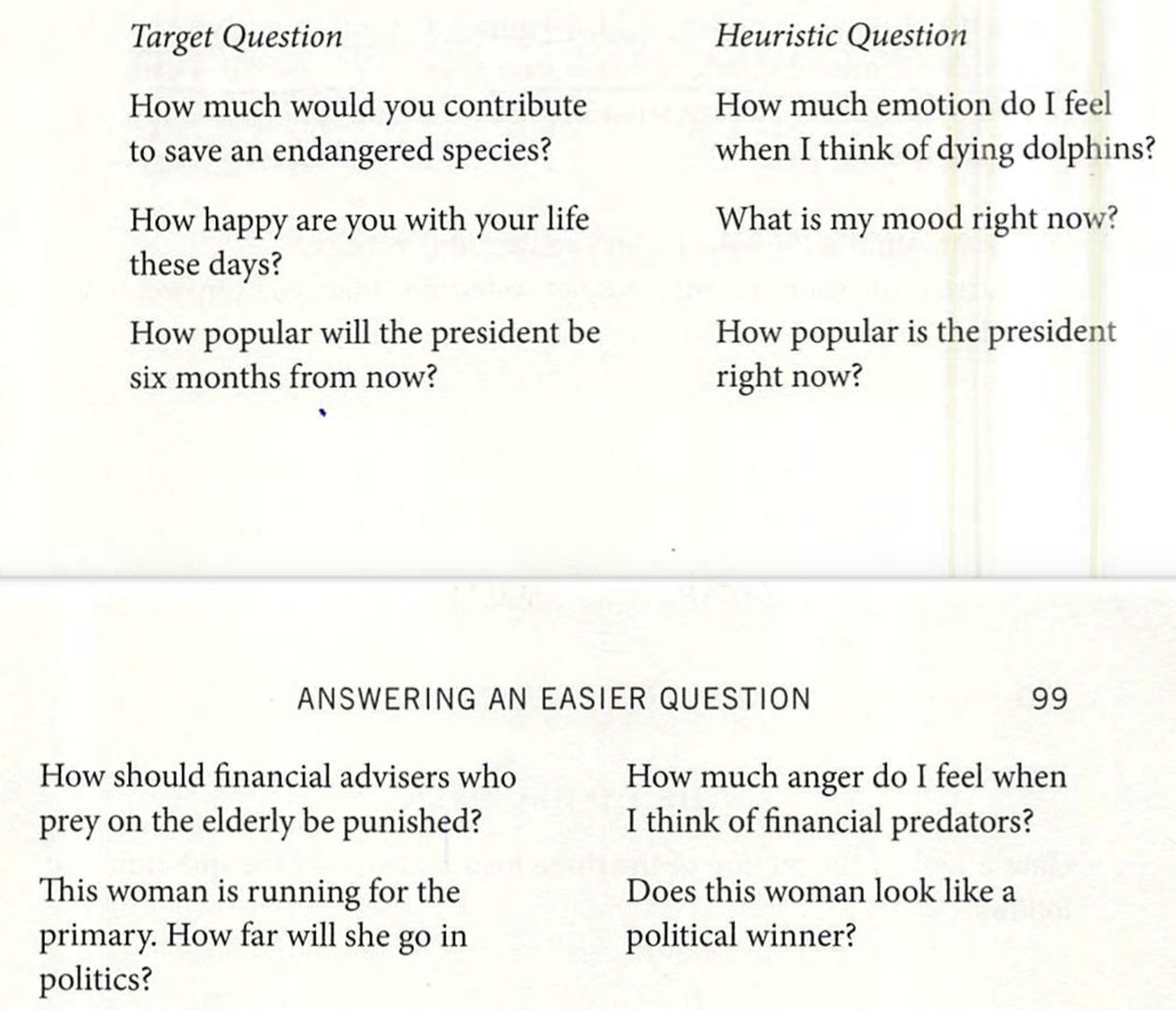
The idea of substitution came up early in my work with Amos [Tversky], and it was the core of what became the heuristics and biases approach. We asked ourselves how people manage to make judgments of probability without knowing precisely what probability is. We concluded that people must somehow simplify that impossible task, and we set out to find how they do it. Our answer was that when called upon to judge probability, people actually judge something else and believe they have judged probability. System 1 often makes this move when faced with difficult target questions, if the an¬swer to a related and easier heuristic question comes readily to mind.
Consider the questions listed in the left-hand column of Table 1.

These are difficult questions, and before you can produce a reasoned answer to any of them you must deal with other difficult issues. What is the meaning of happiness? What are the likely political developments in the next six months? What are the standard sentences for other financial crimes? How strong is the competition that the candidate faces? What other environmental or other causes should be considered? Dealing with these questions seriously is completely impractical. But you are not limited to perfectly reasoned answers to questions. There is a heuristic alternative to careful reasoning, which sometimes works fairly well and sometimes leads to serious errors.

[More . . . ]

Continue ReadingSubstitution as a Lazy Narrative-Preserving Technique (Using Gays Against Groomers as an Example)

Martin Gurri: The Path from Liberal Democracy to Liberal Authoritarianism

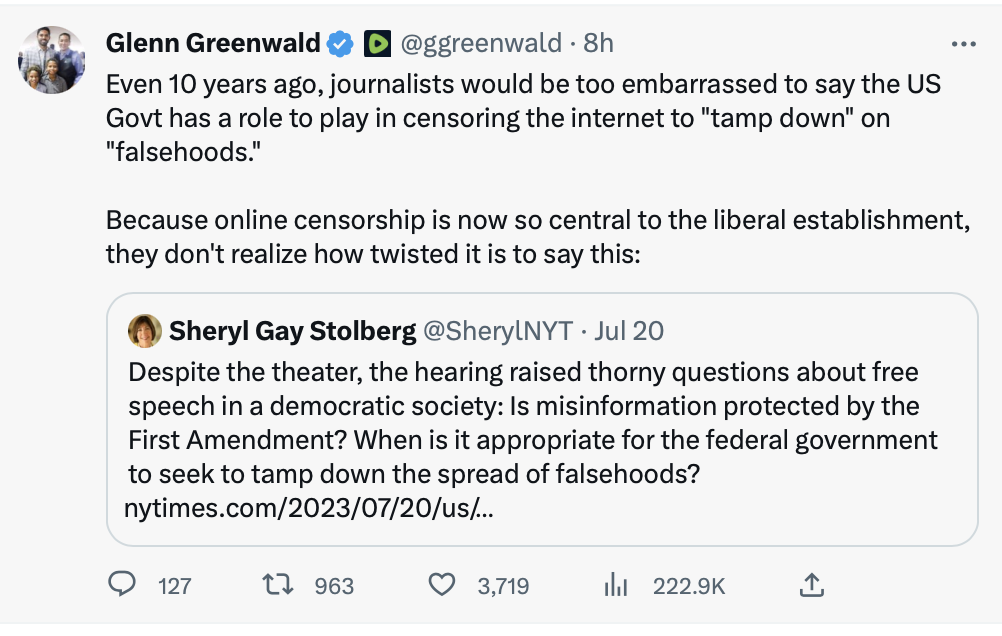
Martin Gurri details the path to present times where many of those on the Left who abhorred government-imposed censorship ten year ago now embrace it. His article is long, detailed an excellent. Title is: "The New Censorship: How the establishment Left embraced government control of digital speech." Here is an excerpt:

The Democratic Party is the natural home of the establishment Left. To this arrangement, the Left brings apparent advantages like the reflexive applause of the New York Times, but also, less evidently, a heavy load of ideological baggage. Its doctrines tend to be unpopular even among Democrats. Most blacks oppose defunding the police, for example. Most Hispanics disapprove of open borders. Most Democrats don’t believe that grievance should trump merit. If put to a vote, these propositions would lose. The Left must therefore transform them into moral commandments, beyond the reach of politics. In the digital age, this can be accomplished only by policing and controlling the Web—and censorship of that magnitude is possible only if Biden or some other Democrat holds the presidency after 2024.

Continue ReadingMartin Gurri: The Path from Liberal Democracy to Liberal Authoritarianism

Whence “Liberals”?

I abhor Donald Trump. I canvassed for Bernie Sanders. I considered myself to be "liberal" until what seems to be the majority of liberals who I know turned pro-censorship, war-friendly, trusting of the FBI & CIA, abandoning the working class in most things except rhetoric, willing to applaud authoritarian measures during COVID & clueless that they were being played by the corporate media on numerous major issues including Russiagate. The majority of these people wouldn't recognize themselves if they time-traveled to meet themselves from ten years ago. For several years I have considered myself to be politically homeless.

Continue ReadingWhence “Liberals”?

Does Psychotherapy Work?

Does psychotherapy work?

Millions of Americans engage in psychotherapy, women receiving treatment at approximately twice the rate of men. At Aporia, Bo and Ben Winegard discuss whether psychotherapy really works. They are extremely skeptical, based on a detailed analysis of the topic in search of reliable metrics. Their article is titled: "The Psychotherapy Myth: Contrary to the claims of the psychotherapy myth, humans can be resilient and tough-minded; they can suffer the slings and arrows of life without expensive interventions from “experts.

Here is an excerpt from their conclusions:

Contrary to the claims of the psychotherapy myth, humans can be resilient and tough-minded; they can suffer the slings and arrows of life without expensive interventions from “experts.” . . .

Thus, a healthy culture should teach that life is often full of misery, dashed hopes, and thwarted desires; it should teach that agony, anguish, and despair are ineradicable parts of the human experience, not aberrant or fleeting intrusions; it should encourage more stoicism, more discipline, more sacrifice; and it should discourage cossetting, indulgence, and morbid contemplation. Reflecting obsessively upon grievances and hardships, like constantly fiddling with a wound, is unwholesome.

Furthermore, the idea that understanding the cause of one’s suffering is the key to curing it is dubious ...Often, the disease is not in the head, but in the society. And thus, even if psychotherapy were highly effective, it might be a dangerous distraction.

The idea that the good therapist is a highly skilled mental engineer who knows how to manipulate the complicated machinery of the human psyche has been memorably promoted in movies such as “Ordinary People,” and, if it were true, it might justify the exorbitant salary some therapists command. But alas, it is no truer than the Freudianism that spawned it; and despite its veneer of sophistication and scientism, psychotherapy ultimately remains a human interaction, purchased at great expense to the patient and perhaps to society.

People will always want to talk to other people about their miseries and insecurities, flaws and failures, hopes and dreams; and counselors and therapists will remain employed into the foreseeable future. Some may even do considerable good. But we hope they will drop the pernicious mythology, the exorbitant prices, and the complicated and often unnecessary licensing system and recognize the simple but tragic fact that many people are desperate for sympathetic social partners and will pay a lot of money for them. What is needed is not more expensively trained experts, but more real social relationships.

Continue ReadingDoes Psychotherapy Work?