
In “The Tragedy of the Cognitive Commons: How AI Could Disrupt the Regeneration of Professional Expertise” Nolan Lovett writes: “AI-assisted productivity and AI-independent expertise are not the same capability, and developing one does not automatically build the other.”
This is an extremely serious problem in the context of training young and upcoming workers. For instance, many lawyers with lifetimes of experience know how to ride herd over AI. They can spot when AI is missing the mark. They know when it is spewing mere information, long strings of words that that lack persuasive content. They can recognize when AI goes off the rails and almost instinctively implement corrective prompts. Just like how chess masters can quickly spot dangers and opportunities on a chessboard.
I’m worried that our current crop of law students and young lawyers will take the easy way out, over and over, because it’s too damned tempting. Until they are mid-career and it’s is too late. They might never acquire the intellectual skills and rigorous habits of perseverance that are necessary to adequately and safely use AI in the legal field. Their clients will be the ones to pay the price.
This is, indeed, as Lovett writes, “a threat to the cognitive commons”:
Without intervention, organizational responses to competitive pressures will deplete the shared expertise that all organizations rely on. By eliminating entry-level positions, organizations prioritize efficiency while socializing the costs of diminishing knowledge. This leads to increased systemic fragility, where failures occur due to validators lacking the Internalized Mastery required for substantive oversight and a loss of meaningful agency in automated work. As retirees leave without adequate successors, the pool of experts shrinks, reducing the ability for independent validation and crisis management.
[aded Aug 10, 2026]
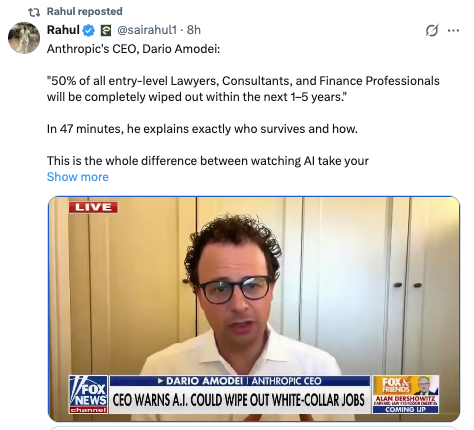
Anthropic’s CEO, Dario Amodei:
“50% of all entry-level Lawyers, Consultants, and Finance Professionals will be completely wiped out within the next 1–5 years.”
In 47 minutes, he explains exactly who survives and how.
This is the whole difference between watching AI take your industry and becoming the person companies desperately need.
Watch it. Then read the guide below on how to become the “AI guy” these companies need.

