Our family vacuum cleaner had seen better days. Like most things that break these days, it wasn't that old; my wife and I bought it less than five years ago. Thus, the frustration and an opportunity. We were aware that there was a vacuum repair store less than a mile from our house, and we decided to see whether we could save our vacuum.
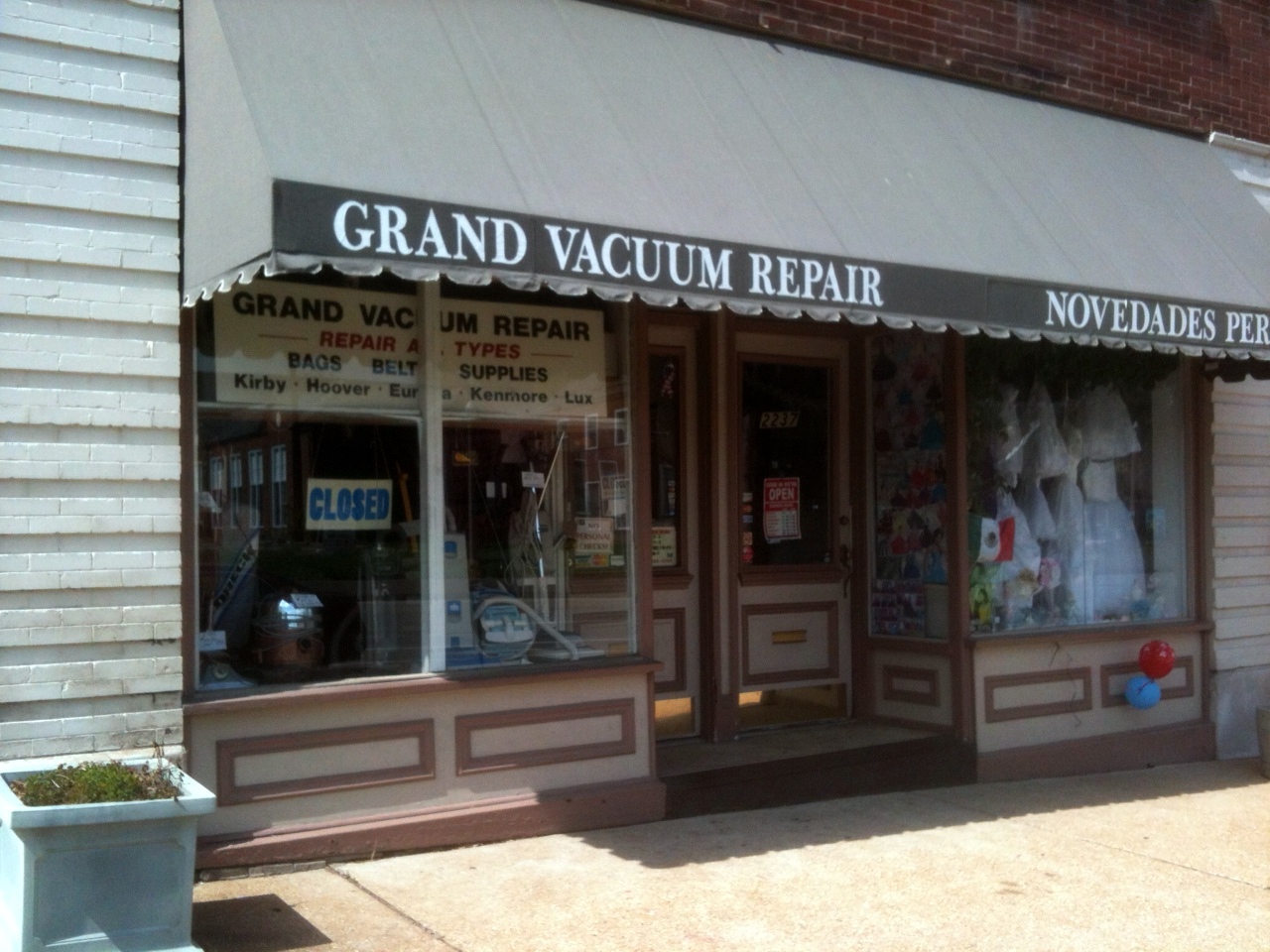
Upon entering, we spoke to "Dan," who has been running his vacuum repair shop for fifty years. He is a affable fellow with a small shop filled with more than 50 used vacuum cleaners. After a quick test of our machine, Dan announced that $40 would get our old vacuum working again. That would have been much less than $200, the price we would pay for a new vacuum cleaner. But for $100 and our vacuum as a trade-in, we could upgrade to a significantly better "commercial vacuum" that someone else had traded-in and which Dan had already repaired. My wife and I decided to upgrade, and we are now happy with our powerful "new" vacuum (not so powerful that it sucks up pets and children, but quite powerful).
It occurred to me that this is an unusual way of doing business in modern America. As Annie Leonard explains so well in "The Story of Stuff," most things that are manufactured these days are designed for a single use (including immense amounts of packaging). My family makes regular use of other kinds of re-sell-it shops, including Goodwill, Salvation Army and private garage sales. But how nice, to also be able to make use of a store for fixes things in order to keep them out of the landfill, especially when these things are expensive household appliances. Perhaps a vacuum cleaner is about as cheap as appliance can be while it is still expensive enough to make it worthwhile to offer a repair shop. At least, I don't remember seeing any smaller appliance repair shops; a look on the Internet tells me that such shops do exist, however.
Dan had more than a few noticeably old (repaired) vacuums for sale, a sight that made me think of the phrase "planned obsolescence." I do think society would be better off with fewer big box purchases and more repair shops. And since Dan was such a competent and friendly fellow, I'll mention that he is an avid bowler who recently bowled his second 300 game.
Yesterday afternoon, while at work, a co-worker rushed into my downtown St. Louis office and urged me to look out my window. His enthusiasm was justified. This is what I saw looking to the west (click on the photo below for much better effect):
This is one of a series of cloud photos that I've posted at DI.
Author Chris Hedges argues that the American Empire is following the trajectory of all empires; we are expanding beyond our capacity to sustain ourselves. We have run up deficits we have no way to repay. We are "hollowing the country out from the inside." Nearly one-third of Americans are living in poverty. We are destroying quality education. We are reaching a "terminal point." Unless we change our course, we will face collapse. The current electoral system is not a legitimate place for seeking meaningful reform, not given the state of money-dominated elections.
Those captive to images cast ballots based on how candidates make them fee. They vote for a slogan, a smile, perceived sincerity, and attractiveness, along with the carefully crafted personal narrative of the candidate. It is style and story, not content and fact, that inform mass politics.
Hedges points out that the structure of the corporate state is thoroughly immunized from meaningful change from a Democrat like Barack Obama, no different than a Republican like George W. Bush. We are facing a bi-partisan-approved looting of the U.S. Treasury by Wall Street and domestic spying. Obama's health care bill is no exception, having been written by corporate lobbyists (4 min) It is "essentially the equivalent of the bank bailout bill written for the insurance and pharmaceutical industry, with $400 million of subsidies." Under the new system, corporate insurers can hold sick children hostage while bankrupting their parents (5 min).
Hedges often criticizes liberals. He explains: The liberal class was never designed to function as the political left. (min 6). It was designed to function as the political center. In the early 1900s liberals were quite vocal and held significant political power. They produced publications with wide circulation. There were several dozen socialist mayors in America. He argues that America got involved in WWI, despite any serious public support, because American bankers had loaned substantial money to Great Britain and France, and they didn't want to lose their money. (min. 7).
As the century went on, politicians followed the 1922 advice of Walter Lipman to use propaganda "to manufacture consent." There's no need to throw many people in prison when you can "herd" them using war-related-emotion rather than facts or reason. (min. 9). A meaningful liberal class, provoked by radical and populist movements, would make piecemeal and incremental reform possible to benefit the needs of the working class. Such radical movements are rare these post-Red-Scare days, and there is thus no longer any bulwark to "protect us from the corporate state."
We have turned from an Empire of Production to an Empire of Over-Consumption. We non longer have true liberals. Instead, we have faux liberals, people who "speak the language of traditional liberalism like Bill Clinton, yet serve the interests of the corporate state." (Min 12). Hedges offers the following evidence of Clinton's assaults on the working class: NAFTA, destruction of welfare, deregulation of the FCC, destruction of the banking system (the US differs from Canada, which did not tear down the firewall of Glass-Steagall). The U.S. has allowed hedge funds to take over its banks). To top things off, Barack Obama "essentially codifies the destruction of both domestic and international law put in place by the Bush Administration," a severe assault on civil liberties, including the right of the Executive branch to carry out assassinations and the new military detention act, which allows Americans to be indefinitely detained if accused of being a "terrorist," an absurdly nebulous charge.
As a result, we now live under "inverted totalitarianism," which "does not find its expression through a demagogue or charismatic leader, but through the anonymity of the corporate state." In our inverted totalitarianism, corporate forces pretend to pay homage to the iconography and patriotism of America, but "have so corrupted the levers of power that as to render the citizenry powerless." (min 14).
Here is the creed of modern liberals:
The creed of impartiality and "objectivity" that has infected the liberal class teaches, ultimately, the importance of not offending the status quo. The "professionalism" demanded in the classroom, in newsprint, in the arts or in political discourse is code for moral disengagement.
What modern day liberals end up doing, according to Hedges is giving deference to institutions like Goldman Sachs ("a criminal enterprise") and other "power centers that long ago walked away from responsible citizenship." He includes the following industries: coal companies, chemical plants the pollute rivers or Wall Street. This allegiance has left the modern liberal class "not only useless, but despised by large segments of American society." Modern liberals (including traditional liberal institutions such as liberal churches, the press, labor unions, education and American culture generally) posit themselves as the "moral voice of the nation, but have failed miserably." (min 16). According to Hedges, modern liberals "want to empower people they've never met. They liked the poor, but they didn't like the smell of the poor." (min 20).
While evangelicals often champion a gospel of greed and personal empowerment . . . Liberals "often speak on behalf of oppressed groups they never meet, advocating utopian and unrealistic schemes to bring about peace and universal love. Neither group has much interest in testing their ideologies against reality.
What I have described above is from the first 25 minutes of the video discussion, which lasts almost three hours.
In 2009 alone, 1.66 million Americans were arrested on drug charges, more than were arrested on assault or larceny charges. And 4 of 5 of those arrests were simply for possession....[T]he money that states spend on prisons has risen at six times the rate of spending on higher education in the past 20 years. In 2011, California spent $9.6 billion on prisons vs. $5.7 billion on the UC system and state colleges. Since 1980, California has built one college campus and 21 prisons. A college student costs the state $8,667 per year; a prisoner costs it $45,006 a year.
The results are gruesome at every level. We are creating a vast prisoner underclass in this country at huge expense, increasingly unable to function in normal society, all in the name of a war we have already lost....
At Democracy Now, Amy Goodman spoke with Wired's James Bamford about the NSA's big new computer surveillance center in Utah.
First of all, how big is it?
Well, it’s going to be a million square feet. That’s gigantic. There’s only one data center in the country that’s larger, and it’s only slightly larger than that. And it’s going to cost $2 billion. It’s being built in this area on a military base outside of Salt Lake City in Bluffdale. As I said, they had to actually extend the boundary of the town so it would fit into it.
Next, what is the NSA up to?
So, what I would like to do—I quote from a number of people in the article that are whistleblowers. They worked at NSA. They worked there many years. One of my key whistleblowers was the senior technical person on the largest eavesdropping operation in NSA. He was a very senior NSA official. He was in charge of basically automating the entire world eavesdropping network for NSA. So—and one of the other people is a intercept operator that was actually listening to these calls, listening to journalists calling from overseas and talking to their wives and having intimate conversations. And she tells about how these people were having these conversations, and she felt very guilty listening to them. These people came forward and said, you know, this shouldn’t be happening. Bill Binney, the senior official I interviewed, had been with NSA for 40 years almost, and he left, saying that what they’re doing is unconstitutional.
What I’d like to see is, why don’t we have a panel, for the first time in history, of some of these people and have them before Congress, sitting there telling their story to Congress, instead of to me, and then have NSA respond to them? I mean, this is the American public who we’re talking about whose phone calls we’re talking about, so—and email and data searches and all that. So I think it’s about time that the Congress get involved, instead of asking questions from a newspaper or from a magazine article, and start actually questioning these people on the record in terms of what they’re doing and how they’re doing it and to whom they’re doing it—you know, to whom they’re doing it.
Hello, I invite you to subscribe to Dangerous Intersection by entering your email below. You will have the option to receive emails notifying you of new posts once per week or more often.

 Upon entering, we spoke to "Dan," who has been running his vacuum repair shop for fifty years. He is a affable fellow with a small shop filled with more than 50 used vacuum cleaners. After a quick test of our machine, Dan announced that $40 would get our old vacuum working again. That would have been much less than $200, the price we would pay for a new vacuum cleaner. But for $100 and our vacuum as a trade-in, we could upgrade to a significantly better "commercial vacuum" that someone else had traded-in and which Dan had already repaired. My wife and I decided to upgrade, and we are now happy with our powerful "new" vacuum (not so powerful that it sucks up pets and children, but quite powerful).
It occurred to me that this is an unusual way of doing business in modern America. As Annie Leonard explains so well in "The Story of Stuff," most things that are manufactured these days are designed for a single use (including immense amounts of packaging). My family makes regular use of other kinds of re-sell-it shops, including Goodwill, Salvation Army and private garage sales. But how nice, to also be able to make use of a store for fixes things in order to keep them out of the landfill, especially when these things are expensive household appliances. Perhaps a vacuum cleaner is about as cheap as appliance can be while it is still expensive enough to make it worthwhile to offer a repair shop. At least, I don't remember seeing any smaller appliance repair shops; a look on the Internet tells me that such shops do exist, however.
Dan had more than a few noticeably old (repaired) vacuums for sale, a sight that made me think of the phrase "planned obsolescence." I do think society would be better off with fewer big box purchases and more repair shops. And since Dan was such a competent and friendly fellow, I'll mention that he is an avid bowler who recently bowled his second 300 game.
Upon entering, we spoke to "Dan," who has been running his vacuum repair shop for fifty years. He is a affable fellow with a small shop filled with more than 50 used vacuum cleaners. After a quick test of our machine, Dan announced that $40 would get our old vacuum working again. That would have been much less than $200, the price we would pay for a new vacuum cleaner. But for $100 and our vacuum as a trade-in, we could upgrade to a significantly better "commercial vacuum" that someone else had traded-in and which Dan had already repaired. My wife and I decided to upgrade, and we are now happy with our powerful "new" vacuum (not so powerful that it sucks up pets and children, but quite powerful).
It occurred to me that this is an unusual way of doing business in modern America. As Annie Leonard explains so well in "The Story of Stuff," most things that are manufactured these days are designed for a single use (including immense amounts of packaging). My family makes regular use of other kinds of re-sell-it shops, including Goodwill, Salvation Army and private garage sales. But how nice, to also be able to make use of a store for fixes things in order to keep them out of the landfill, especially when these things are expensive household appliances. Perhaps a vacuum cleaner is about as cheap as appliance can be while it is still expensive enough to make it worthwhile to offer a repair shop. At least, I don't remember seeing any smaller appliance repair shops; a look on the Internet tells me that such shops do exist, however.
Dan had more than a few noticeably old (repaired) vacuums for sale, a sight that made me think of the phrase "planned obsolescence." I do think society would be better off with fewer big box purchases and more repair shops. And since Dan was such a competent and friendly fellow, I'll mention that he is an avid bowler who recently bowled his second 300 game.