The Hidden Trade-offs Made by Successful People

Shane Parrish has written another excellent post at Farnam Street Blog. The topic is trade-offs. We can't have it all, and we can benefit when we recognize the trade-offs we must make in every aspect of our lives:

Economics is all about tradeoffs. A tradeoff is loosely defined as any situation where making one choice means losing something else, usually forgoing a benefit or opportunity. We experience tradeoffs in zero-sum situations, when a plus in one area must be a negative in another. A core component of economic theory is the study of how we allocate scarce resources and negotiate opportunity costs.

Economics offers tools that we can use as guides for getting what we want out of life if we take economic lessons and apply them to resources other than money. We all know our money isn’t infinite, yet we end up treating our time and energy and attention as if they are. Many of us act as if there are no tradeoffs—we can just do everything if we try hard enough. The irony is that those who know how to make tradeoffs can get so much more out of life than those who try to get everything.


Parrish notes that successful-seeming people all make secret trade-offs. They are not great at everything. I have wondered about this when seeing so many people who I suspect are of modest means, driving cars much more expensive than mine, going out to eat and drink much more often than me, and generally conspicuously consuming much more than me. I have this fantasy where everyone's budget and bank and credit accounts floated above them, and I could then confirm, "Oh, they aren't saving for retirement and they are one missed paycheck from disaster!"  The same thing happens with time as with money.  We can't be super-competent at all things. When we are proficient at some things, it is always at the expense of other things.

Can we reach homeostasis? It's not easy per Parrish:

We’re constantly going off-kilter in one area or another and having to make course corrections. When one area goes well, another is usually sliding. It’s like a game of whack-a-mole. Focus on one area and it’s often to the detriment of another.


One solution to getting a grip on this problem that we must make trade-offs is to track your time. I did this for two months and it was extremely telling. I was spending time pursuing my declared life goals a LOT less than I spent time in mundane chores like cooking/eating/cleaning up, driving and various unproductive activities. I was unconsciously making choices to do less important things at the expense of the things that I treasure (good conversations with close friends, artistic pursuits, working on website and my book). I wrote about my approach to tracking time earlier here.

Parrish offers many other tips in his article. For instance, you need to get over the awkwardness that you won't be great at everything.  That would be impossible

I'm taking heed of the many good ideas in this excellent article.

Continue ReadingThe Hidden Trade-offs Made by Successful People

First Batch of Tumbled Rocks Keeps Me Grounded

When I was a boy, I saw rock tumblers for sale in the Sears Catalogue, but I never had one and never knew anyone who had one. Well . . . decades later I do have a rock tumbler and I have recently learned that there are lots of beautiful rocks to be found only about an hour from St. Louis.


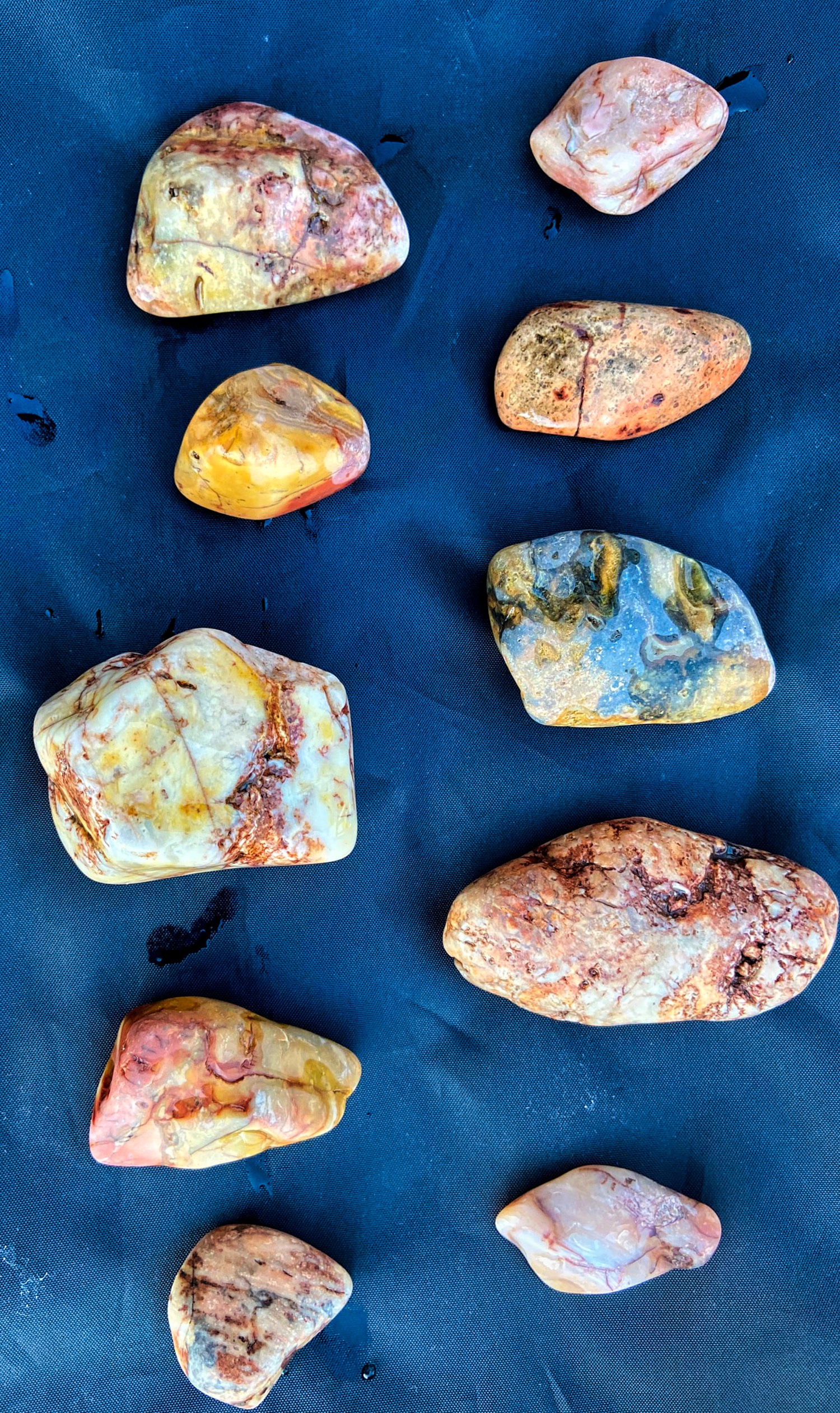
After a month of tumbling in my basement, this is what rocks from a Missouri creek look like (a creek near Farmington, Missouri). They shine even though they are perfectly dry. They are fun to hold and fun to look at. They were all so shy, modest about their beauty, while sitting in the creek. But now they are spreading their little peacock tails. Up close, some of them look like abstract works of art. To see many more images, click on the title to this post and then check out the gallery of photos.

Since I obtained my rock tumbler (a Thumler Model B), I've reached out and found dozens of other people who are passionate about finding and polishing rocks, as well as making jewelry and other objects of art out of them. These rock hounds are all over the place, and all you need to do to make them show up is to mention rocks.


For me, this has been a wonderful hobby, above and beyond the thrill of locating a beautiful rock in a creek or in seeing these polished specimens. I tend to think in the abstract throughout the day. I do it at the drop of a hat. These rocks, on the other hand, are real. I want to hold them and feel them and admire their beauty. This hobby has been an excellent counter-weight to my tendency to philosophize. It has, indeed, kept me "grounded."

Continue ReadingFirst Batch of Tumbled Rocks Keeps Me Grounded

Need to Up My Game on Photoshop

I've dabbled with Photoshop over the years, but I have decided to (as Stephen Covey suggested) "sharpen the saw."  In other words, I want to incorporate new tools so that I can get things done better and more efficiently when I use Photoshop.  Shane Parrish of Farnham Street would identify this as "Compounding," which is a really cool concept, especially when applied to things other than earning interest on money.

And what a better time to learn tips on using photoshop than modern times, when you can attend Youtube University or pay a bit from many other online instructors?  I've already incorporated one change when compositing, something I should have done years ago: Instead of trimming a the top image with the eraser tool, I've started making use of layer masks.  That, and use of the "x" key to switch colors from black to white (black conceals, white reveals), has made it a joy to display only what I want on the top layer.  Whenever you make a mistake, it's non-destructive and hitting the "x" key lets you bring back what you accidentally took away.  What you'll see below is an image I created using the layer mask to display precisely what I wanted in my own body (I'm the guy on top).   I'll paste in the FB commentary so you can experience the joke too:

Last night I spotted my buddy Eddie White at the Southside YMCA. Eddie is active duty U.S. Army and I think his military exercise routine requires him to bench press a house. I was happy to serve as his weight-lifting partner.


My body looks pretty tidy, but it took a long time (about 45 min) to get it looking good. I kept zooming in deep to make the cuts precisely and I was using a mouse. My next step in my education is to learn to use the Wacom Intuos Wireless Graphics Drawing Tablet that I just purchased. There's going to be a learning curve, but I've seen a lot of testimonials from people who learn it and love it so much that you couldn't take it back unless you pried it out of their cold dead hands. So that's my next step in my education, my quest to do more than simply "dabble" with Photoshop.

Continue ReadingNeed to Up My Game on Photoshop

Deep Music Photo

I'm trying to learn some new photo processing techniques by reworking some of my photos from the past. This is a selective color photo of one of my favorite people, Dan Rubright, who is an educator, philosopher, father and lecturer. Mostly, though, I know Dan as an incredibly talented musician who has the knack of transporting himself "inside" of his music and coaxing it to do magic-seeming things. Here's a shot I took of Dan about 4 years ago while he was performing with his group, Wire Pilots. I shot this one through the drums and sticks of Dan's brother Ted Rubright, also a brilliant, multi-talented man. This image brings back vivid memories of their awesome music.


My main challenge in this photo was to pump up the edges without also exposing the noises. In the end, I had to use hand-selection of the blackness, then reverse-texture (LR) in the end, to get the totally black background. There was simply too much noise, given that I had to use high ISO to keep the image tack sharp during the shoot.

Continue ReadingDeep Music Photo