The Speed of Light Illustrated
How long would it take a beam of light to travel from the Earth to the moon (and beyond)? Click the play video on this video that uses NASA imagery.

How long would it take a beam of light to travel from the Earth to the moon (and beyond)? Click the play video on this video that uses NASA imagery.
From the Los Angeles Times article, "Portland’s anarchists say they support racial justice. Black activists want nothing to do with them":
The election of Biden has only antagonized the anarchists — and exposed their differences with the Black activists they claim to support.
Black activists and community leaders, who generally view the defeat of Trump as an opportunity for change within the system, said the anarchists are hijacking the movement and undermining the push for racial justice by continuing to commit violence.
A tweet by James Lindsay of New Discourses:

I struggle to understand the willingness of prepubescent teenagers to take hormone blockers in light of the high physical and emotional risks (other than social contagion and need to please one's social network). What follows is an excerpt from Irreversible Damage, by Abigail Shrier:
“So first of all, the studies show that when a kid is put on puberty blockers, almost 100 percent will go on to do cross-sex hormones.” This is true, though the reasons are not entirely clear. One possibility is that a young person would only go on puberty blockers in the first place if she was reasonably certain of wanting to lead a transgender life. Another is that, after years of socially identifying as a person of the opposite sex, the social costs of taking it all back are quite steep. It’s hard to change your mind about something you’ve been insisting on for so long— even if you might wish you could.
But it was the next thing she learned that sent Katherine [the mother of a teenager] spinning. “When you’ve stopped puberty with puberty blockers and go straight to cross-sex hormones, you absolutely guarantee that you will be infertile.” When the gender clinicians pushed Katherine to start her preteen child on hormone blockers, they were proposing that she put Maddie on a path toward infertility. Her faith in the gender therapists fell apart.
Katherine could not understand how psychologists would encourage this, how doctors would allow it, or why medical professional standards would permit parents to consent to eliminating such a vital human capacity on behalf of their minor children. And yet, right in front of her, schools were encouraging it, parents were going along with it, the media was celebrating it, and everyone was acting as if this were perfectly kosher.
Ten years ago, who would have ever believed that in the middle of a pandemic that has killed as many Americans as 1,000 commercial airliners crashing and burning within a period of 8 months (each of them carrying 250 passengers), many of us would have preferred political leaders who would falsely tell us that there was not a serious pandemic and we could simply go on with our lives? In the abstract, that proposition would have been absurd, but here we are.
Here is Christopher Christakis, a voice I trust on both the medical issues and on the political landscape regarding COVID (click through to hear the short statement).

If you'd like to hear more from Christakis, listen to Making Sense podcast #222 (with Sam Harris):
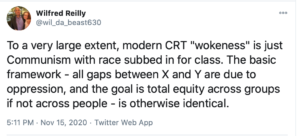
Two Tweets that capture the essence of Wokeness: