It's 2021, the year that neo-racism and neo-segregation came into full bloom. It doesn't matter that "anti-racism" is "well intended." It is now having the same poisonous effects at Disney that it is having every else that this "training" is being forced upon students and employees. Heightened racial conflict is what a company should expect it whenever it segregates groups of its employees by "race." That's what happens when "white" employees are instructed that "they must “pivot” from “white dominant culture” to “something different.” Disney's training claims that “competition,” “individualism,” “timeliness,” and “comprehensiveness” are “white dominant” values that “perpetuate white supremacy culture.” Participants are also told that prioritizing goals is also a "white" thing.
Christopher Rufo has obtained "anti-racism" documents from numerous schools, colleges, government offices and corporations. He has released documents showing the training Disney is inflicting on its employees. This re-education includes racially segregated training groups. The full story can be read at Christopher Rufo's own website (at which you can view the leaked Disney documents). Here is an excerpt from Rufo's article:
In the past year, Disney executives have elevated the ideology of critical race theory into a new corporate dogma—and bombarded employees with trainings on “systemic racism,” “white privilege,” “white fragility,” “white saviors,” and launched racially-segregated “affinity groups” at the company’s headquarters.
I have obtained a trove of whistleblower documents related to Disney’s “diversity and inclusion” program, called “Reimagine Tomorrow,” which paints a disturbing picture of the company’s embrace of racial politics. Although the intention of the program might be noble, multiple Disney employees, who requested anonymity out of fear of reprisals, told me that the Reimagine Tomorrow program has become deeply politicized and engulfed parts of the company in racial conflict.
Rufo has written a companion story at City Journal:
"The Wokest Place on Earth: Disney mounts an internal campaign against “white privilege” and organizes racially segregated “affinity groups.”"
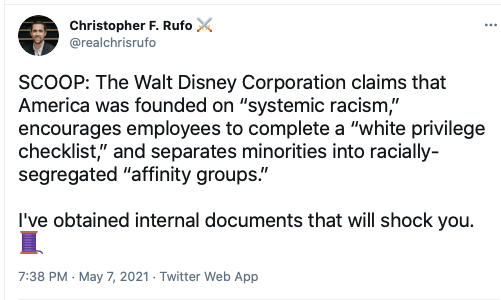
Rufo also tweeted some of the lowlights from the Disney newly instituted education camps:
Disney claims that America has a “long history of systemic racism and transphobia” and tells employees they must “take ownership of educating yourself about structural anti-Black racism” and “not rely on your Black colleagues to educate you,” which is “emotionally taxing.”
White employees are told to “work through feelings of guilt, shame, and defensiveness to understand what is beneath them and what needs to be healed.” They must “listen with empathy [to] Black colleagues” and “not question or debate Black colleagues’ lived experience.”
Finally, participants are told they must “pivot” from “white dominant culture” to “something different.” The document claims that “competition,” “individualism,” “timeliness,” and “comprehensiveness” are “white dominant” values that “perpetuate white supremacy culture.”
Disney recommends that employees read a how-to guide called “75 Things White People Can Do for Racial Justice.” The article tells readers to “defund the police,” “participate in reparations,” “decolonize your bookshelf,” and “find and join a local ‘white space.’”
Finally, Disney has launched racially-segregated “affinity groups” for minority employees, with the goal of achieving “culturally-authentic insights.” The Latino group was named “Hola,” the Asian group was named “Compass,” and the black group was named “Wakanda.”
I agree with Rufo that this training is well-intended, but the effect of the training is poisonous. Dividing people by skin color pits them against each other needlessly, raising suspicions and solving no societal problems in the process. The Woke endgame
is Evergreen State College. In other words, they have no end game. No long term plan. No vision for tamping down the hate and suspicion that they are causing with this neo-racism and neo-segregation.