Classical Art Memes
I can't get enough of classical art memes. Here is a recent favorite:
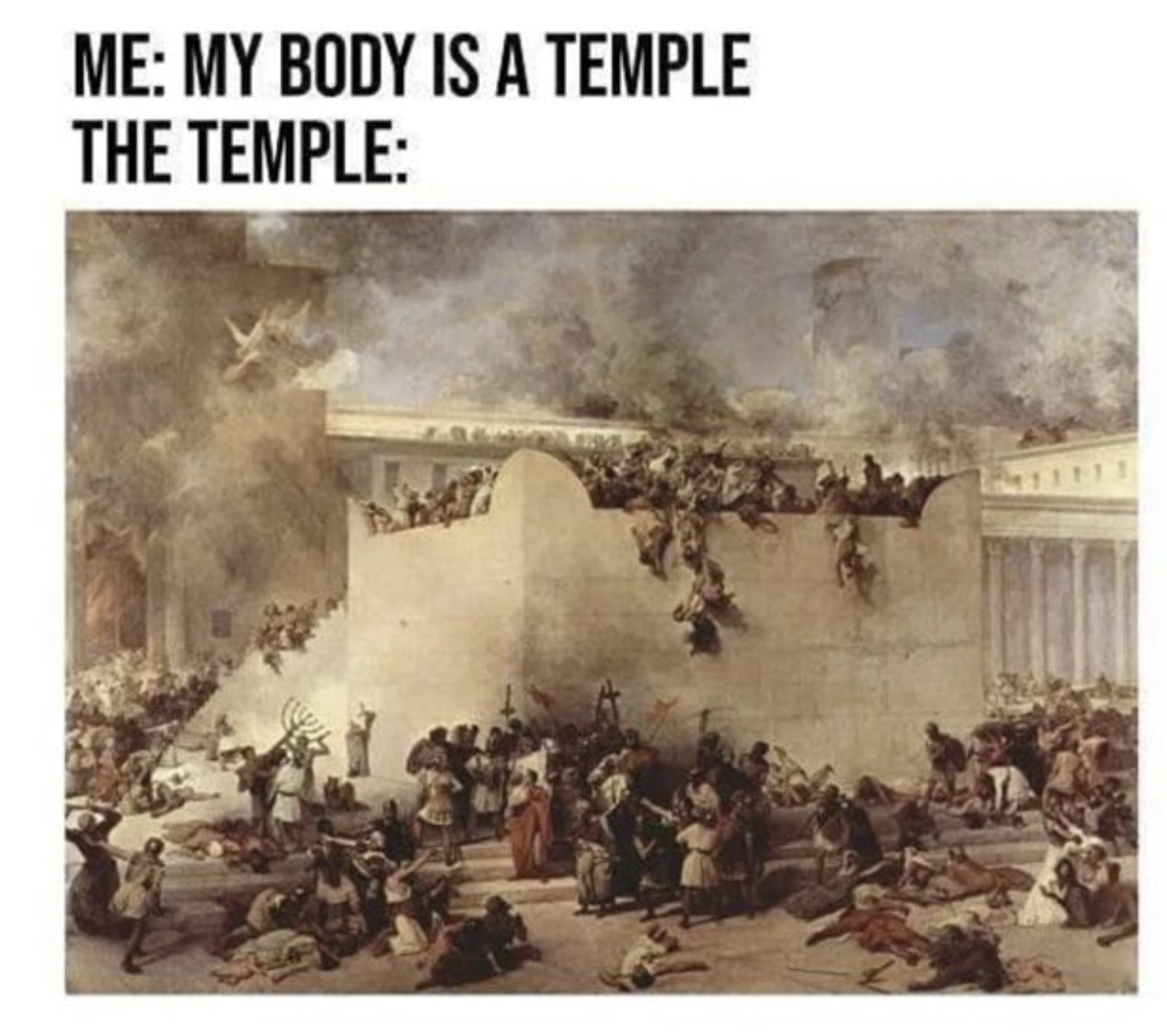

I can't get enough of classical art memes. Here is a recent favorite:
Truly, Russian Spies are EVERYWHERE!!!
I understand that many people have grown up reading and trusting NPR/MSNBC/NYT/WaPo, so their instinct is to keep reading and trusting. To be fair, there is still a lot of good information to be had in these places, but objective eyes will find huge swaths of fact-free insanity about Russia, including the apparent belief that every serious thinker who crosses Democrat Party Orthodoxy is a Russian spy or at least paid by the Russians. It's stunning that so many people paid to be "journalists" spout these claims in the absence of any facts. The ends apparently justify the means, however, so lies and censorship are deemed to be warranted to support one's team. These are very sad days for "journalism" in America.
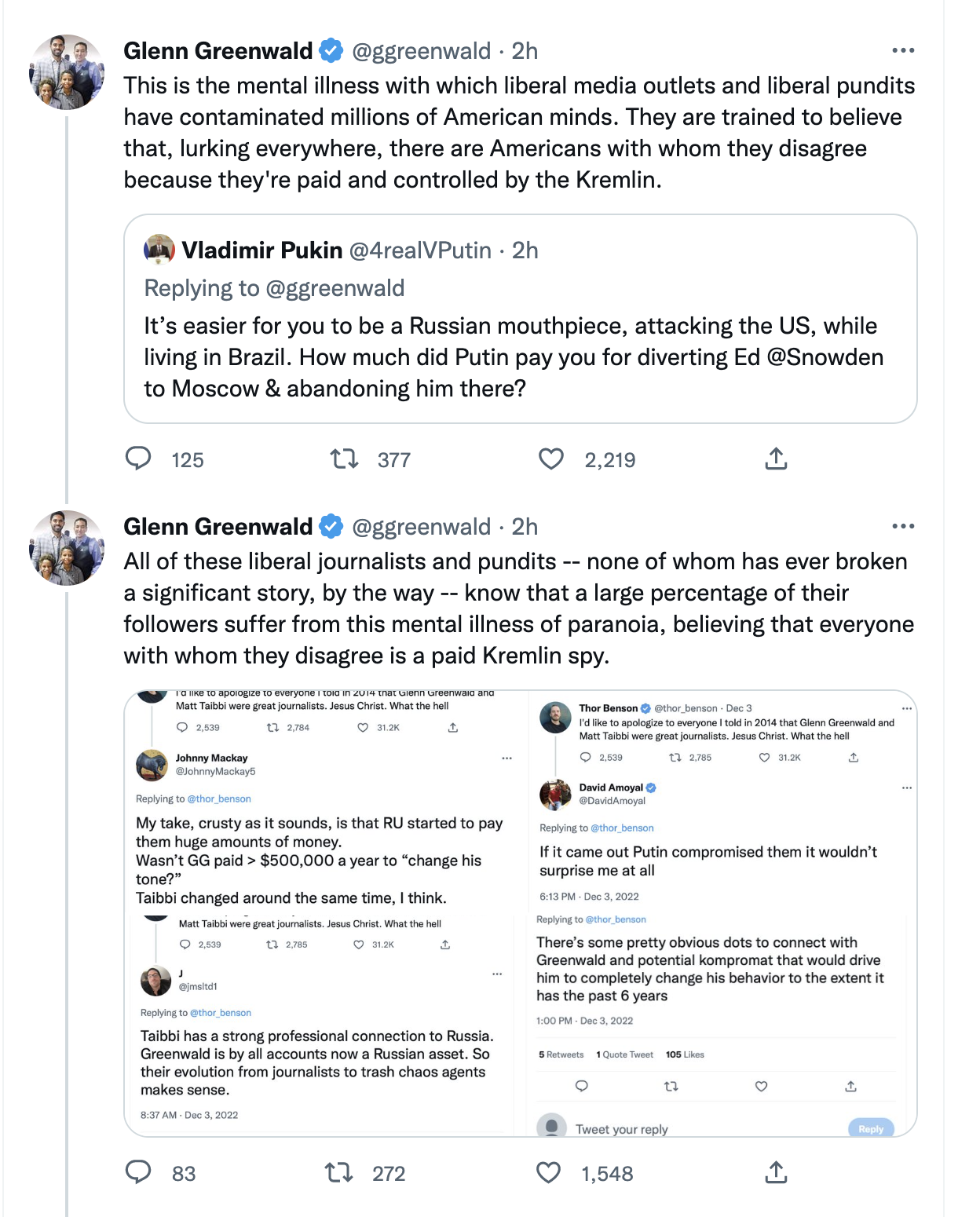
This is the mental illness with which liberal media outlets and liberal pundits have contaminated millions of American minds. They are trained to believe that, lurking everywhere, there are Americans with whom they disagree because they're paid and controlled by the Kremlin...All of these liberal journalists and pundits -- none of whom has ever broken a significant story, by the way -- know that a large percentage of their followers suffer from this mental illness of paranoia, believing that everyone with whom they disagree is a paid Kremlin spy.
Not a drop of proof is needed to make this false claim, even if you are paid to be a "journalist." Same problem with the "Russian Interference in the 2016 election." Do any of these cheerleaders for the Democrats care about the minimal extent of Facebook ads during that campaign?
The myth that Edward Snowden Chose to Live in Russia is dispelled by listening to Obama's White House Staffer, Ben Rhodes, one of the people who forced Snowden to be stuck in Russia:
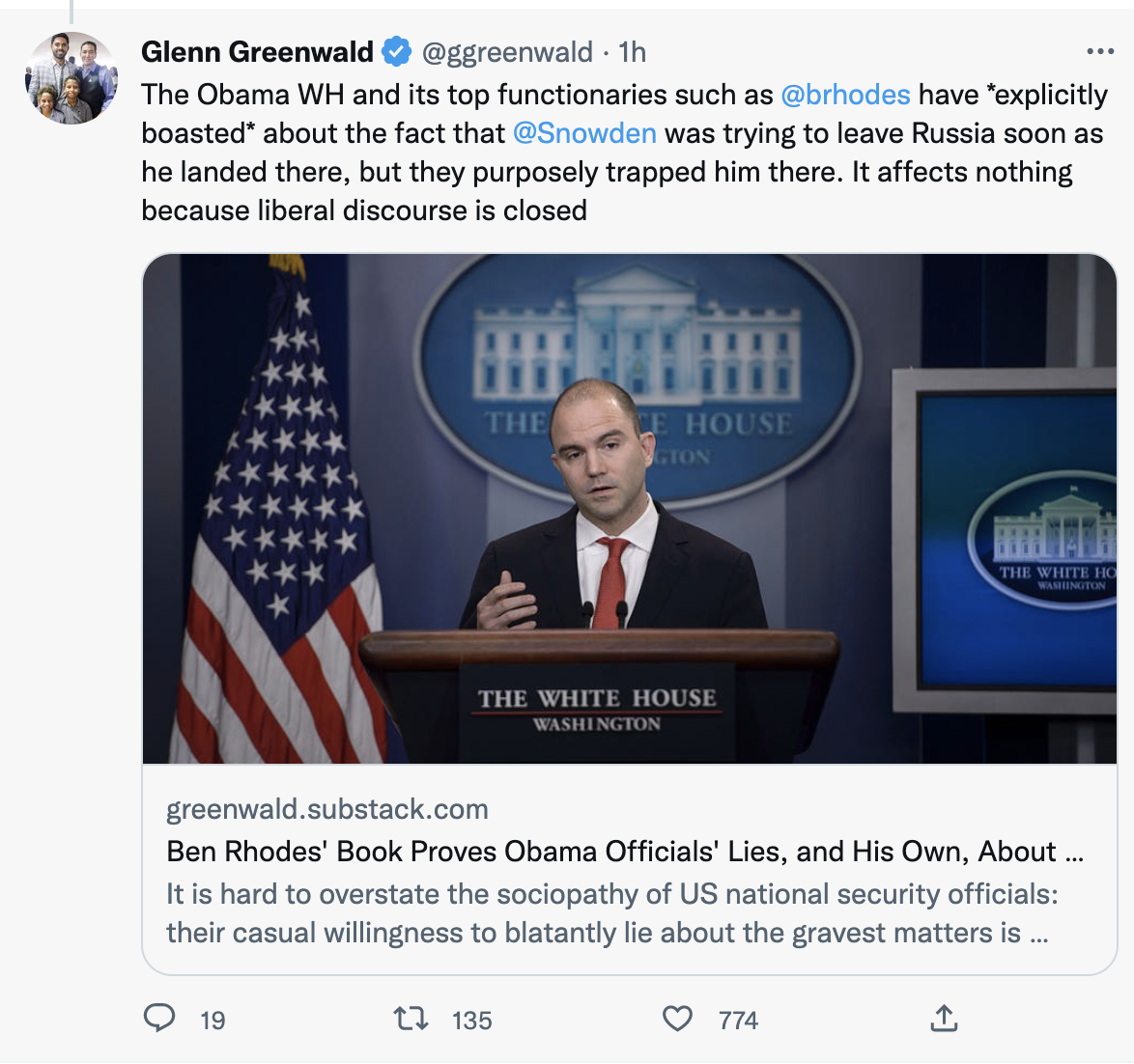
An excerpt from Greenwald's article, "Ben Rhodes' Book Proves Obama Officials' Lies, and His Own, About Edward Snowden and Russia: It is hard to overstate the sociopathy of US national security officials: their casual willingness to blatantly lie about the gravest matters is limitless":
Here are Rhodes' own words:
There was one other, more important signal. Around the time of our second meeting, Edward Snowden was stuck in the Moscow airport, trying to find someone who would take him in. Reportedly, he wanted to go to Venezuela, transiting through Havana, but I knew that if the Cubans aided Snowden, any rapprochement between our countries would prove impossible. I pulled Alejandro Castro aside and said I had a message that came from President Obama. I reminded him that the Cubans had said they wanted to give Obama “political space” so that he could take steps to improve relations. “If you take in Snowden,” I said, “that political space will be gone.” I never spoke to the Cubans about this issue again. A few days later, back in Washington, I woke up to a news report: “Former U.S. spy agency contractor Edward Snowden got stuck in the transit zone of a Moscow airport because Havana said it would not let him fly from Russia to Cuba, a Russian newspaper reported.” I took it as a message: The Cubans were serious about improving relations.
Glenn Greenwald comments:
Ever since Edward Snowden received asylum from Russia in 2013, Obama officials have repeatedly maligned his motives and patriotism by citing his "choice” to take up residence there. It has long been clear that this narrative was a lie: Snowden, after meeting with journalists in Hong Kong, intended only to transit through Moscow and then Havana on his way to seek asylum in Latin America. He was purposely prevented from leaving Russia — trapped in the Moscow airport — by the very Obama officials who then cynically weaponized his presence there to imply he was a civil-liberties hypocrite for “choosing” to live in such a repressive country or, even worse, a Kremlin agent or Russian spy.
But now we have absolute, definitive proof that Snowden never intended to stay in Russia but was deliberately prevented from leaving by the same Obama officials who exploited the predicament which they created. The proof was supplied unintentionally in the memoir of one of Obama's senior national security advisers, Ben Rhodes, entitled The World as It Is: A Memoir of the Obama White House. It is hard to overstate how dispositively Rhodes’ own book proves that Obama officials generally, and Rhodes specifically, lied blatantly and cavalierly to the public about what happened: a level of sustained and conscious lying that can be explained only by sociopathy.
The memoir of Rhodes, now appropriately an MSNBC contributor, is an incredibly self-serving homage to himself that repeatedly attempts to demonstrate his own importance and accomplishments. The passage about Rhodes’ conduct regarding Snowden is very much aligned with those goals. While repeatedly emphasizing how traumatic the Snowden revelations were for the Obama administrations, Rhodes boasts of the crucial role he played in preventing Snowden from leaving Russia as the NSA whistleblower was desperately attempting to do so — exactly the opposite of what people like Rhodes and Hillary Clinton were telling the public about Snowden.
It is really beyond words how willing these people are to lie.
Where would you expect to find sex based differences in career choice most diminished? If you guessed in countries with more wealth and egalitarian culture, you would be wrong. David Geary discusses and interprets the data in his article, "The Nurture of Evolved Sex Differences: Why favorable conditions produce larger sex differences." In wealthy countries like Norway, increased numbers of women pour into fields that are "people oriented" rather than "thing oriented." Consider, first, this data:
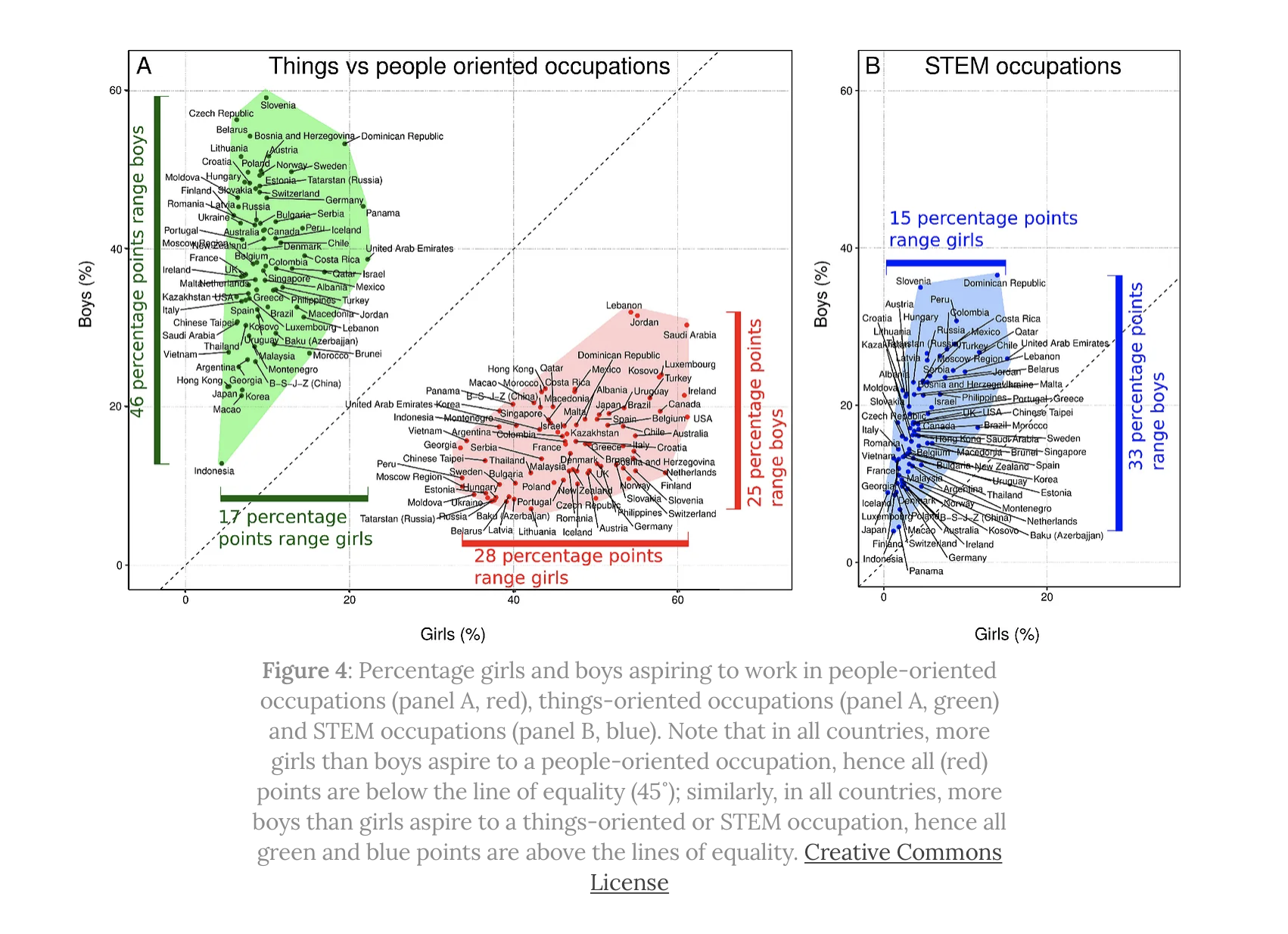
As reviewed by Schmitt and colleagues [33], sex differences in many aspects of personality, self-esteem, and cognitive and psychological functioning are larger in WEIRD, gender equal countries. For instance, women are generally more cooperative and agreeable than men and men are more Machiavellian than women, on average. These differences are larger in more egalitarian countries. One potential reason is that religious prohibitions and proscriptions increase social cooperation and decrease self-serving behaviors in men and this in turn reduces the sex differences in these areas. The release of these prohibitions enables fuller expression of underlying differences; in this case, a decrease in men’s agreeableness and an increase in their use of Machiavellian social strategies [34].
Occupational segregation also increases in WEIRD, gender equal countries, presumably due to underlying differences in preferences for working with and helping people as contrasted with working with things [35]. Girls’ and women’s greater interest in other people and relationships follows from their greater investment in children and their need to develop BFF (best friends forever) relationships that serve as a source of social and emotional support. Boys’ and men’s greater interest in things likely follows from an evolutionary history of tool making, most of which is done by men.
[More . . . ]
“Once a government commits to the principle of silencing opposition, it has only one way to go, and that’s down the path of increasingly repressive measures until it becomes a source of terror to all its citizens”
- Harry Truman