What Passes for Hate Speech

At Public, Alex Gutentag tears apart White House "evidence" that anti-semitic hate speech is on the rise. The evidence is a joke. The claim is yet another government ruse for asserting authoritarian power. Here's an excerpt from this article:

Hate and antisemitism are sharply increasing, say the Biden administration, journalists, NGOs, and the FBI. Groups like the Center for Countering Digital Hate (CCDH), a British nonprofit, claim that censorship is the only way to combat this crisis.

In July, Biden announced a new agenda to fight rising antisemitism, which includes enforcing more censorship of hate speech. The White House is now “[calling] on Congress to hold social media platforms accountable for spreading hate-fueled violence.”

CCDH has successfully pressured advertisers into boycotting Twitter (now called X) in an effort to force the company into restoring the “content moderation” policies it had in place before Elon Musk purchased it. In a reportpublished on June 1, CCDH found that “Twitter fails to act on 99% of hate posted by Twitter Blue subscribers.” Since CCDH started its pro-censorship campaign, Twitter/X has lost 60-70% of its total advertising revenue.

 “The Twitter blue tick used to be a sign of authority and authenticity, but it is now inextricably linked to the promotion of hate and conspiracism,” said CCDH’s CEO Imran Ahmed, who says he started his group after online radicalization led a man named Thomas Mair to kill former British MP Jo Cox. “Our society has benefited from decades of progress on tolerance, but Elon Musk is undoing those norms at an ever-accelerating rate by allowing hate to prosper on the spaces he administers.”

But there is not adequate data to support these claims. Though media outlets promoted the CCDH “report” about hate speech on Twitter/X, it was comprised entirely of a blog post less than 900 words long, based on a review of a scant 100 Tweets. By comparison, 500 million Tweets are sent every day.

The CCDH “report” showcases ten examples of racist and antisemitic posts, but it does not make the other 91 Tweets it supposedly analyzed available. Of these ten examples, seven of them had fewer than 50 “likes,” and two had only about 50 views. Three of the accounts featured in the report have since been suspended, but CCDH has not updated its findings.
Continue ReadingWhat Passes for Hate Speech

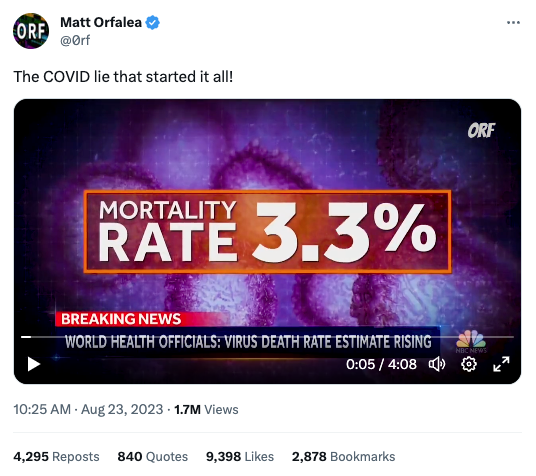
Remember the 3.4% DEATH Rate Gas Lighting?

Matt Orfalea formerly worked for Bernie Sanders' campaign. Now he uses his video-editing skills to piss off the elite by stating facts. Consider how panicked ordinary people SHOULD get if they are repeated told the lie that the DEATH rate of COVID is 3.4%. Elite rent-seekers knew exactly what they were doing when they repeatedly told this lie.

You can also follow Matt on Rumble, the free speech alternative to Youtube.

Continue ReadingRemember the 3.4% DEATH Rate Gas Lighting?

Corporate Media Racecraft

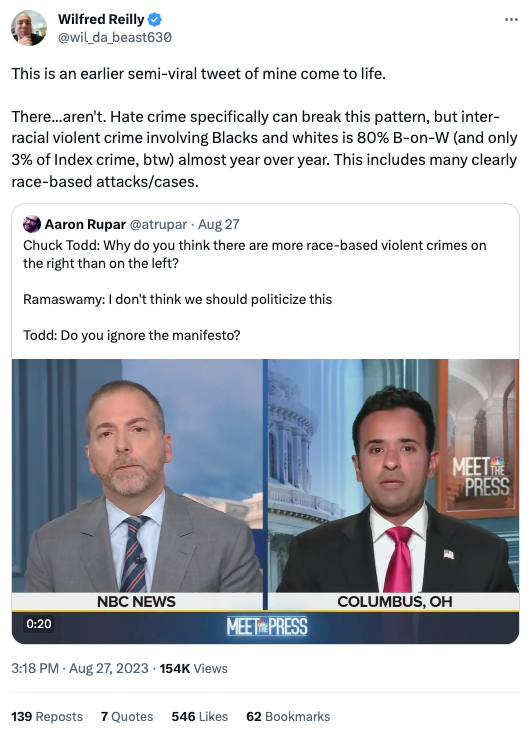
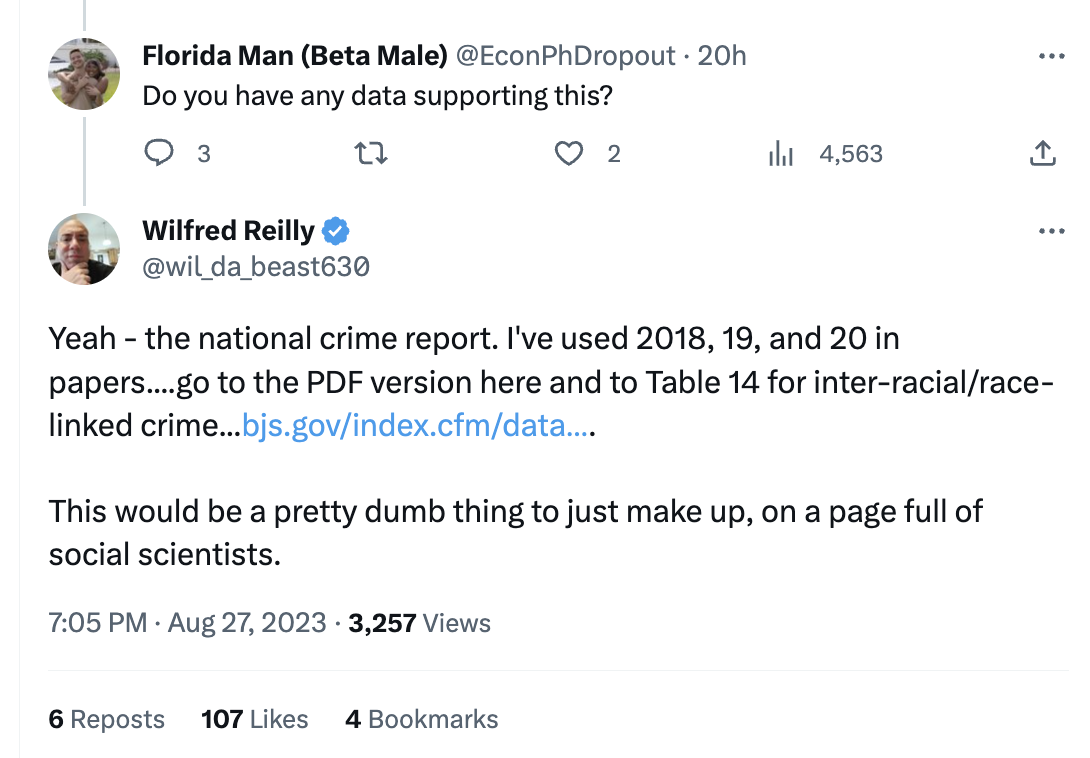
This is a common tactic of the corporate media: Ignore crime statistics to drum up race-based panic. Wilfred Reilly knows his stats and brings sanity to the conversation, sanity that is inconvenient to many progressives:

https://www.bjs.gov/index.cfm/dataonline/content/index.cfm?ty=pbdetail&iid=6686

Continue ReadingCorporate Media Racecraft

Florida and California Both Receive a Failing Grade in First Amendment

If you detest Florida's Stop Woke Act, you should also detest the way that California is trying to turn college professors into its ideological puppets. These are both blatant violations of the First Amendment.

Instead of compelling speech at colleges and allowing professors to be disciplined for doing their jobs, what should college administrators be doing? Greg Lukianoff of FIRE offers this advice:

First, stop breaking the law. When a public university restricts freedom of speech, it violates the First Amendment. Although private universities do not share the same legal obligations, many of them make promises to preserve and promote the free speech rights of students and faculty, and they must honor those commitments.

Speaking of commitments, Greg’s second piece of advice is to enshrine free speech protections in official campus policy. One such policy, the “Chicago Statement,” has been adopted by more than 100 colleges and institutions and is viewed by FIRE as the gold standard for free speech commitments.

But you can’t stop there. It’s easy enough to congratulate yourself for putting a commitment in writing, but the real test is when a campus controversy arises over speech protected by the Constitution or by your school’s commitment to free speech. What do you do then? Do you try and wait it out? Hope that everything will blow over?

Well, FIRE hopes not, because your silence will have a chilling effect on free speech. As the university president, you must “defend the free speech rights of your students and faculty loudly, clearly, and early,” says Greg.

One of the most difficult things you will have to do as president will be to defend unpopular speech, even speech that you disagree with, but that is your obligation. Ultimately, the responsibility falls on college leadership, especially presidents, to publicly and unapologetically show their support for free expression. According to FIRE’s 2022 College Free Speech Rankings, students at the top-ranked schools reported that their administration’s stance on free speech is clear and that their administration would likely defend a speaker’s rights during a controversy on campus, a sentiment that is far less common at schools lower in the rankings.

What else can you do? Well, after you have planned for all of that, you should prepare to teach free speech from day one through campus activities and events. In doing so, you’ll clearly convey to students and faculty that the university places a high value on freedom of speech and civil discourse. FIRE even has free speech orientation materials on our website for interested schools.

Finally, as the leaders of scholarly institutions, you must treat commitments to freedom of speech as yet another scholarly endeavor. Universities should survey students, professors, and administrators to “understand their attitudes toward free expression, and to gather opinions of the campus climate for debate, discussion, and dissent.”

Continue ReadingFlorida and California Both Receive a Failing Grade in First Amendment