Bret Weinstein and Heather Heying Discuss Collusion, conspiracy, and Occam’s Razor
Excellent points made in the 6-minute video by Bret and Heather:
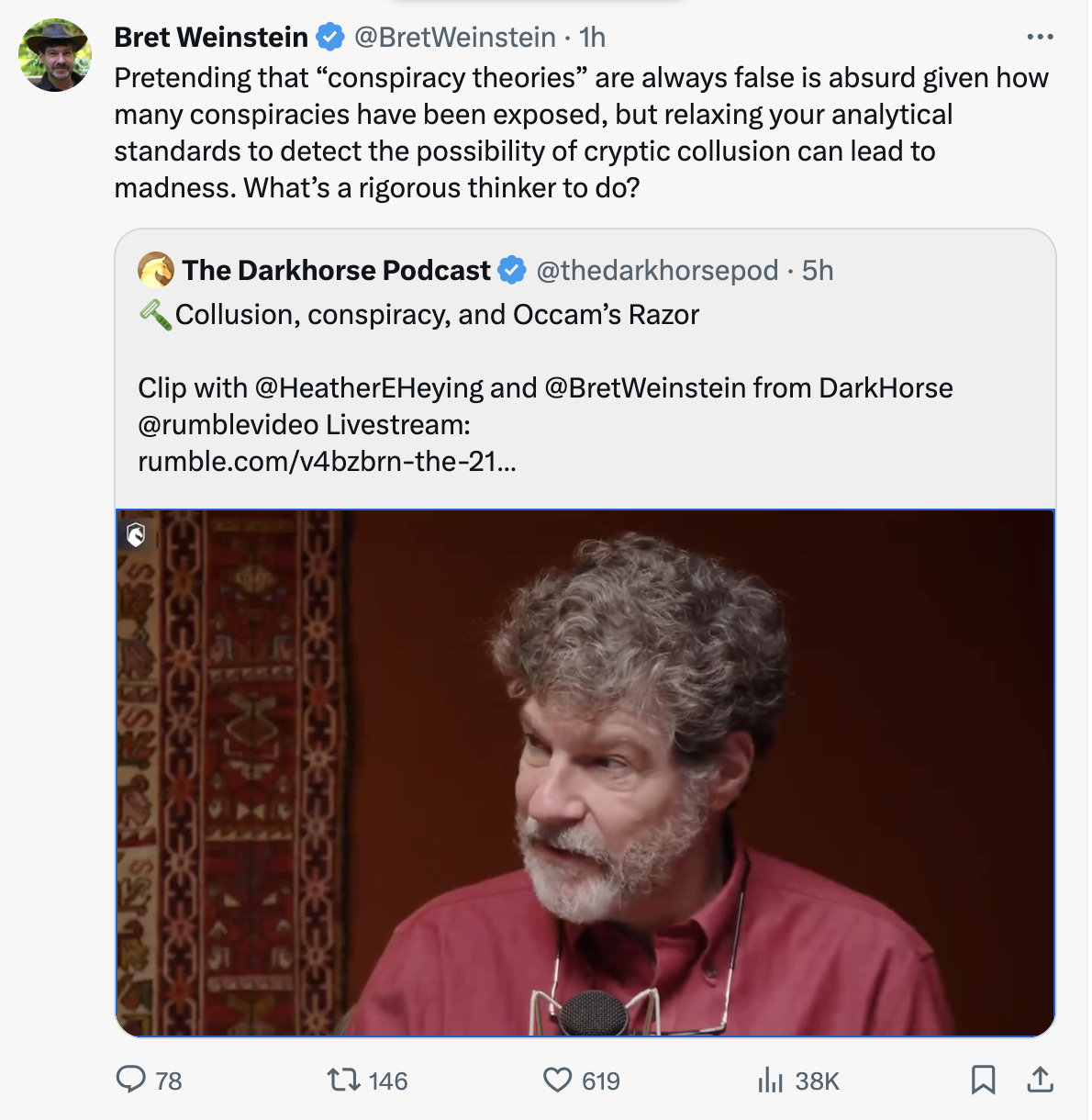

Excellent points made in the 6-minute video by Bret and Heather:
FIRE has released it's list of the ten worst censors of 2023:
The 10 Worst Censors of 2023, in alphabetical order, are:
Book censors
California Community Colleges
Florida state officials
Hypocritical university admins
The Marion County Police Dept.
The Mayo Clinic College of Medical Science
Muirlands Middle School
New York state officials
San Francisco State University
The Texas A&M University system
From FIRE:
It’s past time for off-campus censors to get the dishonor they're due," said FIRE Director of Public Advocacy Aaron Terr. “Censors on and off college campuses have run roughshod over Americans' rights for years, and we hope that by throwing shade at them, we can prompt other would-be censors to think twice.Here's more information about those who made FIRE's list.
Walter Kirn is spot on . . . .
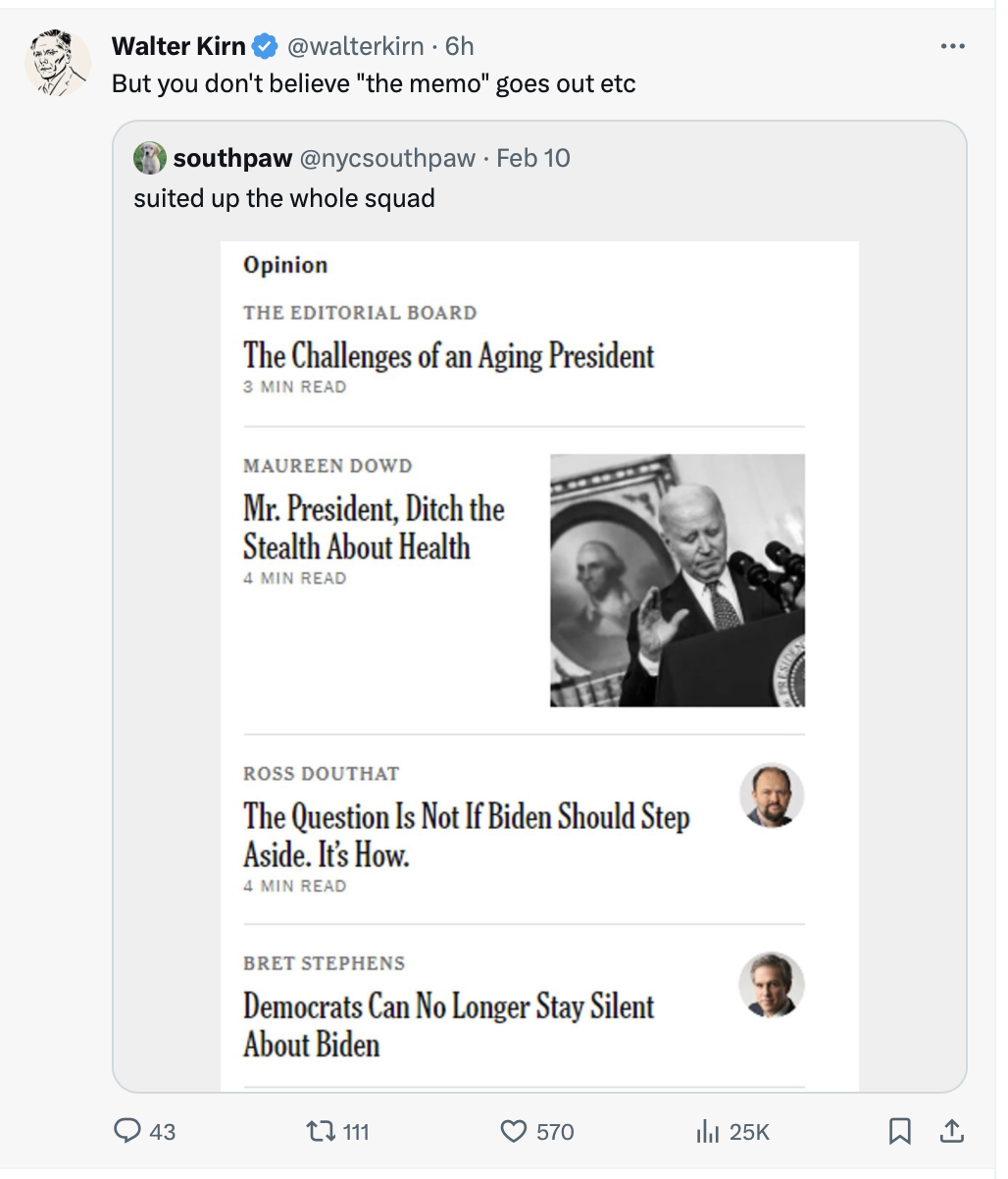
This is not an organic process. Corporate "journalists" refused to talk about this for years, and then, all of a sudden, they can't stop talking about Joe Biden's cognitive decline. I should add my frustration with the many people who want to frame this as a matter of age. Absolutely not. There are many people in their 80s or even 90s who are capable, even brilliant. The pertinent question is about Biden's cognitive decline, not age per se (even though these somewhat correlate).
The big question is who makes these decisions about what corporate journalists can and cannot talk about in lockstep? It's not those who follow the news. It's not voters and it's not anyone we vote for. Who issued that permission slip? I assume the process involves only a few people and that big money empowers them. Real journalists know that their job is to follow stories and report on them. They know that their job is not to campaign for particular candidates.
What is Cancel Culture? In their excellent new book, The Canceling of the American Mind, Greg Lukianoff and Rikki Schlott offer many examples of cancel culture along with this definition (p. 9):
Cancel Culture is just one symptom of a much larger problem: the use of cheap rhetorical tactics to "win" arguments without actually winning arguments. After all, why bother meaningfully refuting one's opponents when canceling them is an easier option? Just take away their platform or career. Nobody else will dare to tread the same ground once you make an example of them.There is good news here, however. Once you understand Cancel Culture as one part of an unhealthy societal conversation, the solution becomes quite clear: We don't have to argue like this.
What's the opposite of cancel culture? Free speech. Lukianoff and Schlott explain:
In the meantime, you should know that Free Speech Culture is a set of cultural norms rooted in older democratic values. Embracing Free Speech Culture means turning back to once popular sayings like "everyone is entitled to their own opinion," "to each their own," «it's a free country," and even "don't judge a book by its cover."
Who is my favorite person who exemplifies the opposite of cancel culture? Daryl Davis. Here's one of his recent Tweets:

Daryl's story is incredible. I've described it in prior posts (and see here and here), but here is a recent succinct description of Daryl's wisdom and heroism by Joe Rogan:

The Foundation for Individual Rights and Expression has announced a new Campus Deplatforming Database.
A deplatforming attempt is a form of intolerance motivated by more than just mere disagreement with, or even protest of, some form of expression. It is an attempt to prevent some form of expression from occurring. Deplatforming attempts include efforts to disinvite speakers from campus speeches or commencement ceremonies, to cancel performances of concerts, plays, or the screenings of movies, or to have controversial artwork removed from public display. An attempt to disrupt a speech or performance that is in progress is also considered a deplatforming attempt, whether it succeeds or fails. Deplatforming attempts do not include criticisms of some form of expression and protests denouncing them that are not motivated by the goal of deplatforming the controversial expression.