More insanely beautiful base jumping
I do have a fascination for freebase jumping. Not for doing it myself, mind you, but for watching others do it well. Here are some incredible videos from beautiful Norway:

I do have a fascination for freebase jumping. Not for doing it myself, mind you, but for watching others do it well. Here are some incredible videos from beautiful Norway:
Consider this description of a significant and tragic event in American history:
[Occurring in May and July 1917, this event] was an outbreak of labor and racially motivated violence against blacks that caused an estimated 100 deaths and extensive property damage in [an American industrial city]. It was the worst incident of labor-related violence in 20th century American history, and one of the worst race riots in U.S. history. It gained national attention. The local Chamber of Commerce called for the resignation of the Police Chief. At the end of the month, ten thousand people marched in silent protest in New York City over the riots, which contributed to the radicalization of many.
[paraphrased from Wikipedia]
Do you know anything about the event described above? The above passage describes the East St. Louis race riot that occurred on Monday, July 2, 1917. I learned about this riot for the first time tonight when I had the opportunity to hear a talk by Harper Barnes, a St. Louis journalist who has recently written a book called Never Been a Time: The 1917 Race Riot That Sparked the Civil Rights Movement. [caption id="attachment_5419" align="alignright" width="150" caption="Harper Barnes - Photo by Erich Vieth"]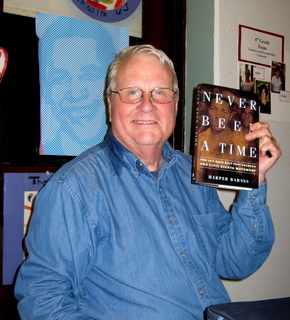 [/caption]
In 1914, the first world war was heating up and so were the heavy industries. East St. Louis, Illinois, located right across the Mississippi River from St. Louis, Missouri, was the home of large aluminum and steel plants.
To backtrack, through the 1910s, one-half million blacks who had resided in the rural South moved up to northern cities. Employers made use of these blacks as strikebreakers. The blacks certainly wouldn't have felt much loyalty toward the unions, because the white unions banned black workers.
[/caption]
In 1914, the first world war was heating up and so were the heavy industries. East St. Louis, Illinois, located right across the Mississippi River from St. Louis, Missouri, was the home of large aluminum and steel plants.
To backtrack, through the 1910s, one-half million blacks who had resided in the rural South moved up to northern cities. Employers made use of these blacks as strikebreakers. The blacks certainly wouldn't have felt much loyalty toward the unions, because the white unions banned black workers.
Should science study race and IQ? A recent article in Nature ("Should scientists study race and IQ") says yes, as long as the research is done carefully and kept free of outside influence and premature application by social scientists and politicians. Science did not give rise to bigotry. After all, scientific studies of race and IQ began in relatively modern times, only after long centuries of "pernicious folk-theories of racial and gender inferiority predated scientific studies." The authors believe that first-rate scientific research will, in the end, dispel much of the racial bigotry that still exists.
Some scientists hold more 'acceptable' views, ourselves included. We think racial and gender differences in IQ are not innate but instead reflect environmental challenges. Although we endorse this view, plenty of scholars remain unpersuaded. Whereas our 'politically correct' work garners us praise, speaking invitations and book contracts, challengers are demeaned, ostracized and occasionally threatened with tenure revocation.
Acts of censure edge close to Lysenkoism. They also do a disservice to science. When dissenters' positions are prevented exposure in high-impact journals and excluded from conferences, the dominant side goes unchallenged, and eventually its rationale is forgotten, forestalling the evolution of crucial ideas.
I am sympathetic to the need to for scientists to carefully examine everything, no exceptions. I'm concerned, though, that we need to look extra-closely at the concept of "race," which I consider to be virtually useless in daily matters. Nor should we allow the simplistic concept of "IQ" to serve as a variable, given much more expansive ways to measure intelligence (see, for example this post on Howard Gardner's work). For more on the dangers of misusing "IQ," see Steven J. Gould's 1996 book, "The Mismeasure of Man."
In sum, we should do good science and I believe that good science would suffocate bigotry. The article points out several examples of this. Good science should be done on only after kicking out the clumsy, pernicious concepts of "race" and "IQ," reframing the debate as the relationship between fine-grained genotypic variation and competence in each of the many ways in which humans display competence. Because genotypic variation within "races" is at least as wide as genotypic variation among "races," a meaningful scientific exploration would not amount to a simplistic survey of how people with different colors of skin do on standardized intelligence tests. That would not be good science. Good science will always take into account the convoluted ever-changing environment, and that is not easy to do when we are dealing with basic concepts that are vague.
I'm not convinced that we are prepared to begin the necessary research on this general topic, because too many of us, including many well-trained scientists, have not done their ontological homework (consider the incoherent and clumsy stumblings of DNA co-discoverer James Watson, described in the article). Are "race" and "IQ" useful constructs with which to do this sort of research? Time will tell if we are intelligent enough to sharpen our constructs before running off to demonstrate our "truths."
How is the war on drugs going, really? According to The Economist, things are not going well.
[T]he war on drugs has been a disaster, creating failed states in the developing world even as addiction has flourished in the rich world. By any sensible measure, this 100-year struggle has been illiberal, murderous and pointless. That is why The Economist continues to believe that the least bad policy is to legalise drugs.
How can one quantify this illiberal, murderous and pointless struggle?The United States alone spends some $40 billion each year on trying to eliminate the supply of drugs. It arrests 1.5m of its citizens each year for drug offences, locking up half a million of them; tougher drug laws are the main reason why one in five black American men spend some time behind bars. In the developing world blood is being shed at an astonishing rate. In Mexico more than 800 policemen and soldiers have been killed since December 2006 (and the annual overall death toll is running at over 6,000) . . . [F]ar from reducing crime, prohibition has fostered gangsterism on a scale that the world has never seen before.
In this article, The Economist points out that it has maintained this same position for 20 years, and it is more evident than ever that the "drug war" is a disaster.Who were the prisoners of Guantanamo? Andy Worthington has compiled a four-part series telling us their stories. Here's the disturbing bottom line:
[A]t least 93 percent of the 779 men and boys imprisoned in total — were either completely innocent people, seized as a result of dubious intelligence or sold for bounty payments, or Taliban foot soldiers, recruited to fight an inter-Muslim civil war that began long before the terrorist attacks of September 11, 2001, and that had nothing to do with al-Qaeda, Osama bin Laden or international terrorism.
I don't pretend to know enough to know whether these accounts are totally accurate, but they are filled with details, personal anecdotes, statistics and reports regarding individual court cases. It has a strong ring of authenticity. Further, these individual accounts corroborate general accounts produced elsewhere. I have no reason to disbelieve any part of Andy Worthington's work. He is a well-reputed journalist who has published elsewhere, such as this post at Huffington Post. I am proud to be an American. America does much right in the world and has the potential to do much more that is admirable. This account by Andy Worthington, however, describes America at its shameful worst.