
Using Media-Friendly Images to Get Your Message Out

At the recent True Spin Conference in Denver, I attended a session titled "How to Create Media-Friendly Imagery," presented by Jason Salzman, who is the co-founder of Effect Communications, and the author of Making The News: a Guide for Activists and Nonprofits (1998). Salzman was also instrumental in putting together the True Spin Conference. Salzman began his session with the idea that television is still the dominant news source for national and international news, according to a 2008 Pew survey. It is an undeniable fact that you need visual imagery to get your story onto the TV news. Visual imagery is also important for getting your story into local newspapers, another news source for many people. Maybe you're thinking that newspapers and television stations should simply be reporting on important stories, whether or not there is an accompanying clever visual image. That's a nice idea that doesn't happen in the real world. You absolutely need to decorate your stories with creative visuals, or else your stories will be invisible to local media. As Salzman says, "This is often ridiculous stuff, but it works." He presented the conference gathering with a long list of types of visual imagery. He added, "When you see some of these things, you might think they are juvenile or stupid, but they really work. As long as your imagery is on message, it's good." Now I know that some of you probably are still thinking that you're not going to sell out-- you would rather be dignified than be accused of being silly or desperate to get coverage for your important issue. Salzman encouraged the audience members to get over their inhibitions, however. "Stunts can be worthwhile. People forget the source, but they remember the message." What kinds of visual imagery seem to catch the attention of the local news media so that you can get your story some real attention? I will walk through Jason's list of seventeen media-imagery techniques, one-by-one. He has graciously allowed me to reprint some of his slides to illustrate these ideas (using these images makes sense, of course, given the topic). 1. Costumes. Salzman stated that costumes are the "oldest and best" use of imagery available. By dressing up as a giant pea pod, he was successful in gaining considerable media attention while making the point that George W. Bush and John McCain were "two peas in a pod." As you can see, he wore his pea pod costume at his session. As another of many examples, Salzman described how mobs of cameras once gathered around real pigs that were part of a protest of pork barrel projects. A member of the audience asked whether it would be better to surprise the media by suddenly pulling out the costume, but Salzman strenuously disagreed. "Don't surprise the media. Tell the media you'll be there [dressed up in your costume]." Members of the media love stories with images. "Tell them you'll be there and tell them how you'll be dressed. This will dramatically increase your odds of showing up on the news." 2. Dramatize a Phrase. Salzman pointed to an example of a huge "budget pie," to illustrate a story that one-half of discretionary spending went to the military. banners 3. Banners. If the timing is right, banners can work beautifully. Let the cameras pan those big banners! He gave the example of the New York garbage barge (at left). [More . . . ]
Continue ReadingUsing Media-Friendly Images to Get Your Message Out

Hypocrisy on parade

Perhaps you've heard about the American hikers being held in an Iranian prison? A couple of Belgian bicyclists who were detained at the same prison have some updates on their situation:

"We're deeply concerned for their well-being," Van den Bosch and Falleur wrote in a news release. "The psychological stresses of detention were very great, especially during interrogation and solitary confinement." As of early December, when Van den Bosch and Falleur were released, the American hikers were being held in solitary confinement, a harrowing experience the Belgian men describe in detail. "We were in cells with no outside contact and a ceiling light on day and night," they wrote. "No communication was possible with other prisoners or with our families. Everything was designed to make us feel very lonely." Van den Bosch and Falleur added, "From our own experience, we can only imagine that the psychological pressure put on the hikers to confess to crimes they are innocent of is extremely intense. Their feeling of loneliness must be extreme."
Yes, no doubt the psychological pressures one must face in those sorts of situations must be intense. Not as intense as the pressures innocent Muslims face in America's torture prisons and secret black-ops sites, but extreme in any case!

Continue ReadingHypocrisy on parade

Greenwashing – Exhibit A: Elephant Poo Poo Paper

I'm getting really tired of greenwashing, so much so that I've creating a new category called "greenwashing" dedicated to these sorts of incidents:

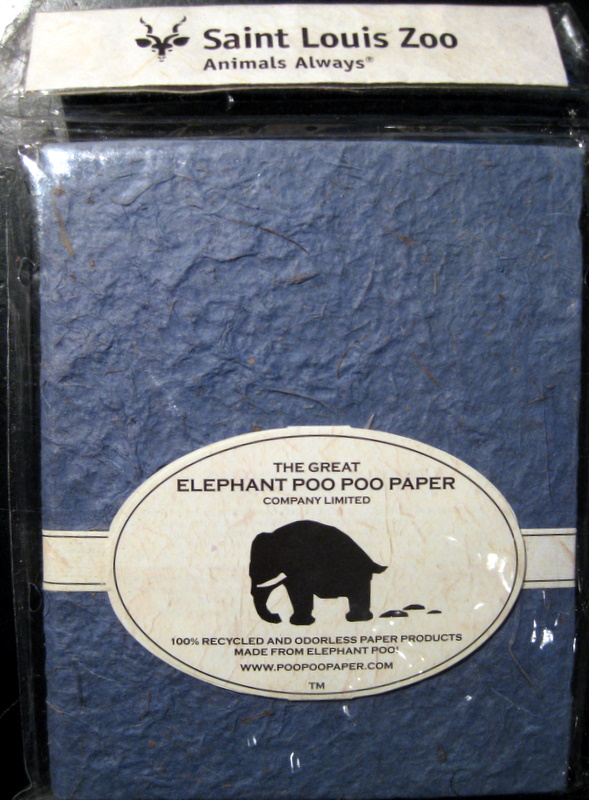
A false or misleading picture of environmental friendliness used to conceal or obscure damaging activities. img_1165

Today I am featuring Exhibit A, "Elephant Poo Poo Paper." It's being featured here as Exhibit A not because it is the worst offender ever, but because it is my first of a series of incidents of greenwashing I'll be pointing out over the months. It's worth our while to point out greenwashing because these sorts of products help maintain the illusion that we don't need to change our lives dramatically to accommodate Earth's depleted and contaminated resources. All we need to do is to buy cute products and claim that we thereby give a damn. Now, back to today's featured product: "Elephant Poo Poo Paper," which was recently purchased at the St. Louis Zoo. Just think: we can now make good use of elephant poop (as though it can't just be left alone to enrich the soil). We can help save the planet by manufacturing heavily-dyed paper and shipping it thousands of miles away from the "elephant conservation parks" where the elephant poo is purportedly gathered and then turned into paper by mixing it with bananas and pineapples. Buy "Elephant Poo Poo Paper" and feel like you are doing your part to save the world. Better yet, give it as a gift so you can loudly broadcast to others that you are doing your part to save the world. If it's actually so good to the earth to make paper out of poop, there is a lot of cow poop (among other kinds of poop) just waiting for those who want to be "green" paper manufacturers.

Continue ReadingGreenwashing – Exhibit A: Elephant Poo Poo Paper

On Feeling Small

There are many people out there who fight Darwin's theory of natural selection because it makes them feel "small," it makes life "meaningless" or it causes only despair. In the February/March 2010 issue of Free Inquiry Magazine, Christopher Hitchens substitutes the word "stoicism" for "despair," then poses several questions in response:

[I]s this Darwinian stuff really the goods or is it not? You can't take a position against it on the mere ground that might make humans feel small. (Incidentally, isn't religion supposed to make people feel small and worthless: mere sinners created from dust by an angry and jealous deity? Our own well charted descent from lowly amoeba and bacteria is surely nothing as humiliating as that.) I suppose you could argue that my next question is to some extent a matter of taste and therefore ultimately undecidable, but how is it more uplifting to human beings to compare themselves to well-tended but helpless farm animals, grateful for any favor from the owner and not believing themselves able to manage any sustenance without a corresponding guardianship?
The point Hitchens raises has puzzled me for many years. How could any life feel worthwhile without a sense of autonomy? As soon as one hands one's fate over to Someone Else (who is guided by God-knows-what), it would seem that the "meaning" of one's life exists merely in the hand-over of control, and not in one's many earthly choices, no matter how impressive they might seem.

Continue ReadingOn Feeling Small