
The real cost of college
Bob Samuels puts the numbers on the table. Here's what a student (and his or her parents) are really paying for when they fork over huge chunks of tuition to a prestigious college.
[T]he reasons why the numbers never add up in higher education is that universities and colleges use a false and misleading method to determine the cost of undergraduate instruction. Many institutions calculate this important figure by taking the total cost for all undergraduate and graduate instruction, research, and administration, and dividing that cost by the total number of students. Schwartz argues that this common method for determining cost is misguided because it assumes that all students will be taught by professors and that there is no difference between the cost of undergraduate and graduate education. In other words, when a university or state calculates how much it has to spend to educate each additional student, it includes in the costs, the full salary of a professor, but everyone knows that at research institutions, professors only spend a small percentage of their time teaching undergraduate students. According to Schwartz, parents are really paying for the cost of undergraduate instruction plus graduate instruction plus research plus administration. To be precise, undergraduates are subsidizing the cost of research and graduate education, and no one admits this fact.I think that he leaves out another big factor in his informative post. Many people pay big money for prestigious colleges because they want their children to attend school alongside other people who can pay big bucks to go to a prestigious college. Why is that important? Why isn't their only one goal to become smarter, which many people do by self-study? In Spent: Sex, Evolution and Consumer Behavior (2010), Geoffrey Miller explains that universities are often in the business of "educational credentialism."
Harvard and Yale sell nicely printed sheets of paper called degrees that cost about $160,000.... alumni of such schools . . . work very hard to maintain the social norm that, in casual conversation, it is acceptable to mention where one went to college, but not to mention one's SAT or IQ scores. If I say on a second date that "the sugar maples in Harvard Yard are so beautiful every fall term," I am basically saying "My SAT scores were sufficiently high (roughly 720 out of 800) that I could get admitted, so my IQ is above 135, and I had sufficient consciousness, emotional stability, and intellectual openness to pass my classes. Plus, I can recognize a tree." The information content is the same, but while the former sounds poetic, the latter sounds boorish.Miller also has a lot to say about conspicuous consumption in his book, and it should be another factor for why so many colleges can get away with charging immense amounts for education without justifying those amounts. It doesn't hurt the universities financial condition that the ability to pay exorbitant tuition is a plus for many parents. It is boorish to announce one's high salary at a social function, but it is quite acceptable to drop the following in conversation: "Tuition is coming due for my two kids; one is at Harvard and the other is at Yale." Mission accomplished, because you just announced to the world that your kids both have the minimal intellectual and social requirements for entry at those institutions (and they got those genes from you!) and that you have the financial wherewithal to pay for all of that tuition.
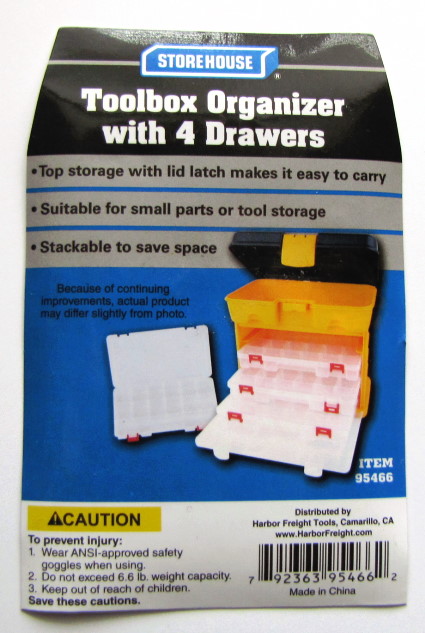 I need ANSI-Approved eye protection to open a drawer? Did an actual lawyer sign off on this?
This box is actually lower quality than a similar one that I'd bought at Target a couple of years earlier for the same price. Target doesn't have them any more, so I resort to Harbor Freight.
I've been mail-ordering from Harbor Freight since the 1980's, long before they had stores east of California. This is a cheap tools import house that now has an outlet a few blocks west of
I need ANSI-Approved eye protection to open a drawer? Did an actual lawyer sign off on this?
This box is actually lower quality than a similar one that I'd bought at Target a couple of years earlier for the same price. Target doesn't have them any more, so I resort to Harbor Freight.
I've been mail-ordering from Harbor Freight since the 1980's, long before they had stores east of California. This is a cheap tools import house that now has an outlet a few blocks west of