Comparing cars, bus and bicycles
How much machinery does it take to transport 100 people by car, bus or bicycle? Check out this poster.

How much machinery does it take to transport 100 people by car, bus or bicycle? Check out this poster.
I'm not writing about gadgets here, but about the information that makes the gadgets useful: Software. This video is nominally about web design consulting. But I've lived these situations back before the web, as well as with web clients. One problem is that the buyer of information has no idea what it's worth until he has it. And once he has it, why should he pay someone for it? Therefore, it isn't valuable. This dovetails neatly into other copyright issues, but I'm not going there. I have a few websites, most of which are loaded with free information that I painstakingly collected and developed. The sites are also built from scratch, mostly with a simple text editor. Some people see value in this; I receive donations. Some years as much as the low three figures. People used to ask me if HTML was easy. I'd say, "Yes, you just need to remember how a few hundred easy commands interact." Most developers don't bother to make sure their site even meets official web standards (as published and tested for free by W3C.org). Even WordPress, the engine on which this site is built, shows errors in the validator. Google? Thousands of errors on every page. I've had clients who understand what I do, and were happy to pay. Unfortunately, usually their superiors had to be cajoled. Eventually, these situations melt down and leave me out of work. The "Just a small change" problem comes up often. After I've been reporting and demonstrating every step of the way, and finally a web site is finished, then do they bother to look and notice that it isn't what they need. They make "little" requests comparable to having a builder simply move a bathroom from the first floor to the second as the keys to a house are handed over. This video made me cringe.
A few weeks ago, my daughters (aged 9 and 11) convinced me to go dumpster diving out in the alley behind our house in the City of St. Louis. We've gone dumpster diving a few times over the years. Based on the prior expeditions, my daughters fully expect that if they look through a few dozen dumpsters, they'll find something valuable. You see, this is America, where people through away perfectly usable toys and games, as well as furniture, appliances and clothing. And even when you don't find usable merchandise, you'll see literally tons of single-use paper and plastic being thrown out. When you see the incredible piles of discarded usable things with your own eyes, it is all-the-more astounding. Even more surprising, if you're looking the highest ratio of usable stuff, look in the dumpsters behind apartment-dwellers rather than the dumpsters behind expensive single-family homes.
Perhaps it sounds disgusting to go dumpster diving. If so, get over it, because it can be far more than an anthropological field trip--it can be like winning a mini-lottery. My kids and I have found several extremely nice coats, for instance (we washed them and gave them away to friends). We once found a working DVD player. We've taken home shelves and other items of furniture. We've found dozens of toys, which merely need to be cleaned up to become usable. As I'm finding these sorts of things, I keep thinking "Why wouldn't someone take the time to donate this to Good Will of Salvation Army?" When people throw a valuable thing into the landfill, it's gone forever--what were they thinking?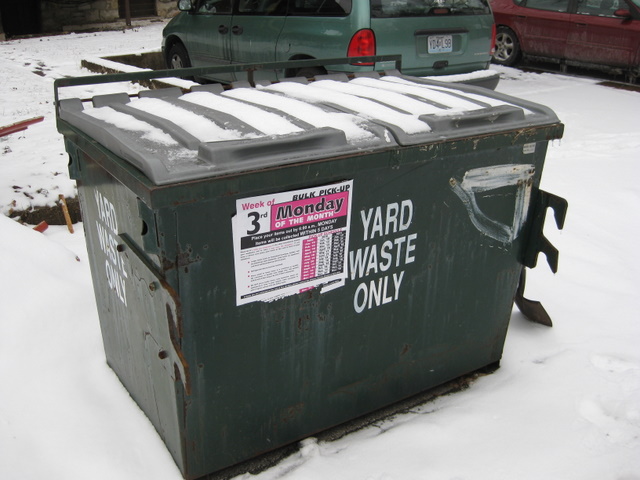 Here's what we found on our recent expedition. First of all, I must digress. The City of St. Louis provides special separate dumpsters for Yard Waste Only and other dumpsters for general rubbish. On our recent expedition, I looked into 20 of of those yard-waste-only dumpsters. About half of them contained non-yard waste. This astounds me too. Why would someone screw up this incredibly sensible system for recycling vegetation by throwing plastic, food and paper into a yard waste dumpster?
And here's a typical example of what you often find in a yard-waste-only dumpster:
[caption id="attachment_11660" align="aligncenter" width="300" caption="Contents found in a yard-waste only dumpster"]
Here's what we found on our recent expedition. First of all, I must digress. The City of St. Louis provides special separate dumpsters for Yard Waste Only and other dumpsters for general rubbish. On our recent expedition, I looked into 20 of of those yard-waste-only dumpsters. About half of them contained non-yard waste. This astounds me too. Why would someone screw up this incredibly sensible system for recycling vegetation by throwing plastic, food and paper into a yard waste dumpster?
And here's a typical example of what you often find in a yard-waste-only dumpster:
[caption id="attachment_11660" align="aligncenter" width="300" caption="Contents found in a yard-waste only dumpster"]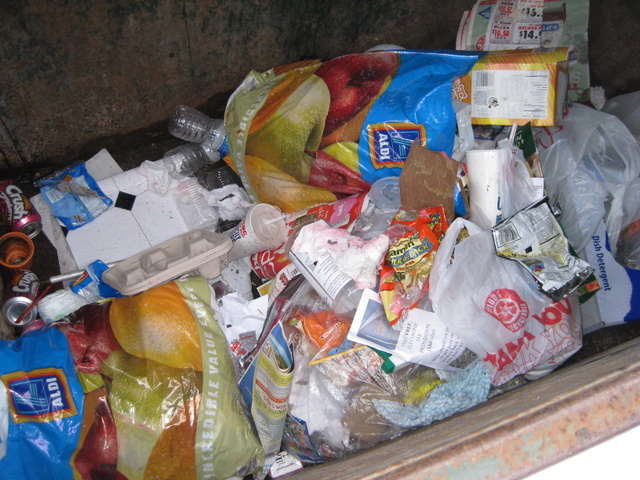 [/caption]
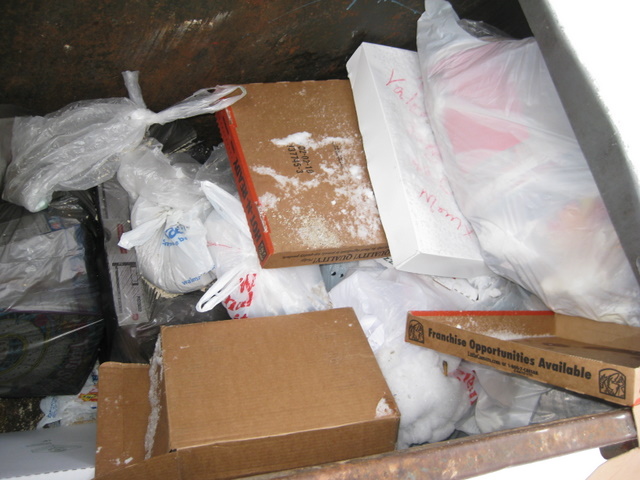
As I mentioned at the beginning of this post, people throw away massive amounts of single-use paper and plastic. Probably the biggest single category is cardboard pizza boxes. In our one-hour expedition, I probably saw 500 used pizza boxes.
[/caption]
As I mentioned at the beginning of this post, people throw away massive amounts of single-use paper and plastic. Probably the biggest single category is cardboard pizza boxes. In our one-hour expedition, I probably saw 500 used pizza boxes.
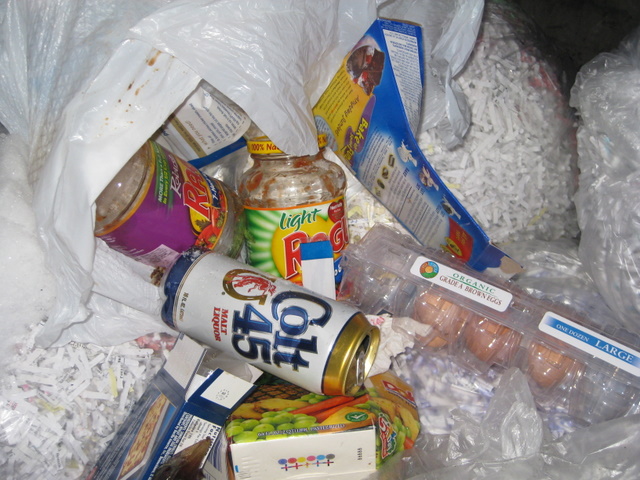
 But we also saw huge amounts of clearly recyclable goods that were not being recycled. Hundreds of glass jars, metal cans and plastics and immense amounts of paper, all of it headed for the landfill. We also saw hundreds of pounds of colorfully-inked food packaging. All of it carefully designed to catch your eye at the store, and then you toss it into the landfill. But, it's not like you really toss it in--instead, a huge fleet of city trucks carts this packaging far away from the city in order to dump it into the landfill. It makes me wonder how many toxic chemicals were released into the environment in order to produce all of this food packaging.
 We found several toys and many items of clothing that had been saturated in pasta sauce, meat grease or who-knows what kind of fluid. We decided to keep looking. What my girls ended up taking home for a quick clean-up was a little toy dog that they found inside of a woman's big purse. You'll see his photo below. My girls named him "Oscar" (after Sesame Street's Oscar), and he now lives with us .
[caption id="attachment_11661" align="aligncenter" width="450" caption="Oscar"]
We found several toys and many items of clothing that had been saturated in pasta sauce, meat grease or who-knows what kind of fluid. We decided to keep looking. What my girls ended up taking home for a quick clean-up was a little toy dog that they found inside of a woman's big purse. You'll see his photo below. My girls named him "Oscar" (after Sesame Street's Oscar), and he now lives with us .
[caption id="attachment_11661" align="aligncenter" width="450" caption="Oscar"] [/caption]
If you put a train horn onto a car, you could drive around making people jump--literally. I confess that I couldn't stop laughing at this juvenile prank. It will cost you $375 to buy a cheap one. I wish it would be practical to put a train horn on my bicycle.
At Huffpo, social scientist Steven Bryant points out what the media needs to do if it wants to become respectable. The key is that "journalism needs to become journalism again":
The news media - and not the opinion side, but the reporting side - must start reporting which side's argument is correct... and stop reporting only the argument between the two sides itself. The inability of the media to act as "the umpire" - the referee - between the two sides of our political "reality fight" is as astoundingly detrimental a development in our civic culture as the freedom corporations now have to spend as much as they want to influence policy development and election results . . . Imagine a future America in which - no matter how artfully one side used language to lie about the other side's position - our journalists didn't just interview those making such fanciful claims but called them out for being liars! Imagine how you would feel if that was what you saw on the news! To those journalists who say "I can't call people liars when I report on them," I say "It's called fact-checking. Try it. You'll like it." Imagine if the evening news didn't just report the debates going on in Congress - (as if the debates were news just for being debates... news because "people not getting along" has become newsworthy in unto itself)- but reported that "In today's debate on (fill in the subject of your choice), Senator XXX lied about what would happen if this bill was enacted."Of course, to do this, the media would need to hire experienced and intelligent (i.e., relatively expensive) reporters, providing them with fact-checking crews. And viewers would need to invest more energy watching, because the stories are going to often be longer and more contentious, at least at first. Perhaps reporters will be required to warn their guests to get honest or get back on topic. Perhaps some guests won't, and reporters will need to give them the hook, perhaps right in the middle of broadcasts. But after awhile,wouldn't there be a big payoff? Wouldn't the talking heads and political con artists eventually know that they will be exposed, and therefore more often show up ready to discuss what to do about real problems facing the country? I agree entirely with Bryant, but I suspect that the media know that there is currently no financial incentives for distilling and providing useful information rather than the infotainment and the "conflict pornography" that currently pass as news.
