The death of free market fundamentalism?

Richard Eskow is more optimistic than me about the "death" of free market fundamentalism. Here's part of what he had to say at Huffpo:

We're . . . seeing the death struggle of a dying ideology. This ideology provided intellectual cover to business and political elites for decades, but events have proved conclusively that it doesn't work. What's more, people are beginning to see that it's inconsistent with the country's traditional values of competition and free enterprise. . . . While the theories and rationalizations varied wildly, the conclusions were always the same: Deregulation was always the right approach, even (especially) for the most concentrated and rapacious businesses. Consumer regulations should be avoided because they hurt everybody, especially (somehow) consumers. And cutting taxes for the rich magically made things better for everybody else. The arguments changed but the results were consistent: greater upward distribution of wealth, and more concentration of power, delivered by those the special interests funded and placed into positions of influence. . . . Now the ideology lies in ruins.
I am sold by Eskow's description of why free market fundamentalism should be publicly discredited. But I think Eskow is over-optimistic about the "death" of that idea: In modern times, ideas get their legs from a combination of truth and power. We might have truth on our side, but we don't have the power. There's still too much money to be had by too many big business by promulgating fair market fundamentalism. Lack of regulation and lack of transparency simply makes too much big money for many big businesses, many of whom have bought substantial control of the media, as well as having bought Congress. I don't think free market fundamentalism will die until there is real debate, but that won't happen without campaign finance reform and media reform. If the "merits" of free market fundamentalism were ever freely debated in the media, it would shrivel and die, but have a long way to go before that pernicious idea is fairly and freely debated.
Continue ReadingThe death of free market fundamentalism?

Dawkins’ Greatest Show on Earth

Richard Dawkins released The Greatest Show on Earth in November to really and truly assemble substantial amounts of understandable evidence in one place for those 40% of Americans who can't stand to follow the evidence where it leads and for those of us who want the hordes to quit making excuses and to follow that evidence. I haven't read Dawkins' new book yet (though I own it), but Jerry Coyne has read it, and he reviewed it at The Nation. Coyne begins his review by characterizing the absurdity of refusing to acknowledge evolution by natural selection. The situation is as bad as as this hypothetical:

Imagine for a moment that a large proportion of Americans--let's say half--rejected the "germ theory" of infectious disease. Maladies like swine flu, malaria and AIDS aren't caused by micro-organisms, they claim, but by the displeasure of gods, whom they propitiate by praying, consulting shamans and sacrificing goats. Now, you'd surely find this a national disgrace, for those people would be utterly, unequivocally wrong. Although it's called germ theory, the idea that infections are spread by small creatures is also a fact, supported by mountains of evidence.

Coyne also describes Dawkins' chapter setting forth powerful evidence illustrating that evolution is a tinkerer:

In a wonderful chapter called "History Written All Over Us," Dawkins shows that animal anatomy is like a medieval palimpsest, carrying traces of our evolutionary ancestry. Human goose bumps, for instance, serve no function: they're remnants of the muscles used by our mammalian ancestors--and our living relatives like cats--to erect their fur, making them warmer and giving enemies the illusion of greater size. Modern genome sequencing has also uncovered vestigial DNA: useless, broken genes that are functional in our relatives and presumably were too in our ancestors. Our own genome, for instance, harbors nonfunctional genes that, in our bird and reptile relatives, produce egg yolk. Embryology--the study of development--brings more proof to the table. The pharyngeal arches of the early, fishlike human embryo are derived directly from the gill arches of fish, though they go on to become, among other things, our larynx and eustachian tube.

Coyne has given us a well-written review. Now it's time for me to go read Dawkins' book itself, so I can speak first hand. BTW, Catch this excellent 3-minute video of Dawkins describing the purpose of writing The Greatest Show on Earth.

Continue ReadingDawkins’ Greatest Show on Earth

Arch photos

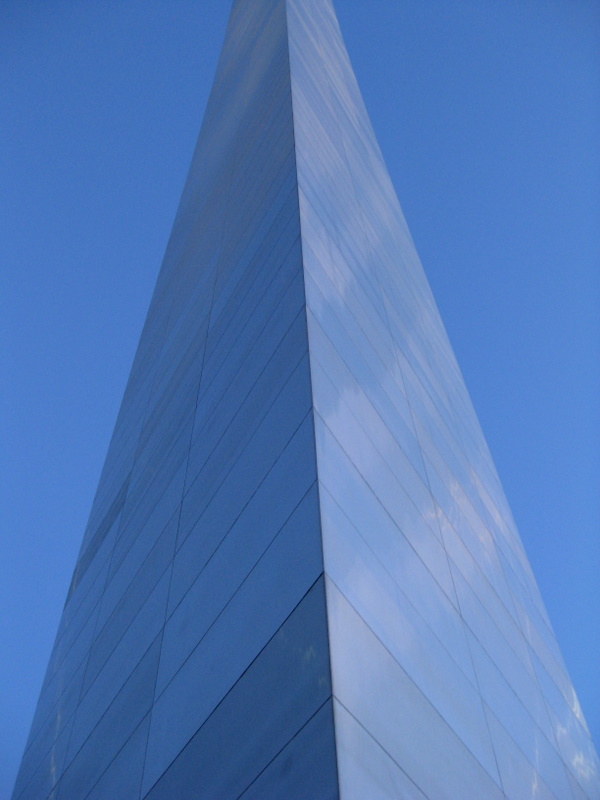
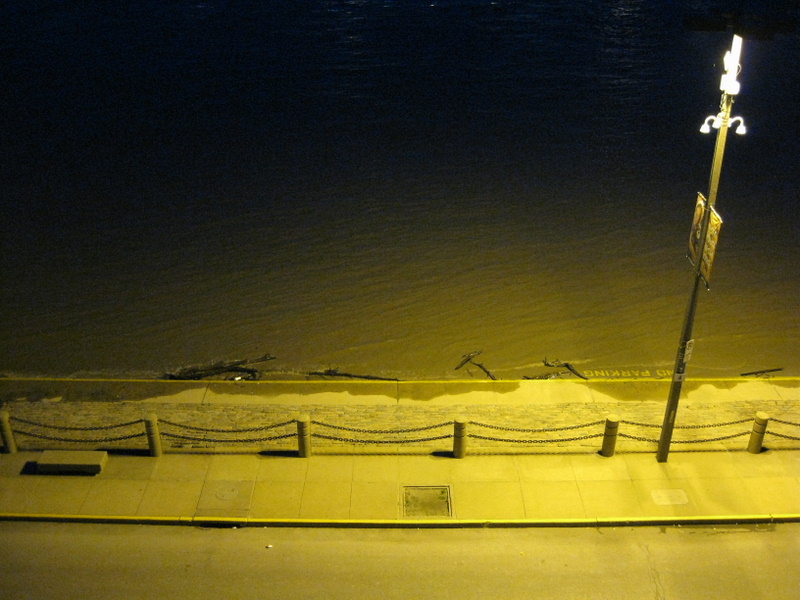
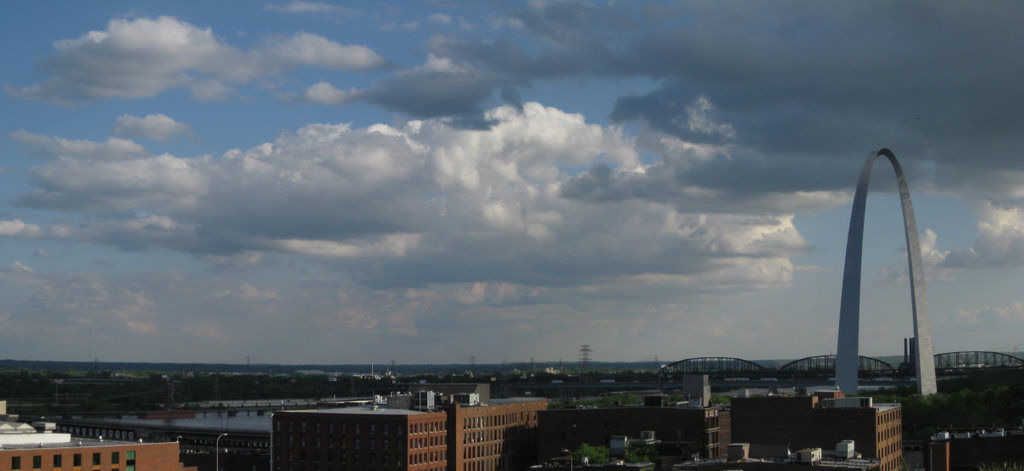
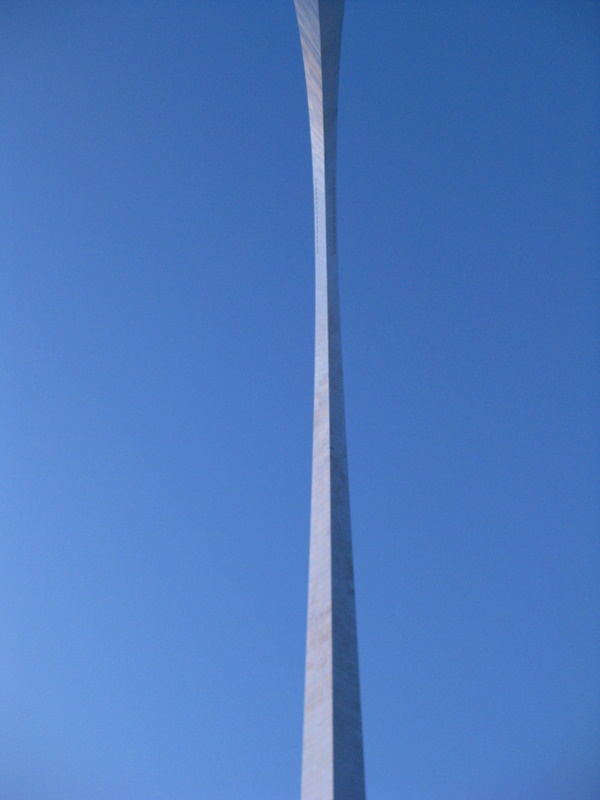
I love photographing the most famous monument in St. Louis, Missouri, the Gateway Arch. I've spent time at the riverfront downtown St. Louis for the past two nights. Last night, it was for a business meeting, where I shot this panorama (click the photos for a expanded views): arch-panorama-2 Tonight, my wife and daughters returned to watch the sun set--the river water was high, making the river look much larger than usual. I focused on the sky, though, including this vertical panorama: stretched-archIt was taken by standing directly under the arch and shooting up. For a thicker version of the arch, move up to within 30 feet of one of the legs and you'll end up with this: thick-legAs the sun went down, I shot this silhouette of the south leg and some of the visitors. south-legShortly thereafter, while walking back to our car, my 11-year old daughter JuJu was struck by the color of the river bank lit by the streetlight. That image is the somewhat eerie ending to this little gallery: streetlightNone of this is difficult to do; it's all there for the taking. BTW, I used a consumer grade camera (the Canon Powershot SD1100IS). For those interested in the geometry of the arch, Wikipedia offers this:

This hyperbolic cosine function describes the shape of a catenary. A chain that supports only its own weight forms a catenary; in this configuration, the chain is strictly in tension. An inverted catenary arch that supports only its own weight is strictly in compression, with no shear. The gateway arch itself is not a catenary, but a more general curve called a flattened catenary of the form y=Acosh(Bx); a catenary is the special case when AB=1. While a catenary is the ideal shape for an arch of constant thickness, the gateway arch does not have constant thickness as it is narrower near the top.

Continue ReadingArch photos

Three political axis

At the Daily Dish, Andrew Sullivan presents Noah Millman's 3-axis political taxonomy system:

liberal vs. conservative (attitudes toward the individual and authority) left vs. right (attitudes toward social/economic winners and losers) progressive vs. reactionary (attitude toward past and future)
My reaction? We need something like this. We need better labels (than "right" versus "left"), to enable better dialogue.

Continue ReadingThree political axis