How to use and save electricity

Mr. Electricity has assembled a straight-forward website full of great ideas and useful links--everything you'll need to understand, use and save electricity. Here's what the site covers, in the words of "Mr. Electricity":

I explain exactly what a kilowatt hour is and how much you pay for one. And I show you how to calculate exactly how much electricity your household appliances use, so you know which items are guzzling the most juice (and which ones are the best targets for savings). You'll also learn exactly how to read your electric meter, if you like. . . . And I not only give you meaningful tips for slashing your electricity consumption, I give you the tools to figure out exactly how much you're saving as well. Finally, I've answered countless questions from readers about saving electricity. If you have a question, it's probably answered here already.
The site offers dozens of illustrations. Oh, and one more time, this is a site geared toward saving electricity. For example, check out this page on "vampire power" demonstrating that many appliances burn more electricity to "run the clock" than to provide the function for which you bought them (e.g., VCRs and microwave ovens). "Mr. Electricity's" real name is Michael Bluejay.

Continue ReadingHow to use and save electricity

Deepwater horizon: an event horizon for the oil age?

In a speech given earlier this year, the Chief Economist for BP made his case that fears about peak oil were overblown.

"One factor is resources. They are limited, and a barrel can only be produced once. But ideas of peak oil supply are not true. Doomsayers have exaggerated the issue. The bell-shaped curve of production over time does not apply to the world's oil resources," he told the seminar in Alkhobar city. "Those who believe in peak oil tend to believe that technology and economics don't matter, and I think this is false.The application of technology, the innovation of new technology and economic forces especially mean that recoverable oil resources can increase. If there is a peak in oil, it will come from the demand side. There are always fears, but these remain overstated and exaggerated."
A barrel can only be produced once, this is true. And technology has allowed us to tap into oil reservoirs that were unthinkable a few decades ago. Yet as the catastrophic ongoing oil geyser in the Gulf of Mexico shows us, technology is not the savior the oil majors would have us believe. Advanced technology may allow us to drill for oil a mile under water, but it obviously does not offer any easy solutions when things go horribly awry as they have on the Deepwater Horizon rig, which has been spewing hundreds of thousands of barrels of oil into the Gulf of Mexico for over a month. [More . . . ]

Continue ReadingDeepwater horizon: an event horizon for the oil age?

The problem with buffeting and choppy fans

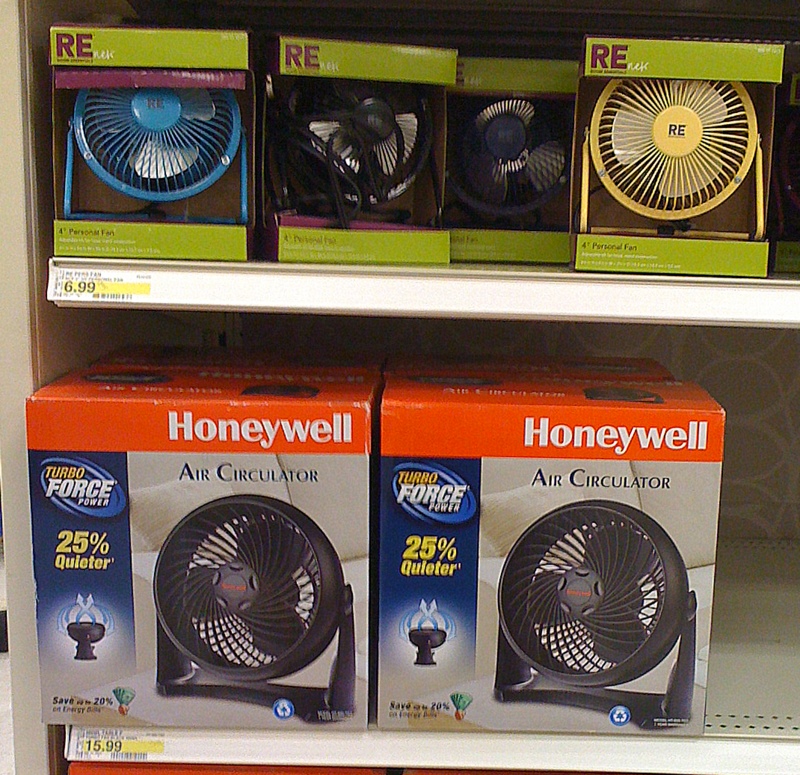
Manufacturers and retailers are great at solving problems we didn’t know that we had. Sometimes, our "problem" is lack of social prestige. Check out this high tech “Air Multiplier” I recently spotted at Target. Here’s what it offers. No blades. No “buffeting.” No “choppy air.” Silly me. I thought that fans were supposed to buffet the air and make it choppy. Now I know, however, that the fans I already own are defective and that I need to fix this problem by purchasing several of these $300 Dyson “Air Multipliers.” Image by Erich Vieth Why would someone buy such an expensive contraption when you can easily buy a decent fan for $15 and a great fan for $75? Geoffrey Miller explains this phenomenon in an incredibly well-written and well-researched book titled Spent: Sex, Evolution and Consumer Behavior. I could write 100 posts commenting on the various sections of Spent; Miller's book is that good. I’m well on my way. See here, for example, and here. Out of curiosity, I visited the Dyson website to see whether this “Air Multiplier” is more energy efficient that a traditional fan. Information about energy usage is conspicuous by its absence on Dyson's site, however. I know enough about marketing that if the Air Multiplier were more energy efficient than traditional fans, this information would be prominently displayed on Dyson's packaging. Along the same lines, note that the Dyson Air Multiplier is "safe," even though all modern fans come with grill designed to keep fingers away from the blades. I they are going spin their product's qualities wildly (no pun intended), they would certainly make sure that we were informed about the Air Multiplier's ability to save energy--if only that were true. [For comparison, I have inserted a few old-fashioned "fans" that you can buy at Target, a few feet down from the throne of the Air Multiplier. As you can see, these fans are considerably cheaper. In fact, for the price of one Air Multiplier, you could buy eighteen $16 fans. ]img_0006 Chapter 7 of Spent is titled “Conspicuous Waste, Precision, and Reputation. In this chapter, Miller convincingly argues that we don’t buy to merely have; rather, many of our purchases are for the purpose of displaying qualities to others. We are very much like peacocks, it turns out. We like to conspicuously waste resources (this is an expensive and thus reliable signal that we have enough resources to waste). We also engage in conspicuous precision, spending lots of money to display that we have not only resources, but also an appreciation of technology that goes far beyond the mental capabilities of those people are willing to settle for those damned buffeting fans.

Continue ReadingThe problem with buffeting and choppy fans

Finish the job, Mr. Obama.

At the NYT, Paul Krugman is making it clear that even Obama rhetoric and mixed-signals are enraging the financial sector. Check out these numbers:

Look, for example, at the campaign contributions of commercial banks — traditionally Republican-leaning, but only mildly so. So far this year, according to The Washington Post, 63 percent of spending by banks’ corporate PACs has gone to Republicans, up from 53 percent last year. Securities and investment firms, traditionally Democratic-leaning, are now giving more money to Republicans. And oil and gas companies, always Republican-leaning, have gone all out, bestowing 76 percent of their largess on the G.O.P. These are extraordinary numbers given the normal tendency of corporate money to flow to the party in power. Corporate America, however, really, truly hates the current administration. Wall Street, for example, is in “a state of bitter, seething, hysterical fury” toward the president, writes John Heilemann of New York magazine.
Therefore, Mr. Obama, finish the job. Your attempts to straddle a middle position has lost most of your financial sector money. Give it up, because it is political crack cocaine. Quickly get behind meaningful financial reform. Use that bully pulpit to show that you really mean it when you speak for regular folks and for main street. Get passionate and loud, if you really mean want to reform Wall Street. I should tell you that I voted for you, but I'm just about to write you off on financial reform. Why aren't you outlawing banks that are too big to fail? Why aren't you pushing furiously for re-enactment for Glass-Steagall?

Continue ReadingFinish the job, Mr. Obama.

Who elected British Petroleum to be our government?

No one elected BP to run any level of American government. But we are a government by the money, not the People, so that is a big invitation to British Petroleum to control entire beaches to prevent the news media from from reporting the full extent of the damage resulting from the Gulf of Mexico oil leakage. Mother Jones reports. In the meantime, most Americans passively sit and watch, along with our politicians, giving a well-documented irresponsible company endless opportunity to operate in relative secrecy while 65 miles of delicate Gulf Coast ecosystem has been ruined by oil. If a "terrorist" with brown skin from the Middle East had caused all of this immense damage, we would have declared yet another "war." But it's a bunch of Caucasian men wearing suits who crapped up the Gulf waters and beaches, and they have given huge amounts of money to Congress, so it's all so very very different . . . And keep in mind that this disaster does not simply affect the Gulf Coast. Did you see the photos of the oil-soaked pelicans? The "White Pelicans" aren't simply "Gulf Coast" birds--they migrate all the way from the Gulf Coast up to Minnesota--it has been quite the spectacle to see them passing through St. Louis twice each year. We'll see how many survive to fly next year. And that's merely one species. There is no reason for trusting that BP will do the clean-up job correctly, putting the environment before its profits. From the Mother Jones article (above), we've seen that BP will "fix" the problem by hiding information. News is now breaking that the oil has now penetrated 12 miles into the Louisiana marshes. I'm feeling sick about this disaster and sick about the lack of action by our federal government--Why is the Obama Administration continuing to defer to the "government" of British Petroleum? As soon as the first drops of oil escaped into the Gulf waters, this was no longer BP's disaster; it became an immense American tragedy. You've heard of "too big to fail." Lots of bank money is making sure that we will continue to have "too big to fail banks." If these Gulf oil rigs are too dangerous to fail, we shouldn't have them either (here's the obvious alternative). But no logic, no evidence and no earnest well-directed passion to preserve the environment will overcome huge corporate election contributions. I'm feeling the frustration of Chris Matthews:

Continue ReadingWho elected British Petroleum to be our government?