
7 billion reasons to consider 7 billion

In the three minutes it takes to view this excellent National Geographic video on the rapidly increasing numbers of people, earth's population will increase by 170 people. That explosive growth has real life ramifications that will affect our quality of life: I applaud the willingness of National Geographic to discuss this critically important issue. Many people and organizations shy away from the topic of the earth's carrying capacity. Another organization dedicated to making sure that we don't shy away from the topic is Global Population Speak Out (GPSO). Here is GPSO mission statement:

The Population Institute, based in Washington DC, is seeking prominent scientists, scholars, and other concerned citizens to participate in this international program of action. The mission is to raise awareness in the global community about the current size and growth of the human population on Earth -- and to highlight the challenges this size and growth present as we attempt to achieve planet-scale ecological sustainability.

I am proud to say that I am Pledger #36.
Continue Reading7 billion reasons to consider 7 billion

Scalia’s Problem

Recently, Justice Antonin Scalia shot his mouth off about another bit of “social” judicial opinion and managed to be correct to a fault again. Here is the article. Basically, he is of the opinion that if a specific term or phrase does not appear in the Constitution, then that subject is simply not covered. Most famously, this goes to the continuing argument over privacy. There is, by Scalia’s reasoning (and I must add he is by no means alone in this—it is not merely his private opinion), no Constitutionally-protected right to privacy. As far as it goes, this is correct, but beside the point. The word “private” certainly appears, in the Fifth Amendment, and it would seem absurd to suggest the framers had no thought for what that word meant. It refers here to private property, of course, but just that opens the debate to the fact that there is a concept of privacy underlying it. The modern debate over privacy concerns contraception and the first case where matters of privacy are discussed is Griswold v. Connecticut, 1965. That case concerned the right of a married couple to purchase and use contraception, which was against the law in that state (and others). The Court had to define an arena of privacy within which people enjoy a presumed right of autonomous decision-making and into which the state had no brief to interfere. Prior to this, the Court relied on a “freedom of contract” concept to define protected areas of conduct. Notice, we’re back in the realm of property law here. People who insist that there is no “right to privacy” that is Constitutionally protected seem intent on dismissing any concept of privacy with which they disagree, but no doubt would squeal should their own self-defined concept be violated. Therein lies the problem, one we continue to struggle with. But it does, at least in Court tradition, come down to some variation of ownership rights—which is what has made the abortion debate so difficult, since implicit in it is the question of whether or not a woman “owns” her body and may therefore, in some construction of freedom of contract, determine its use under any and all circumstances. [More . . . ]

Continue ReadingScalia’s Problem

Big wasted money

I know I've quite recently written about the immense amount of money the United States is pouring into Afghanistan, but this terrible waste of money simply must stop. It occurred to me that the huge amount of money we are spending to fight poor people in Afghanistan needs to be described in terms that make it more understandable to the average American. Imagine that the federal government made a big announcement tomorrow that it would start funding large-scale improvements for each of America's largest 100 cities. In accordance with this new program to build bridges, hire teachers, convert buildings to high energy efficiency and retrain workers (in addition to other things), the federal government would pay each of America's biggest 100 cities $20 million. Imagine this celebration! The citizens of each of these cities would be treated to ribbon-cutting ceremonies complete with large replicas of checks, each of which contains the number $20 million. The mayors of these cities would tell their citizens about all the great things they will be able to do with $20 million. Now imagine that while this celebration is going on, a 10-year-old child walks up to a reporter on the street, tugs at his sleeve, and tells him that something is wrong. The cameras keep rolling as the surprised reporter asks the child what could possibly be wrong with each of America's 100 biggest cities getting a grant of $20 million. The child pulls out a calculator and explains that $20 million times 100 equals only $2 billion. The reporter asked the child what could possibly be wrong with this. The child explains:

$2 billion is what America spends in Afghanistan each and every week. In order to spend a big amount of money on America's 100 biggest cities, an amount equal to the amount we waste in Afghanistan each year, we would need to pay each of America's biggest 100 cities $20 million every week for a year.
The reporter blurts out, "Think of the huge number of teachers and police officers we could hire for that kind of money. $20 million times 50 weeks means that each of American's biggest cities would get $1 Billion. Think of the crumbling bridges we could fix with that. Think of the improve schools, the improved health care and the collective relief we would feel knowing that our hard-earned tax dollars are being used wisely. At that point, the child would again tug at the reporters sleeve and remind him, "We are not spending tax dollars in Afghanistan. It is all borrowed money we are blowing over there. In fact, 42 cents of every dollar spent by the federal government in 2010 is borrowed money. " At that point, the reporter might look at the camera and say something like, "That's it from here tonight. I'm speechless."

Continue ReadingBig wasted money

Doing what is right rather than what is profitable

Barry Schwartz (on whom I’ve posted before) says it’s clear that “we need to rein in the bankers.” What is the solution indifferent, uncaring and selfish individuals and institutions? More rules? More incentives? Barry Schwartz says rules and incentives are not long-term solutions because they de-moralize us. They create large populations of people who do everything for incentives. We become addicted to incentives. Further, there is no set of rules that will effectively get us what we need. Bankers are smart and they will find cracks in any rules. They will find a new way to bring the financial system, once again, to the point of collapse. What we really need is virtue and character --- “we need people who want to do the right thing.” We need “practical wisdom,” the moral will and skill to figure out what the right thing is, and then to do it. Aristotle studied carpenters and other crafts-people who appreciated that you often need to bend the rules to get the job done. Dealing with other people demands flexibility improvisation, and wise people understand this. Wise people do this rule-bending “in the service of the right aims.” We need to do this rule bending in the service of others, not merely ourselves. This is “practical wisdom” in a nutshell. [More . . . ]

Continue ReadingDoing what is right rather than what is profitable

DI traffic

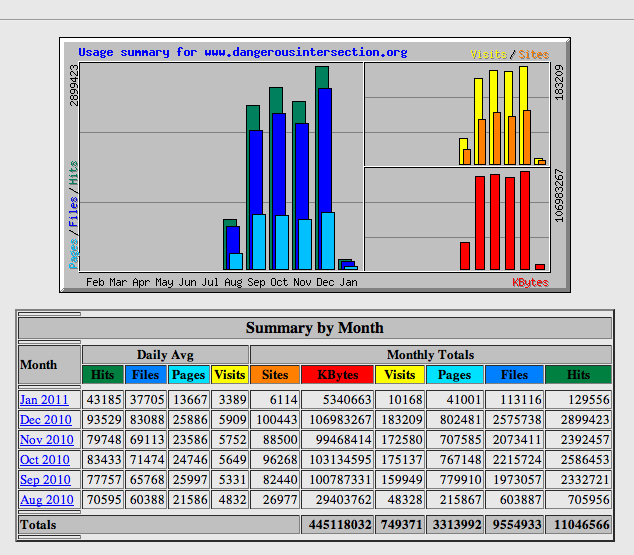
I founded Dangerous Intersection back in March, 2006.  That was 4,500 posts and 21,000 comments ago.  Now that we've reached the end of another year, I decided to check DI's traffic.  We're not a huge site but we're not small either.  I thought readers might find it interesting to see the same stats that I periodically check. Here they are (this is a clickable image): As you can see, we receive almost 6,000 daily visitors these days, which is gratifying and a great honor to each of us who write at this site.  [Note: We changed servers in mid-August, so you will not see the full year's stats in this image]. Thanks to all of you have visited DI or commented at DI over the past year.  Our plan is to keep improving and keep growing.  For those who have not commented before, please do consider leaving a comment, especially if you disagree with us. And happy new year to everyone.

Continue ReadingDI traffic