
Barack Obama does nothing to stop the Comcast-NBC merger

At Huffpo, Josh Silver of Free Press points out the utterly painful trend we've seen regarding the President of "Hope" and "Change."

President Obama is being squeezed by a corrupt Washington that is run by industry lobbyists, fake grassroots groups, massive political spending and PR machines that make the most basic public interest protections impossible to advance. But rather than tell that story, dig in, and fight like a true leader would, Obama has chosen to hire corporate-friendly advisers, compromise on the most crucial substance, and attempt to eke out weak, symbolic, half-victories gift-wrapped in flowery oratory and spin. It's a losing strategy that has become brutally transparent.
But what about all of those protections of the public that the FCC built into the merger terms.
This merger will touch all corners of the media market, and you won't be immune. Comcast will jack up the prices that other cable and online distributers pay for NBC content, and those prices will be passed to you. That means higher cable and Internet bills, even if you don't subscribe to Comcast. Comcast and the FCC Chairman argue that there are "conditions" applied to the merger that protect the public, (details about the conditions are not out yet) but they fail to mention that the key provisions are either voluntary (no, that's not a typo), or expire after a few years. Then, all bets are off, as the merger squeezes out what's left of independent, diverse voices from television dials, and forever changes the Internet as we know it.
Continue ReadingBarack Obama does nothing to stop the Comcast-NBC merger

Wikileaks and a Swiss bank list

On Monday, Rudolph Elmer is said to have turned over to Wikileaks names of US, UK and Asian celebrities, lawmakers and business-folks who may or may not have been trying to avoid paying taxes. Apparently, the data are confusing even to those used to dealing with such, so release won't be soon. Still, it will be interesting to see who is in the Heidi Fleiss Black Book of off-shore accounts. Most particularly if there are any prominent (and current) US lawmakers.

Continue ReadingWikileaks and a Swiss bank list

Eagle days on the Mississippi River

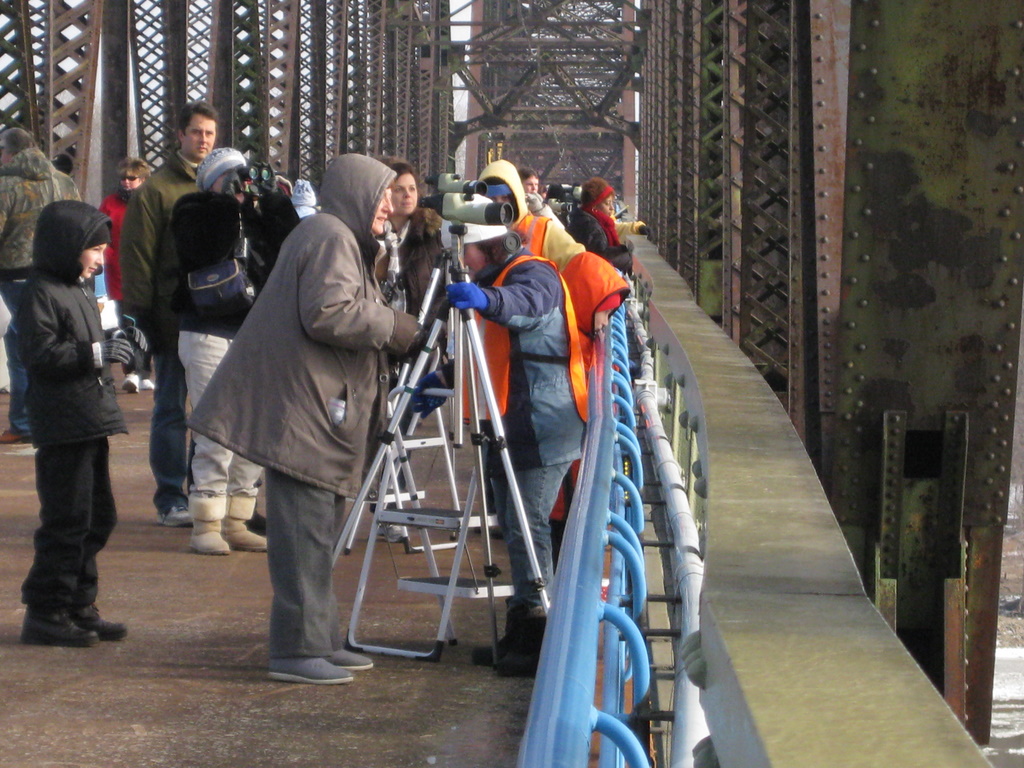
Although St. Louis was founded as a fur trading post, it is no longer well known as a place to view wildlife. But you can still spot wildlife. Yesterday my family traveled about 10 miles north of downtown St. Louis to the "Old Chain of Rocks Bridge," which spans the Mississippi River.

The bridge was for a time the route used by U.S. Route 66 to cross over the Mississippi. Its most notable feature is a 22-degree bend occurring at the middle of the crossing, necessary to allow river traffic to have uninterrupted navigation on the river. Originally a motor route, the bridge now carries walking and biking trails over the river. The bridge was added to the National Register of Historic Places in 2006.

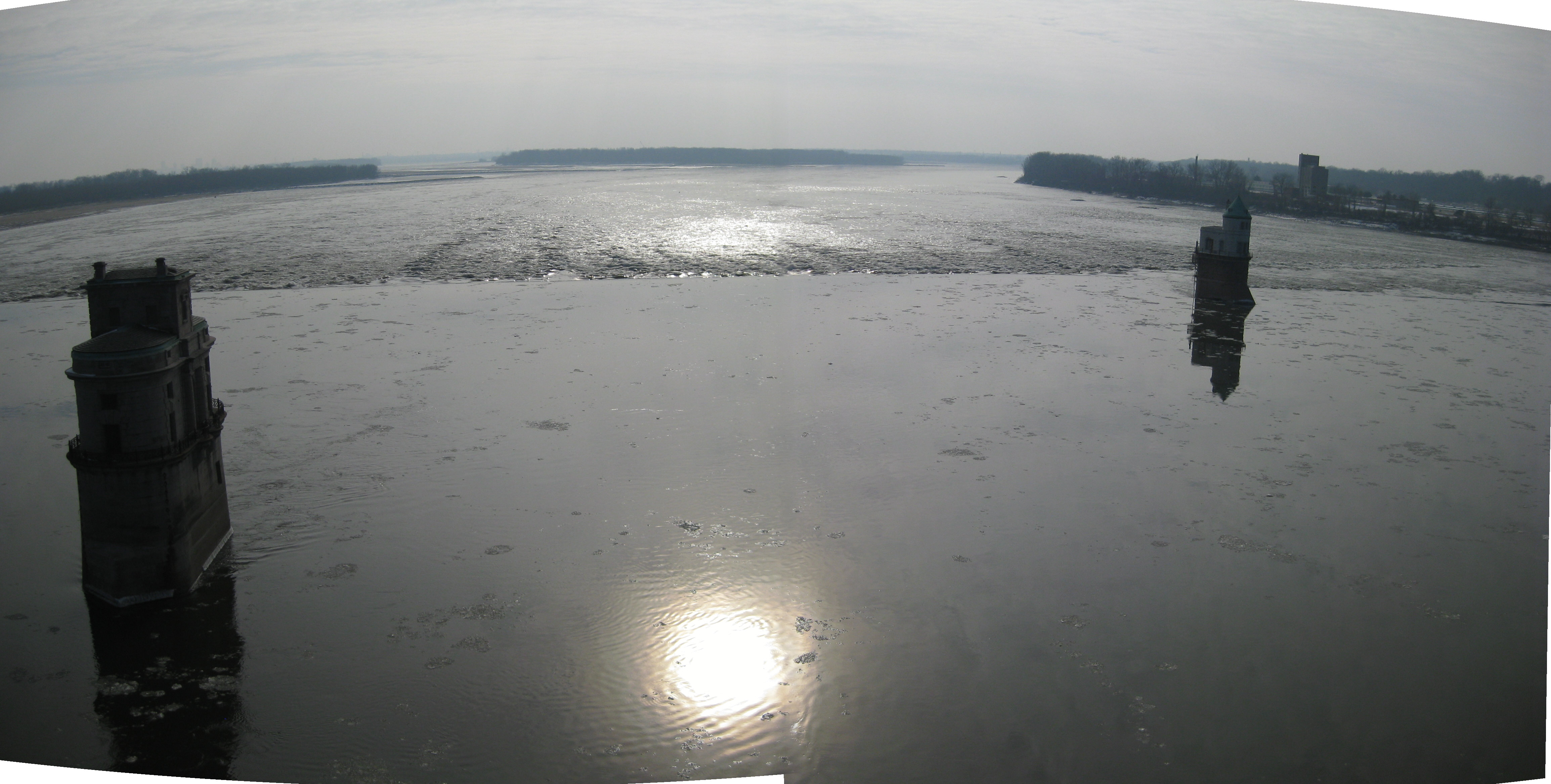
I do need to add that this was a brilliant use of an old narrow bridge. Click on the thumbnail for a panorama showing the view south from the bridge (Downtown St. Louis is on the horizon to the left). The bridge is located in a big wide relatively quiet area (except for one other bridge that runs parallel), where one can enjoy the Mississippi River and the surrounding undeveloped areas, just north of the Chain of Rocks rapids and a bit south of the confluence between the Missouri and Mississippi Rivers. For one weekend each year, this wonderful bridge is featured as the venue for Eagle Days, a prime spot for viewing American bald Eagles. This is rather cool, to be able to spot wild bald eagles right in the heart of the Midwest. Here's a bit more description of their migration relevant to the Mississippi. [More . . . ]

Continue ReadingEagle days on the Mississippi River

What scientific concept would improve everyone’s cognitive toolkit?

This question from The Edge and the dozens of thoughtful answers make for some good reading. Basically, each author picks a single idea they feel is necessary for everyone to "get" in order to understand the world we live in; to have a successful technological civilization. I found this via Pharyngula, who suggested that the Mediocrity Principle may be The One. That is, the basic understanding that we are not the special reason for the existence of the universe. His argument is that basic math skills would help. We're talking about skills that even average college students seem to lack, but are nominally taught to most people who graduate secondary schools. Adjacent to PZ, Sue Blackmore argues for the primacy of understanding that CINAC (Correlation Is Not A Cause). Apparently this lesson is hard to drum into even college students who are nominally studying science. Most of the answers are direct explanations of ideas necessary to scientific understanding. But a few are more of the "what would be nice to discover" variety. But go see for yourself. There are many insightful replies to this question by 160 authors.

Continue ReadingWhat scientific concept would improve everyone’s cognitive toolkit?

Emergent consciousness

In the December, 2010 edition of Discover Magazine, neuroscientist Antonio Damasio sets forth his understanding of human consciousness. Damasio has recently published a new book on this topic, Self Comes to Mind. Here's a short excerpt from page 66 of his deeply thought-provoking article at Discover (not available yet online):

Conscious minds result from the smoothly articulated operation of several, often many, brain sites. The ultimate consciousness product occurs from those numerous brain sites at the same time and not in one site in particular, much as the performance of a symphonic piece does not come from the work of a single musician or even a whole section of an orchestra. The oddest thing about the upper reaches of a consciousness performance is the conspicuous absence of a conductor before the performance begins, although as the performance unfolds, a conductor comes into being. For all intents and purposes, a conductor is now leading the orchestra, although the performance has created the conductor--the self--not the other way around. Building a mind capable of encompassing one's lived past and anticipated future, along with the lives of others added to the fabric and the capacity for reflection to boot, resembles the execution of a symphony of Mahlerian proportions. But the true marvel is that the score and the conductor become reality only as life unfolds. The grand symphonic piece that is consciousness encompasses the foundational contributions of the brainstem, forever hitched to the body, and the wider-than-the-sky imagery created in the cooperation of cerebral cortex and sub cortical structures, all harmoniously stitched together, is ceaseless forward motion, interruptible only by sleep, anesthesia, brain dysfunction, or death.
Damasio, well known for his groundbreaking work in his early book, Descartes's Error, takes special care to describe the complexity of the mind, the marvel of this emergence of consciousness, and he specifically points out the importance of the emotions for a thorough understanding of consciousness: Emotions are complex, largely automated programs of actions concocted by evolution. The actions are carried out in our bodies, from facial expressions and postures to changes in viscera and internal millieu. Feelings of emotion, on the other hand, are composite perceptions of what happens in our body and mind when we are emoting. As far as the body is concerned, feelings are images of actions rather than actions themselves. While emotions are actions accompanied by ideas and certain modes of thinking, emotional feelings are mostly perceptions of what our bodies do during the emoting, along with perceptions of our state of mind during that same period of time. [More . . . ]

Continue ReadingEmergent consciousness