[M]usic can activate the same reward circuits in the brain as food and sex.
Participants listened to their songs of choice in a PET scanner, which detects the release of the feel-good neurotransmitter dopamine, and again in an fMRI scanner, which measures brain activity. The scans showed that just before feeling enjoyable chills in response to the music, listeners experienced a dopamine rush near the frontal striatum, a brain region associated with anticipating rewards, followed by a flood of dopamine in the rear striatum, the brain’s pleasure center. “It’s like you’re craving the next note,” Salimpoor says.
Here's the study. I've also noted from my "anthropological" visits to Christian churches (here, for example), that people tend to sense the presence of Jesus during those emotional peaks that occur in the middle of religious music. You can tell, because people start waving their hands in the air during those emotion-inducing parts of the music. I've also noticed that Jesus becomes more intense when a song modulates to a new key. Seems that Jesus likes the same aspects of music as his human worshipers.
The Super PAC launched Thursday by the satirist Stephen Colbert and blessed by the Federal Election Commission is a terrible idea.
It makes a mockery of our campaign finance laws, inviting politicians of all stripes to launch their own Super PAC-linked TV "news" shows and then use those programs to raise buckets of money from corporations, labor unions and other special interests.
It’s the sort of thing Common Cause has always been against. We hate it.
And it’s positively brilliant!
But "...inviting politicians ... to launch their own... TV 'news' shows..."??? What if we flip it, and TV "news" shows launch their own politicians?
Uh, oh. Too late.
This video made me do a double-take. How are these children able to play such big guitars so well? The little girl in the middle is the one to watch extra closely.
The music is certainly precisely played. For many years I taught guitar lessons, and I could never teach such a young child to confidently play a bar chord (you'll see a few of these in this video). I'm stunned and staggered and delighted to see and hear the music, but a little wary about how hard these children had to be pushed to reach this performance level. I'd love to know more about the teaching methods . . .
Dave deBronkart learned that he had renal cancer in 2006. From his doctor and from many internet resources, he heard that his death was imminent. Then, he hooked into an internet network of renal cancer patients, where he learned about a scientific (but not well-known) treatment that offered him a chance. He pursued the treatment and had a great result. He became an e-patient, a patient who became empowered because he acquired access to important data. Now, 4 years later, he gave the following TED talk, and you'll see that he's very much alive and kicking.
I recent had a similar experience, though not in nearly as serious a situation as Dave's. I was diagnosed by two doctors with "tennis elbow." I don't play tennis, but I play the guitar, and I suspect that that strumming was the precipitating cause for me. About three months ago, before I noticed any problem, I assumed that tennis elbow was irritating, but that it quickly went away when you stopped engaging in the causative activity. The two doctors I consulted told me otherwise. They said that tennis elbow lasted for as long as a year, or more, and that it can be disabling. They said that you simply take aspirin and rest it, that it is a long drawn out problem and that there is not much else you can do about it. I "confirmed" this first-hand, when I stopped playing the guitar for two months, but the condition did not get any better. I bought two types of arm wraps at the drug store and I wore one or the other for weeks. My arm remained extremely weak. For instance, I could not lift a heavy book with the affected arm. When someone shook my hand, I felt excruciating pain at the elbow.
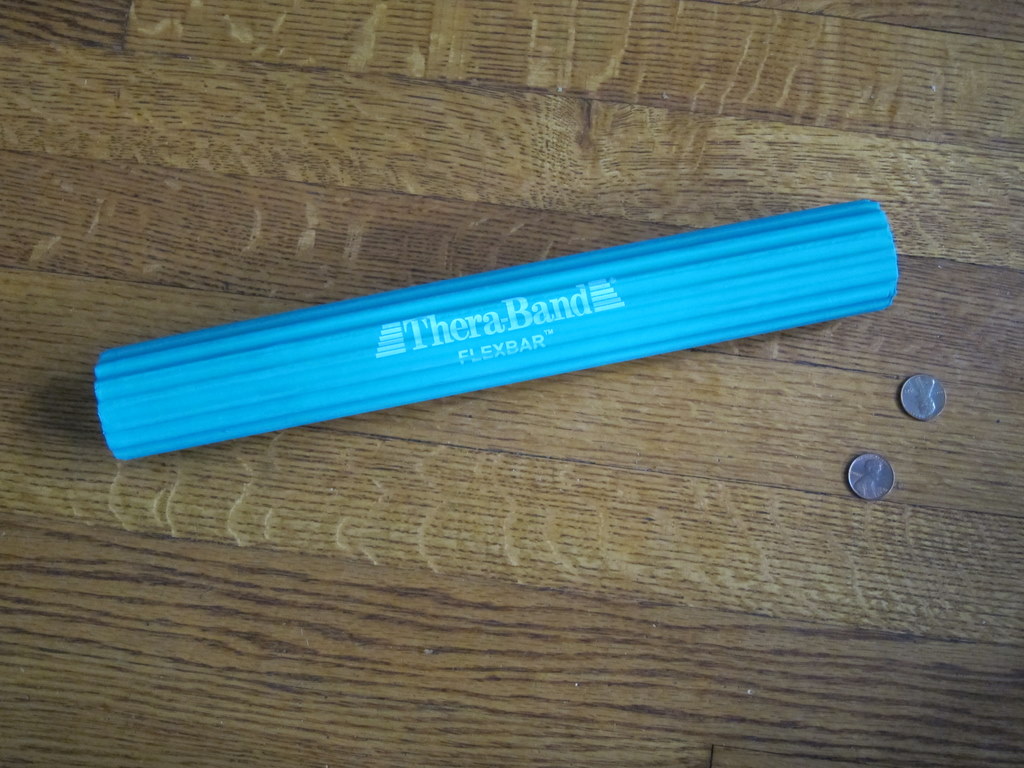
Like Dave, I refused to stop searching for a better answer. I took to the internet, and about three weeks ago I found what appears to be a cure. It's a rubber bar that costs $15:
[caption id="attachment_18575" align="aligncenter" width="300" caption="Thera-Band FlexBar"][/caption]
I've been doing the simple exercises for two weeks (click this link and watch the short video demonstrating the exercise); it's amazingly simple and it takes less than 10 minutes per day. My pain has decreased by 95% and my strength has probably tripled, even though I'm taking only one over-the-counter Naproxen per day. This is a scientifically-designed and tested remedy, which suits me fine. In fact, the device and exercise was being tested in a double-blind study that was so incredibly successful that the experimenters stopped the study in mid-stream and gave all of the patients rubber bars. It pains me to think of all of the victims of "tennis elbow" out there who are suffering with the pain needlessly because their doctors are telling them what my doctors told me.
I have no interest in any form of voodoo, such as homeopathic medicine, and you'll hear a lot about these unscientific treatments on the Internet. This post is not about unproven and unscientific remedies. What you heard from Dave (and from me) is that there are often effective and proven remedies out there, and that you will not learn about from your doctor. I agree with the main point made by Dave, that we need better methods for sharing information regarding successful treatments that are already out there. E-patients, unite!
President Barack Obama recently suggested that America's wars had cost $1 trillion. Reuters suggested that Obama is not being forthright:
Staggering as it is, that figure grossly underestimates the total cost of wars in Iraq, Afghanistan and Pakistan to the U.S. Treasury and ignores more imposing costs yet to come, according to a study released on Wednesday. The final bill will run at least $3.7 trillion and could reach as high as $4.4 trillion
The study referred to is this one, by Costs of War. Unlike your local newspaper or your local TV news, this is website that pulls no punches. Here are some of the findings:
While we know how many US soldiers have died in the wars (just over 6000), what is startling is what we don’t know about the levels of injury and illness in those who have returned from the wars. New disability claims continue to pour into the VA, with 550,000 just through last fall. Many deaths and injuries among US contractors have not been identified.
At least 137,000 civilians have died and more will die in Afghanistan, Iraq, and Pakistan as a result of the fighting at the hands of all parties to the conflict.
The armed conflict in Pakistan, which the U.S. helps the Pakistani military fight by funding, equipping and training them, has taken as many lives as the conflict in neighboring Afghanistan.
Putting together the conservative numbers of war dead, in uniform and out, brings the total to 225,000.
Millions of people have been displaced indefinitely and are living in grossly inadequate conditions. The current number of war refugees and displaced persons -- 7,800,000 -- is equivalent to all of the people of Connecticut and Kentucky fleeing their homes.
How disproportionate has been America's response to the 9/11 attacks? Reuters offers this:
What followed were three wars in which $50 billion amounts to a rounding error. For every person killed on September 11, another 73 have been killed since.
Hello, I invite you to subscribe to Dangerous Intersection by entering your email below. You will have the option to receive emails notifying you of new posts once per week or more often.