
The Problem with “Culturally Responsive Education” (CRE) and Other Variants of Neoracism

Dana Stangel-Plowe of the Foundation Against Intolerance and Racism (FAIR) explains:

In our latest video, FAIR’s Dana Stangel-Plowe discusses the issues surrounding a new academic theory called “Culturally Responsive Education.” While intended to connect students with their educational material on a deep level, Stangel-Plowe explains how this new method achieves the opposite by assuming people who superficially look like one another must also think like one another.

[T]he idea of providing kids books that feature characters who look like them feels intuitive as a way to connect them to the material; but building curriculum around students’ skin color, ancestry, or gender raises serious questions about the very purpose of education in our diverse and pluralistic nation.

By making assumptions about what will engage students based on race or immutable traits, CRE is racist. The idea that all people who share the same group identity would also share the same interests, experiences, or beliefs is reductive and demeaning to the unique human beings in that group.

Stangle-Plowe offers a more detailed analysis at FAIR's website:

Despite what some of its proponents would have us believe, CRE is much more than simply a framework for student-centered learning and a celebration of different cultures and cultural ways of knowing. CRE’s focus on “power dynamics,” “social change,” “liberation,” and “equitable outcomes” plainly reveal that critical pedagogy is baked into CRE. Critical pedagogy, popularized by Paolo Freire, is the Marxism-derived school of critical theory applied to education. Thus, it designates K-12 classrooms as the place to start a revolution to dismantle the dominant power structures—meaning our current systems of liberal democracy. Critical pedagogy is explicitly a political ideology—similar to other illiberal ideologies that focus on “liberation” and seek equality of outcomes—aiming to turn students into revolutionary activists.

With CRE becoming widespread, we must consider: Is there a better way to leverage student engagement for success across cultures? And, most importantly, how do we ensure that all students, regardless of their group identities, become “classroom insiders” without dehumanizing them or flattening them into stereotypes—and without replacing learning with activism?

It seems that we are mastering the art of slicing and dicing people culturally in much the same way that Google, Facebook and Amazon are using Billy Ball analytics on their customer bases. I see no problem categorizing people by their interests, such as knitting, pickle ball or art. The problem is with dividing people by irrelevant categories, such as the way they look or (often) the place where they were born. CRE assumes that people are "stuck" in these irrelevant categories and they they want more and more of the same. As Stangle-Plowe states, this is insulting and destructive. I'm proud to say that I am constantly learning many wonderful things from people who look different than me. I'm also proud to say that I don't obsess over what a person looks like. CLE is a well-meaning but destructive to the American Dream that we are one people who can work and play together. E pluribus unum.

Evaluating people based on superficial characteristics is inaccurate and lazy.  We need to avoid all miscategorizations, of course. Because people are extremely complex, it makes no sense to judge them on "race," sex or national origin any more than it would to determine who they are based on astrology.

Our cultural dysfunction based on insanely off-target miscategorizations needs to be cut off at the root, as suggested by Sheena Mason:

FAIR is

a nonpartisan organization dedicated to advancing civil rights and liberties for all Americans, and promoting a common culture based on fairness, understanding and humanity.

In conclusion, I am including FAIR's Principles of Peaceful Change:

FAIR Principles of Peaceful Change

Based on Dr. Martin Luther King Jr.'s Principles of Nonviolence

Exercise Moral Courage. Telling the truth is a way of life for courageous people. Peaceful change cannot happen without a commitment to the truth.

Build Bridges. We seek to win friendship and gain understanding. The result of our movement is redemption and reconciliation.

Defeat Injustice, Not People. We recognize that those who are intolerant and seek to oppress others are also human, and are not evil people. We seek to defeat evil, not people.

Don’t Take the Bait. Suffering can educate and transform. We will not retaliate when attacked, physically or otherwise. We will meet hate and anger with compassion and kindness.

Choose Love, Not Hate. We seek to resist violence of the spirit as well as the body. We believe in the power of love.

Trust in Justice. We trust that the universe is on the side of justice. The nonviolent resister has deep faith that justice will eventually win.
Continue ReadingThe Problem with “Culturally Responsive Education” (CRE) and Other Variants of Neoracism

Intolerance of Viewpoint Diversity at Colleges

From a NYT op-ed by Emma Camp, "I Came to College Eager to Debate. I Found Self-Censorship Instead."

“Viewpoint diversity is no longer considered a sacred, core value in higher education,” Samuel Abrams, a politics professor at Sarah Lawrence College, told me. He felt this firsthand. In 2018, after he published an Opinion essay in The Times criticizing what he viewed as a lack of ideological diversity among university administrators, his office door was vandalized. Student protesters demanded his tenure be reviewed. While their attempts were unsuccessful, Dr. Abrams remains dissatisfied with fellow faculty members’ reactions. In response to the incident, only 27 faculty members signed a statement supporting free expression — less than 10 percent of the college’s faculty.

Continue ReadingIntolerance of Viewpoint Diversity at Colleges

Education Schools as the Incubators of Wokeness

An excerpt from a recent article written by Peter Boghossian and Lyell Asher. The article is titled: "Ed Schools: Weak Academics & Woke Politics: "Why Colleges Are Becoming Cults."

So it's no surprise that the most blatant attempts at censorship and indoctrination on college campuses have come primarily from administrators trained in institutions—ed schools—which combine both of the characteristics I just mentioned. Low academic standards—can't debate, and high-octane political orthodoxy—won't debate.

. . .

[O]ut of the five studies he looked at, four of them showed that students pursuing education degrees had the absolute lowest scores. That was the finding of the Army Classification Test from 1946, the Selective Service test from 1951, the Project Talent tests from the 1970s, and the test for admission to graduate school (otherwise known as the GRE) in the early 2000s.

The only exception was the Scholastic Aptitude test of 2014. On that test, students who indicated a primary interest in education came in next to last place—14th out of 15. In addition to their weakness in academics, ed schools are just as notorious for their woke political orthodoxy.

Continue ReadingEducation Schools as the Incubators of Wokeness

New Charter School Focuses on Free Speech and Individual Achievement

Twenty years ago, who would have ever thought that this type of curriculum would have been a new direction, controversial or necessary? FAIR reports:

Ian Rowe believes in teaching students four cardinal virtues: courage, justice, wisdom, and temperance. These qualities make up the core curriculum at his forthcoming International Baccalaureate public charter high schools in the Bronx, set to open in 2022. A product of New York City’s public school system himself, Rowe is determined to give parents an option that promotes classic ideas about equality that many still believe can work.

“The schools will be grounded in the ideas of equality of opportunity, individual dignity and our common humanity,” says Rowe. “They're schools that will be dedicated to this idea of democratic discourse, our ability to debate across differences, where we won't reduce kids to individual, immutable characteristics. We won't reduce kids to just characteristics like race or gender, but instead treat each student as individual human beings with great capacities to achieve.”

Rowe's program seeks meaningful progress in the ability of students to survive in the real world:

“I think a lot of [these debates are] a massive distraction from some fundamental issues facing kids of all races in our country,” said Rowe. “It's still the case that less than 40 percent of all kids in our country are reading at grade level. This is a massive literacy crisis. Things like Critical Race Theory and DEI have nothing to do with improving outcomes for children and take attention away from important factors like family structure, having school choice, the ability for parents to choose great schools, really empowered curricula that's rigorous in nature, the science of reading. You know, these are the factors that really determine whether or not kids are going to be successful.”

Continue ReadingNew Charter School Focuses on Free Speech and Individual Achievement

Our Modern Tower of Babel

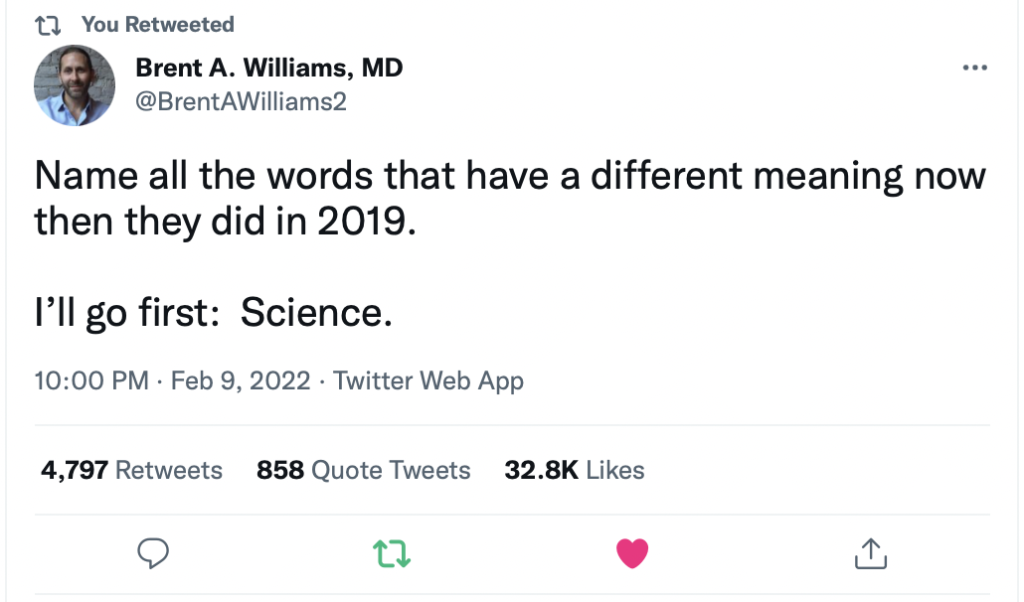
This is a riveting and disheartening tweet-thread, begun when Brent Williams asked a rather simple question: "Name all the words that have a different meaning now then they did in 2019."

Check out the thread. Many of these suggestions seem spot-on. No wonder we have such a difficult time talking with each other. No wonder so many have given up trying to converse with people from other tribes. We are living in modern-day Babbel. Here are some of the many candidates mentioned in the tweet-thread:

Dangerous Conversion Therapy Woman. Man. Phobia Healthy Vaccine Science Freedom Pandemic Insurrection Vaccine Racism and Racist Gain of Function Public health expert Gender Misinformation Left Wing and Right Wing, Liberal and Conservative Peaceful Violence Fact-Checker Truth Equality Fascist Conspiracy Theory Safe Trusted Freedom Infrastructure Progressive Fact Anti-vaxxer Inclusion Diversity News Reporting Tolerance

Continue ReadingOur Modern Tower of Babel