John Cleese Puzzles over Wokeness with Helen Pluckrose
Helen Pluckrose offers an excellent wokeness primer to John Cleese:
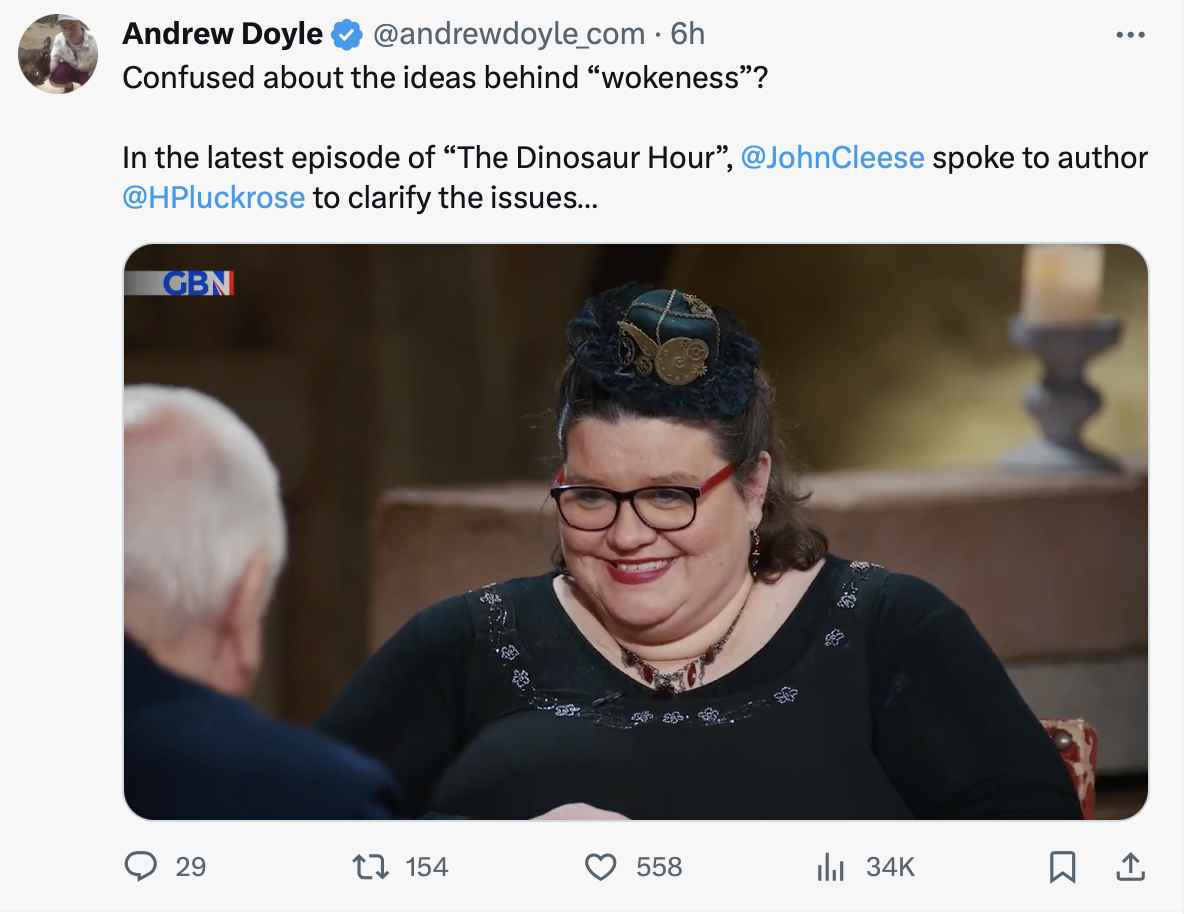

Helen Pluckrose offers an excellent wokeness primer to John Cleese:
The Nashville mass killings were a big national story covered by all major news outlets. A vicious person gunned down three children and three adults at a school in Nashville. Immediately after the shootings, all of us wanted to know why the shooter fired 152 rounds, murdering six people. Back on April 3, CNN reported that the police "have yet to determine a motive."
But then, oops, we learned that the shooter was a trans person, meaning that lots of special rules kick in. The main rule: Even though the shooter wrote a long manifesto, it's important that we keep the manifesto secret. Government officials and corporate media outlets have marched in lockstep ever since.
Thus, at at NPR or MSNBC, you won't learn anything about the fact that three pages of the shooter's manifesto have been leaked. Back near the time of the killings, however, on March 28, 2023, MSNBC wrote:
A day after Monday’s shooting at The Covenant School in Nashville, we know much more about the shooter and the dead. But one question remains: “Why?” Why this school, why these victims, why was the shooter motivated to take these lives? The search for a motive is a logical one. There’s a deep desire to understand what pushed a person to carry out such a heinous crime, especially when three children are dead.
Now that three pages of the manifesto have been leaked, MSNBC no longer has any interest in sharing with us what the murderer wrote on those pages.
NYT, CNN and WaPo published stories reporting that several pages were leaked and that they are authentic, but none of these three outlets offer any specifics about what the three pages reveal. No quotes and no images of those pages. The NYT focuses on how upset government officials are that three pages were leaked (without describing the content of the leaks). CNN focuses on the alleged fears of some parents that release of the manifesto will harm people, including by "copycat attacks." CNN sanitizes the leaked pages, saying only:
The released pages use hate-filled language directed toward the school and children and include what appears to be a timeline of events seemingly leading up to the shooting.
And here's Google/YouTube, once again keeping us safe from knowing important things, such as the motives of mass killings, as Seth Dillon attempted to report:
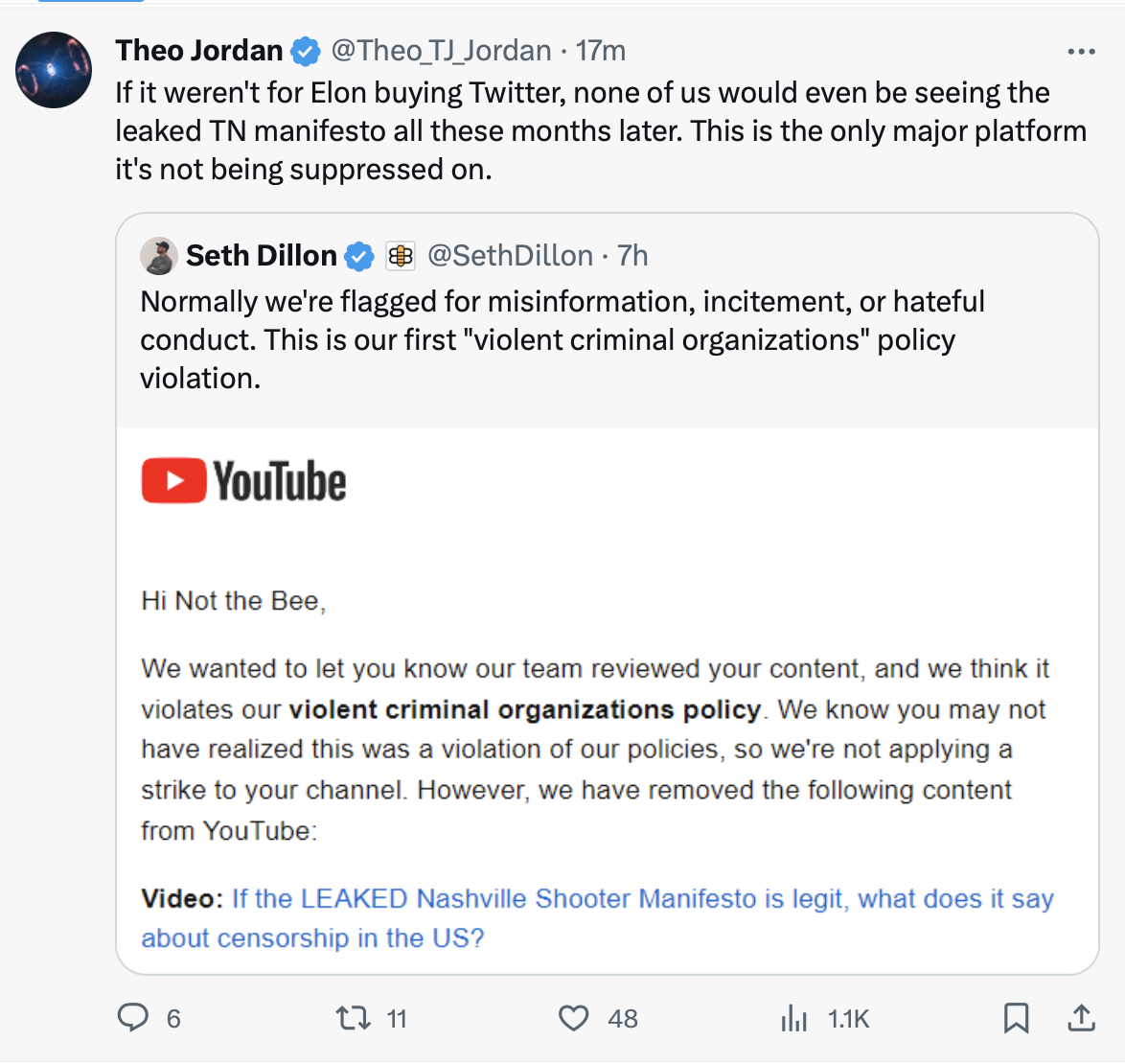
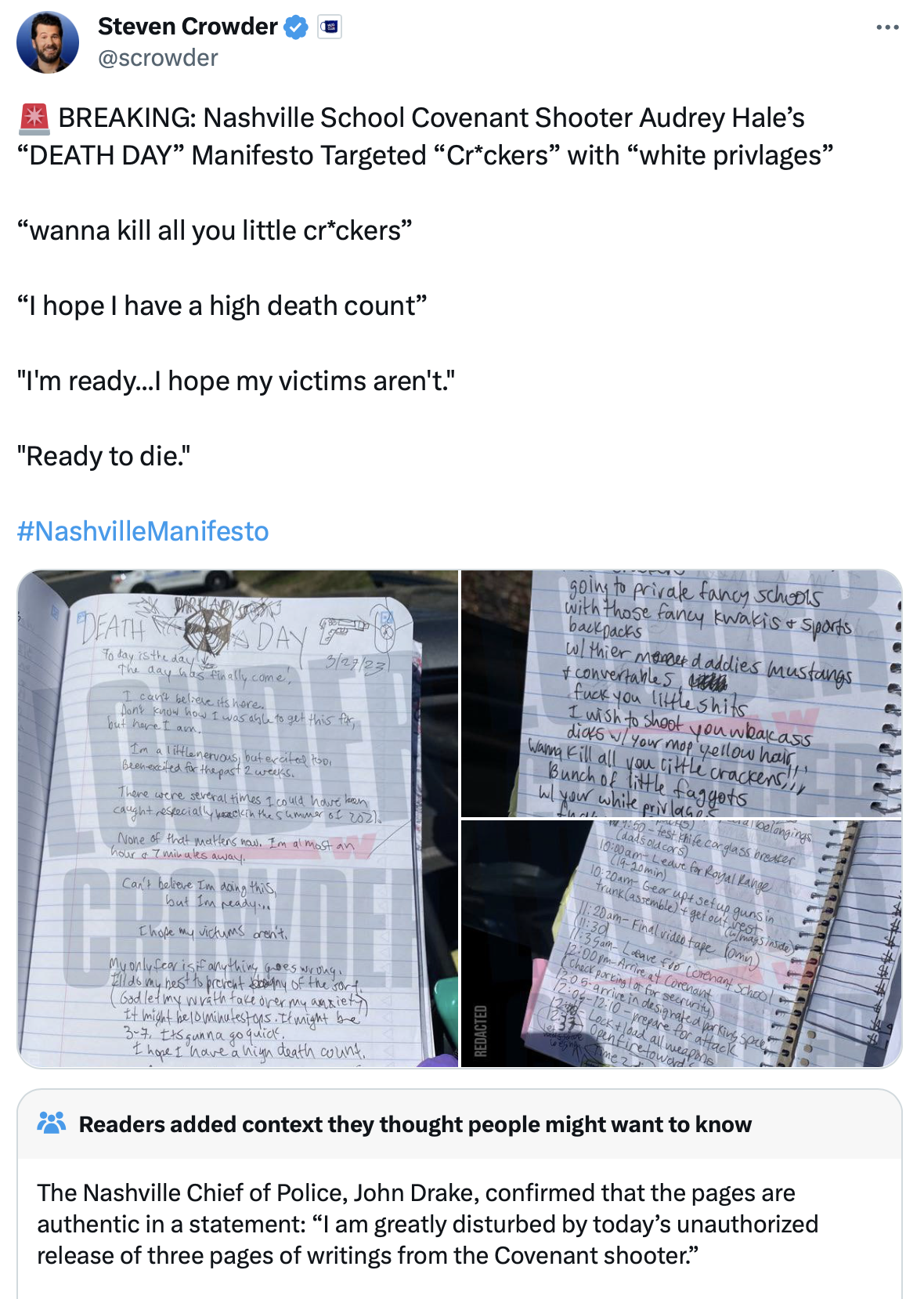
What do we know from those three pages? To actually know the words the killer wrote, we need to turn to X (formerly Twitter): Steven Crowder writes:
BREAKING: Nashville School Covenant Shooter Audrey Hale’s “DEATH DAY” Manifesto Targeted “Cr*ckers” with “white privlages”
“wanna kill all you little cr*ckers”
“I hope I have a high death count”
"I'm ready...I hope my victims aren't."
"Ready to die."
At The Free Press, Greg Lukianoff and Rikki Schlott explore how it came to be that so many American Colleges have come to embrace canceling and censorship rather than free speech. Here is an excerpt from "How American Colleges Gave Birth to Cancel Culture: A new book shows how universities first embraced a system of social punishment that now pervades our everyday lives":
The First Amendment wasn’t created to protect the interests of the rich and powerful. After all, the moneyed and influential have historically been protected by their wealth and power. And the United States didn’t need a special right to protect the will of a majority—that’s what democratic votes are for.
In the end, the First Amendment is primarily needed to protect minority views, unpopular opinions, and the expression of those who clash with the ruling elite.
But on campus today, you’re likely to hear this argument turned entirely on its head—as if championing free speech is somehow doing the bidding of the powerful. But that’s only because academia doesn’t like to admit that it actually is extremely wealthy and influential itself, or that those who defend the status quo are defending an extraordinarily powerful American industry. . .
From a purely financial perspective, the higher education apparatus is among the wealthiest and most influential institutions in the world. But you wouldn’t know that from the way many in academia try to position themselves. Colleges and universities are far from the humble academic hubs they claim to be, but many in higher education have a hard time admitting it’s been a long while since they were the underdogs.
Academia’s free speech skepticism is part of a long history of powerful people undercutting the First Amendment. Given that elites seldom like limitations on their power (and particularly on their power to censor), it shouldn’t come as a surprise that the First Amendment was limited by judges and politicians from the very moment of its inception.
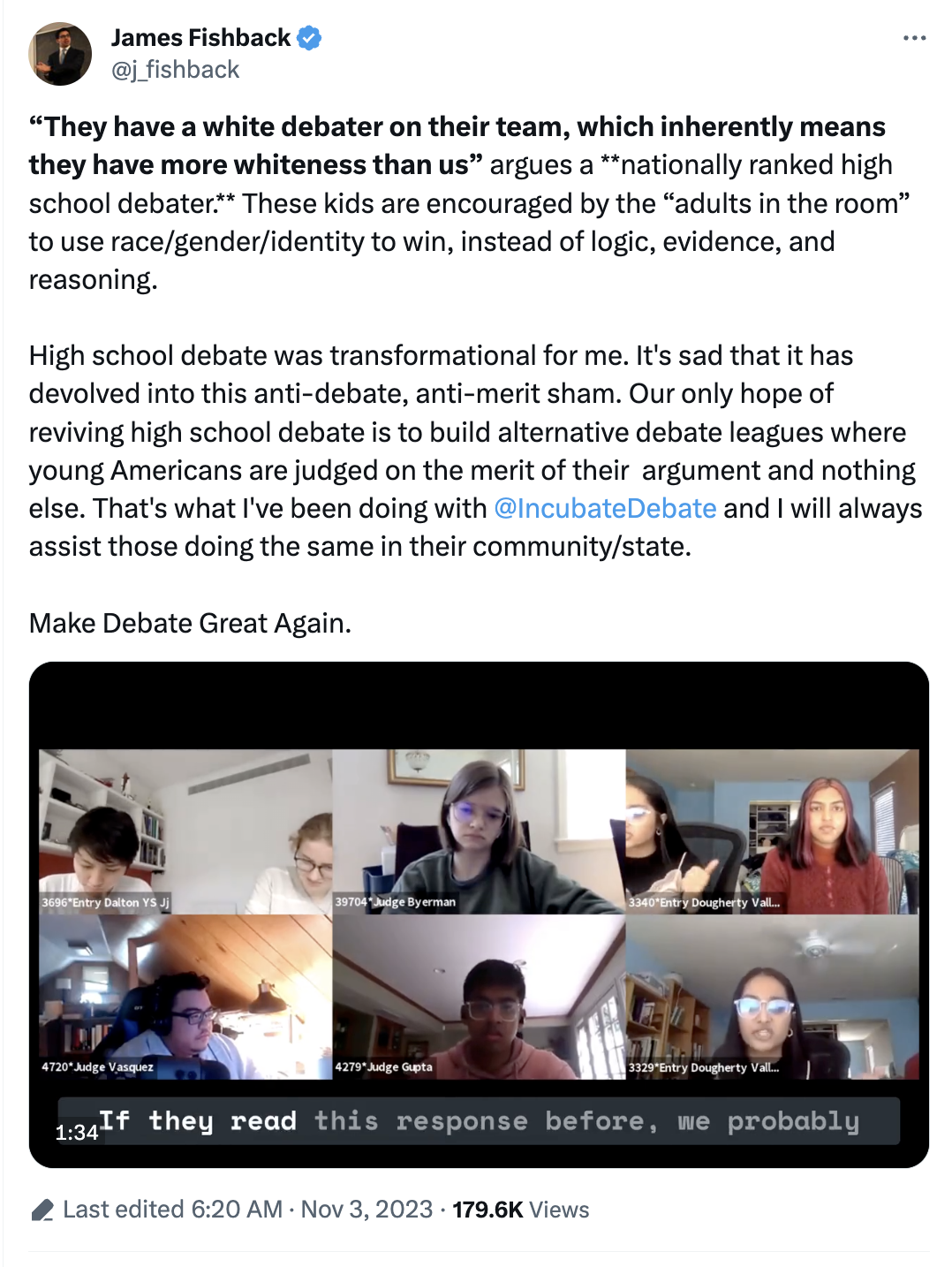
Meanwhile, a nationally ranked high school debater displays her oratory skills . . .
From David Sachs:
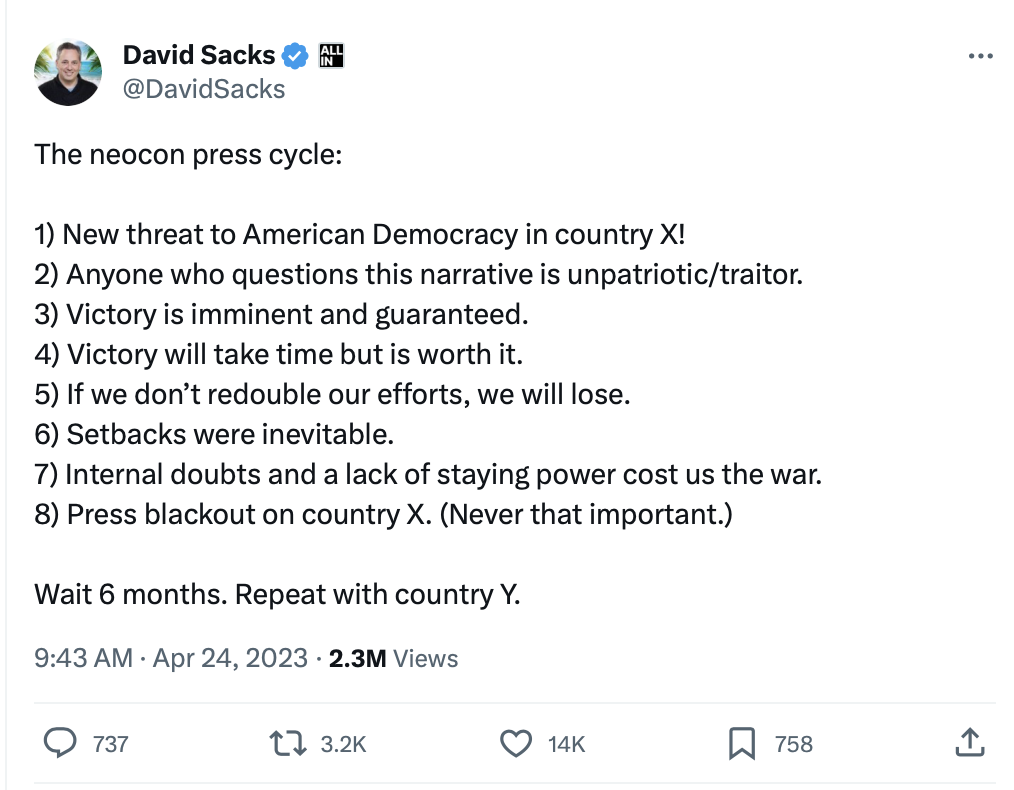
The neocon press cycle:1) New threat to American Democracy in country X! 2) Anyone who questions this narrative is unpatriotic/traitor. 3) Victory is imminent and guaranteed. 4) Victory will take time but is worth it. 5) If we don’t redouble our efforts, we will lose. 6) Setbacks were inevitable. 7) Internal doubts and a lack of staying power cost us the war. 8) Press blackout on country X. (Never that important.)
Wait 6 months. Repeat with country Y.
In case you are looking for a detailed definition for "neocon."