
My Plight: Burning Hours to Dissect Dumb Ideas with Precision

Claire Lehmann is Editor of Quillette. She nailed it in the Tweet below.
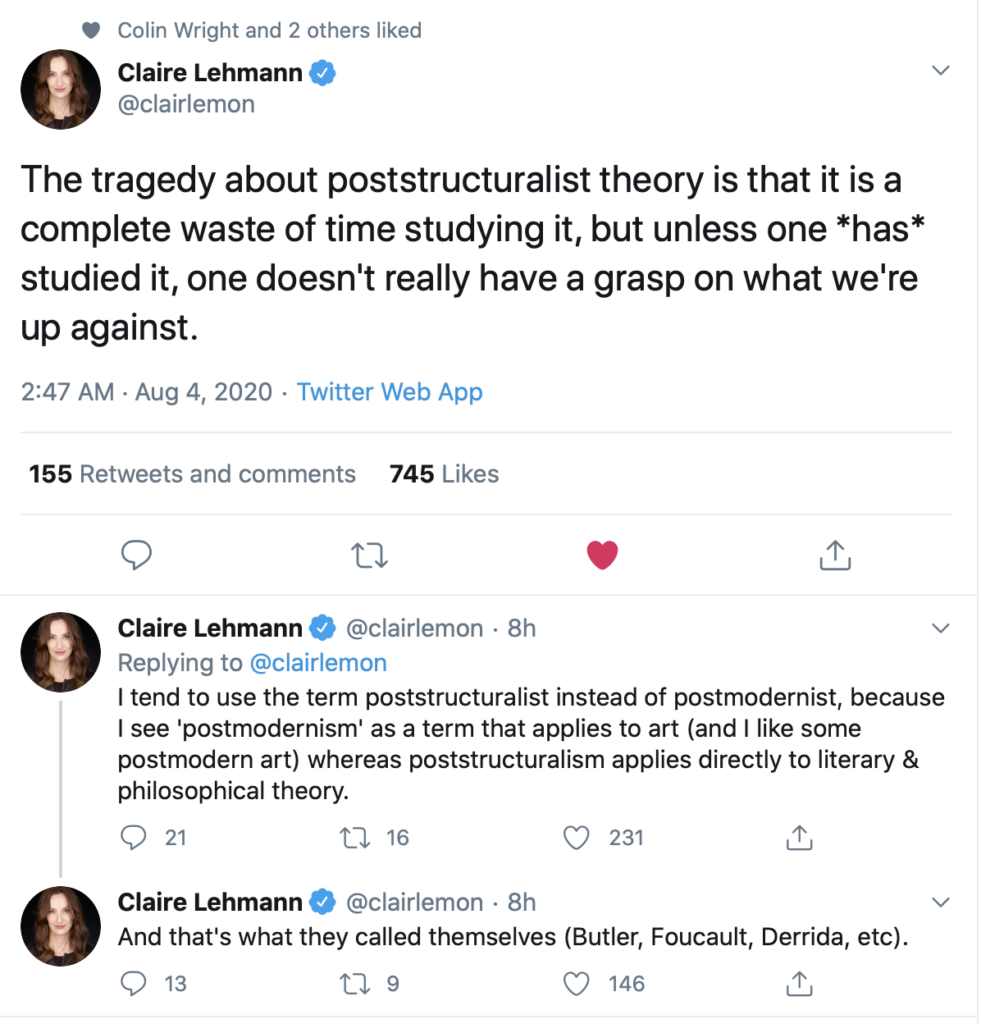
The Woke movement (she terms it "post-structuralist" thought) is a fermenting vat of vague, self-contradictory claims, much of them unhinged from the analytical evidence-based Enlightenment tradition that has proven itself by sending people to the moon. Wokeness functions as a Trojan horse; it looks like something good, but functions to disarm skeptical analytical thought. It functions much like fundamentalist religion, elevating raw feeling above analytical thought.

We need to meet Wokeness on its own terms if we are to show where it has gone astray. The challenge is that it requires a substantial investment to become fluent in Woke. Further, fully engaging seems like a non-ending exercise, given the continuous propagation of new ad hoc Woke concepts. Is it even possible to have a conversation where one side disparages analytical thinking, self-critical thought and even mathematics? It's the equivalent of sending a time-traveling Enlightenment thinker back to the Dark Ages to discuss the scientific method with Middle Age Church leaders.

I'm looking for the sweet spot--enough familiarity that I can demonstrate to timid outsiders that the Wokeness is drenched in destructive anti-intellectualism. Woke thought is also sprinkled with some salient legitimate concerns and emotionally-charged factual accuracies, however, so one needs to read and listen carefully.

Much of the danger can be nullified by putting the definitions of key Woke terms under the spotlight, terms such as "anti-racism, "critical," "systemic racism" and "gender."  Modern Discourses has compiled an excellent encyclopedia for understanding the origin and meaning of these terms by the Woke, as well as additional commentary.

In the meantime, how does one most efficiently convey this danger of Woke thought to the great majority of Americans, who are quietly hunkering down, waiting for this wave of socially-reverse-engineered thought to pass over? How does one best warn that this wave of anti-intellectualism and stifled inquiry will be around for a long time, given that a loud (but relatively small) mob of Woke activists has cowed the two key institutions that should be fighting the hardest against it (media and universities)?

That is our plight.
Continue ReadingMy Plight: Burning Hours to Dissect Dumb Ideas with Precision

Joe Rogan Discusses Polarization, Education, Woke Culture and More with Jonathan Haidt

This episode of Joe Rogan's podcast, first released 18 months ago, features moral psychologist Jonathan Haidt, who has studied the culture wars as deeply as anyone. I recommend the entire discussion as a fruitful approach to the current madness. Haidt focuses on how we have raised children since the 1990s and the dangers of overprotecting them. At about 1:20, Haidt shows some stunning graphs showing that girls are have been terribly hurt (much more than boys) by the advent of social media and smart phones, along with unrealistic conceptions of beauty.

This excerpt by Haidt begins with his description of classical liberalism (Min: 55:10):

I think young people are losing touch with some of the hard-won lessons of the past, so I'm not going to say “Oh, we have to just accept whatever morality is here.” I still am ultimately liberal in the sense that what I dream of is a society in which people are free to create lives that they want to live. They're not forced to do things. They're not shamed. There's a minimum of conflict and we make room for each other. If we're going to have a diverse society, we've really got to be tolerant and make room for each other. That's my dream. I think in the last five or ten years, we've gotten really far from that. My first book, "The Happiness Hypothesis," was about ten ancient ideas. One is that we're too judgmental. You know “Judge not, lest ye be judged.” But I think the new version of that . . . if there were a 21st century Jesus, he'd say: “Judge a lot more. Judge all the time. Judge harshly. Don't give anyone with the benefit the doubt. Don't let anyone judge you. That is not going to be a recipe for a functioning society. So, no, I do not accept this aspect of 21st century morality.

Continue ReadingJoe Rogan Discusses Polarization, Education, Woke Culture and More with Jonathan Haidt

Glenn Greenwald’s Disheartening Effort to Produce a Movie about Martina Navratilova

One of my biggest concerns these days: We no longer seem capable of civilly discussing even the most important issues with each other. I fear where this might lead us, but I am extremely confident that this is a very bad thing for all of us.

I'm linking to a fascinating article at the intersection of cancellation culture, transgender issues, prominent filmmakers and women's athletics, written by a gay man (Glenn Greenwald), who arrived at the following disheartening conclusion:

My own thinking about the film in light of this controversy surrounding Navratilova seemed to establish that there was no room for Kimberly Reed, as a pioneering trans woman, to produce a nuanced, complex cinematic portrayal of another nuanced, complex LGBT woman pioneer: one that included Navratilova’s heresy on this issue but did not fixate on it or allow it to suffocate everything else that defined her life and who she is. At least, it seemed clear, there was no way in the current climate to produce a nuanced film without spending the rest of our lives being treated the way Reed College students treated Kimberly Peirce when she tried to show and talk about her own groundbreaking film.

Continue ReadingGlenn Greenwald’s Disheartening Effort to Produce a Movie about Martina Navratilova

Seattle Office of Civil Rights About to Be Sued for Unapologetic Racism

It's the year 2020 and Christopher Rufo is about to file a civil rights complaint against Seattle's Office of Civil Rights. No, you didn't misunderstand me.

Rufo is the director of the Discovery Institute’s Center on Wealth & Poverty. He’s directed four documentaries for PBS and is currently a contributing editor for City Journal, where he covers homelessness, addiction, mental illness, crime, and other afflictions.  He explains:

Seattle’s Office of Civil Rights has developed a “race and social justice” curriculum for all 10,000 city employees.

I’ve obtained new documents from the city’s segregated “whites-only” trainings, which induct white employees into the cult of critical race theory.

The trainers require white employees to examine their “relationships with white supremacy, racism, and whiteness” and explain how their “[families] benefit economically from the system of white supremacy even as it directly and violently harms Black people.”

Under the banner of “antiracism,” Seattle’s Office of Civil Rights is now explicitly endorsing principles of segregationism, group-based guilt, and race essentialism—ugly concepts that should have been left behind a century ago.

Rufo has posted the training documents used by the Office on his website.

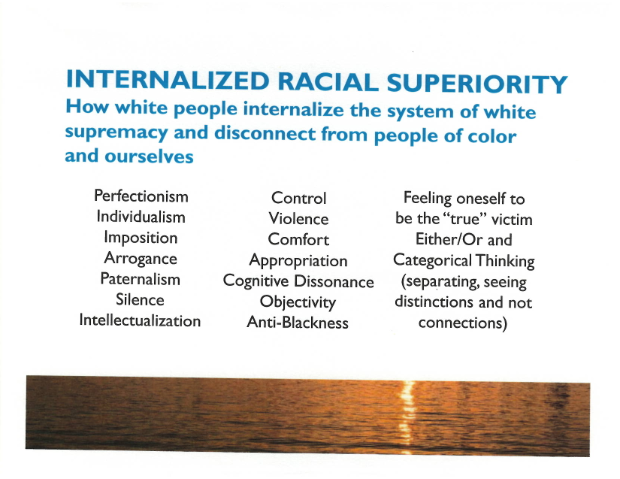
Here's a sample from the training material:

Continue ReadingSeattle Office of Civil Rights About to Be Sued for Unapologetic Racism

Andrew Sullivan Discusses the Zero Sum Game Trap of Critical Theory

In "The Roots Of Wokeness," Andrew Sullivan notes that critical theorists ignore history. They throw many of the principles of classic liberalism into the trash, including the lessons we've learned from the Enlightenment. They do this as a prerequisite for the only kind of progress that they are able to envision. Sullivan's discussion occurs in the context of his review of a brand new book that dissects the critical theorist movements:

Cynical Theories: How Activist Scholarship Made Everything About Race, Gender and Identity,” by former math prof James Lindsay and British academic, Helen Pluckrose. It’s as deep a dive into this often impenetrable philosophy as anyone would want to attempt. But it’s well worth grappling with.

By now, most of us are aware of the linguistic territorial wars being waged by the Woke and their efforts to shrink the Overton Window whenever they feel threatened by opposing arguments and evidence. There is much more to the movement, however, and it attacks classical liberalism itself. It also denies the long dramatic history of social progress and seeks to impose its own brand of authoritarianism:

For me, these theorists do something less forgivable than abuse the English language. They claim that their worldview is the only way to advance social progress, especially the rights of minorities, and that liberalism fails to do so. This, it seems to me, is profoundly untrue. A moral giant like John Lewis advanced this country not by intimidation, or re-ordering the language, or seeing the advancement of black people as some kind of reversal for white people. He engaged the liberal system with non-violence and persuasion, he emphasized the unifying force of love and forgiveness, he saw black people as having agency utterly independent of white people, and changed America with that fundamentally liberal perspective.

The gay rights movement, the most successful of the 21st century, succeeded in the past through showing what straights and gays have in common, rather than seeing the two as in a zero-sum conflict, resolved by prosecuting homophobia or “queering” heterosexuality. The women’s rights movement has transformed the role of women in society in the past without demonizing all men, or seeing misogyny as somehow embedded in “white supremacy”. As we have just seen, civil rights protections for transgender people—just decided by a conservative Supreme Court—have been achieved not by seeing people as groups in constant warfare, but by seeing the dignity of the unique individual in pursuing their own happiness without the obstacle of prejudice.

In fact, I suspect it is the success of liberalism in bringing this kind of non-zero-sum pluralism into being that rattles the critical theorists the most. Because it suggests that reform is always better than revolution, that empirical truth is on the side of the genuinely oppressed and we should never fear understanding things better, that progress is both possible in a liberal democracy, and more securely rooted than in other systems, because it springs from a lively, informed debate, and isn’t foisted on society by ideologues.

Continue ReadingAndrew Sullivan Discusses the Zero Sum Game Trap of Critical Theory