Jonathan Haidt Discusses Two Versions of Identity Politics: “Common Enemy Politics” and “Common Humanity”

I've followed Social Psychologist Jonathan Haidt closely for many years (as you can see by searching for his name at DI). He is the author of several excellent books, including The Happiness Hypothesis, The Righteous Mind: Why Good People Are Divided by Politics and Religion and The Coddling of the American Mind. Haidt's thought process crosscuts the prevailing two wings of political thought in the United States. In this extended interview with Joe Rogan, Haidt dissects many topics, including identity politics. He urges that this phrase encompasses two separate approaches, "Common Enemy Politics" and "Common Humanity."

Haidt also distinguishes between two prevalent types of conversations, two types of "games" being played that often make conversations frustrating. Many of us insist upon playing the "truth seeking game," while others play a game that assumes a Manichean battle where A) no one gains except at the expense of someone else, B) where people are not seen as individuals but a members of groups, and C) you can tell who someone is merely by their appearance. Much of the fruitless dialogue on social media and elsewhere makes a lot more sense once we realize that these two approaches have virtually nothing in common--they serve entirely different purposes. Just because we exchange words does not mean we are, in any meaningful way, communicating.

I'm strongly in agreement with Haidt's analysis.

Haid's distinction parallels David Sloan Wilson's distinction between science-oriented "factual realism" and group-survival-oriented "practical realism."

In addition to embedding the video of the interview, I invested some time to create a transcript of several sections of this interview, from about Min. 33 - 55. I have cleaned up the wording to omit throat-clearings and false starts, but I have worked hard to be true to the substance of the conversation.

--

Haidt – Rogan Interview

33:18 JH: You have to look at different games being played. Yale was a place that taught me to think in lots of different ways and it was constantly blowing my mind when I took my first economics course. It was like wow, here's a new pair of spectacles that I can put on and suddenly I see all these prices and supply. I never learned to think that way, where I learned about Freud in psychology or sociology. A good education is one that lets you look at our complicated world through multiple perspectives. That makes you smart. That's what a liberal arts education should do. But what I see increasingly happening, especially at elite schools, is the dominance of a single story, and that single story is life is a battle between good people and evil people, or rather good groups and evil groups, and it's a zero-sum game. So if the bad groups have more, it's because they took it from the good groups, so the point of everything is to fight the bad groups. Bring them down create equality and this is a terrible way to think in a free society. That might have worked you know in biblical days when you got the Moabites killing the Jebusites or whatever, but you know we live in an era in which we've discovered that that the pie can be grown a million-fold. So to teach students to see society as a zero-sum competition between groups is primitive and destructive.

34:22 JR: In your book, you actually identify the moment where these micro aggressions made their appearance and they were initially a racist thing.

JH: Yeah. The idea of a micro aggression really becomes popular in a 2007 article by Derald Wing Sue at Teachers College. He talks about this concept of microaggressions. There are two things that are good about the concept, that are useful. One is that explicit racism has clearly gone down--by any measure explicit racism is plummeted in American across the West—but there could still be subtle or veiled a racism.

37:27 JR It's ultimately for everyone's sake, I mean, even for the sake of the people that are embroiled in all this controversy and chaos. It would be fantastic across the board if there was no more sexism, there was no more racism, there was no more any of these things. It would be wonderful. Then we could just start treating humans as just humans. Like this is just who you are you're just a person. No one cares. What a wonderful world we would live in if this was no longer an issue at all.

JH: Beautifully put.

JR: How does that get through?

38:01 JH: We were getting there, okay? That's what the twentieth century was. We were shaped by the late 20th century. The late 20th century was a time in America in which, you know, earlier on there was all kinds of prejudice. I mean, when I was born, just right before you were born, it was legal to say you can't eat here because you're Black and so that changed in 1964-65. But it used to be that we had legal differentiations by race and then those were knocked down. But we still had social [discrimination] and it used to be that if you were gay that was something humiliating. It had to be hidden. If you look at where we were in 1960 or ’63, when I was born and then you look at where we got by 2000, the progress is fantastic on every front, so that's all I mean when I say we were moving in that direction.
Continue ReadingJonathan Haidt Discusses Two Versions of Identity Politics: “Common Enemy Politics” and “Common Humanity”

Post-Race Rapper Preaches Tolerance

I first encountered Zuby on Twitter, where I was intrigued by his upbeat mini-prose. Zuby says that his race is the most uninteresting thing about himself. If I told you that Zuby currently lives on the southern coast of England, you probably wouldn’t guess that he spent much of his life in Saudi Arabia. If I told you that Zuby was an up and coming rap artist, you probably wouldn’t guess that also graduated from Oxford, with a degree in computer science or that he spent several years of his life as a business consultant. In addition to creating music, Zuby is now an author, podcaster, public speaker, fitness expert and life coach. Zuby refuses to allow his do not fall into any predictable silo. To make a political point that trans women should not be allowed to participate in women’s sports, he posted a video in which he claimed to have broken the British Women's deadlift record of 238kg (528 pounds). Zuby claimed that he "identified as a woman whilst lifting the weight."

On July 24, 2020, Zuby joined Brett Weinstein on the DarkHorse podcast. I took the Youtube transcript, edited it for clarity and present it here as an introduction to Zuby.

Zuby - Min 74:53

There are certain games you win by just not playing. Just don't play that game. Don't get dragged into this thing. It's something I experience. I always feel like I've often got people, especially nowadays, trying to drag me into things that I don't want to get involved with. I don't think it's a good idea. I don't think it helps.

My worldview is really simple when it comes to stuff like this. It is the Martin Luther King, Jr. vision. The way I was raised from when I was a child growing up in Saudi Arabia . . . from the beginning I've been surrounded by all types of different people, different religions different colors, different ethnicities, different nationalities, whatever. That's just been the norm for me forever, so the whole idea of viewing people through this very narrow lens, from being a child I've always thought, it's silly and it's asinine. It makes me somewhat upset when I see that now day in and day out. It's white this and black that. Can we can we stop?

So much of this is just unnecessary and it's antagonizing and it forces people to keep viewing the world that way. That's the least interesting thing. It's such an uninteresting thing about someone. That's the thing. The fact that I'm a black male is one of the least interesting things about me. It certainly doesn't say anything about my personality or my character or my beliefs or my abilities or anything. Yeah, it's observable and, cool, okay. But if someone is talking to me, I don't want that to be the thing that's in their head and that they're obsessing over. I'd like them just to talk to me. I'm Zuby. Just talk to me and we'll be cool. We can be friends. All that stuff is details.

There is a growing tent of people who are politically sort of in the center left and center right who are sort of uniting and recognizing that they're tired of the extremism and they don't like cancel culture and they don't like this super identity politics thing on any side, and they don't want to destroy the whole system and they don't think the country is terrible. I think there's that there's that growing group of people Who I think are slowly gaining a bit more and more courage. I think that they're sort of seeing podcasts like this. What I'm doing with my podcast and you know whether it's Joe Rogan or Dave Rubin, etc. like all these guys, they're sort of saying okay, cool.

People are talking about this and there's a range of people here who are sensible and don't want to scream at each other and call each other racist every three seconds. There's that growing group, so I do hope that that swells and gains enough courage and momentum for people to eventually just be like, okay, look, like we're going to stop entertaining the crazies and we're going to stop letting them sort of determine everything and set all the rules and control everybody and cancel everybody. I think once enough once there's enough critical mass there, then you can get back to a sort of stage of normalcy where people are being reasonable again. And we can actually solve some of the problems because we can talk.

Zuby - Min 29:20

In the in the USA, you guys say Black American, African-American, Latino, American, white American etc. Here (in Great Britain) we just say “British.” Right! There you go. So it's not common to hear that this person is white British or this person is a Black Brit.

Zuby - Min 12:12

Last week I spent two days just getting attacked for the fact that I said that it's bad to be racist to white people. I was getting emails, DMs like, all kinds of horrible stuff, for me saying no, this is bad. This isn't good. I don't think we should judge people based on the color of their skin or call people inferior or do any of this and then I start getting attacked. What kind of what is this world that we're living in that that is considered? It's a strange thing.
\

Continue ReadingPost-Race Rapper Preaches Tolerance

William Shatner: Not a Cisgendered Man or a Cis Man

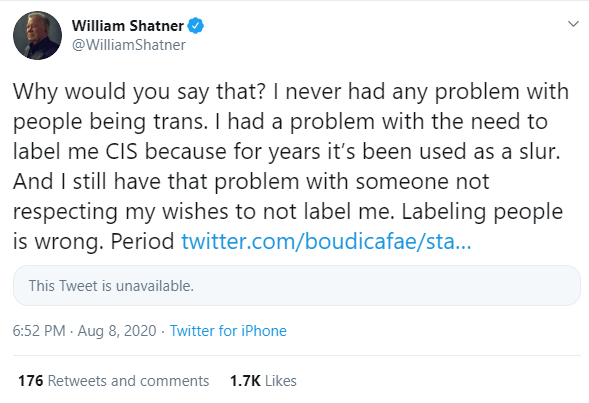
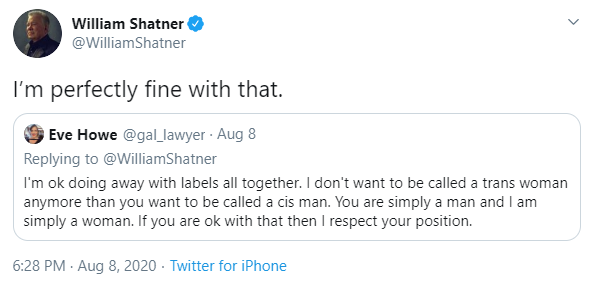
In the past Facebook exchange, I was called a "cis" man.  I objected and indicated that I should be referred to as simply as a "man." Several people in that group refused, continuing to refer to me as a "cisgendered man." I found this insulting, not only because there is a perfectly good word already existing to describe me, but also because of the way "cis" and "cisgendered" are most often used. In my experience, "cis" and "cisgendered" are used as terms of disparagement.  I have found it odd that someone would claim that they need to relabel me in order to define themselves.

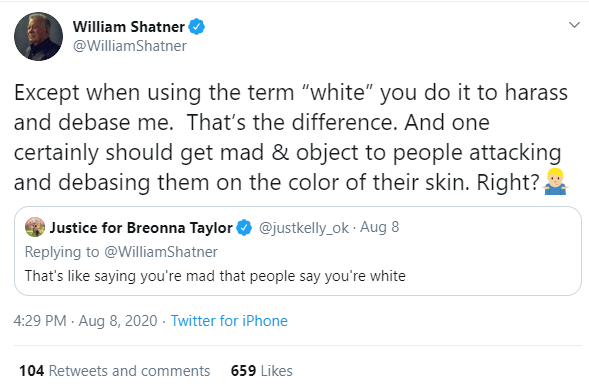
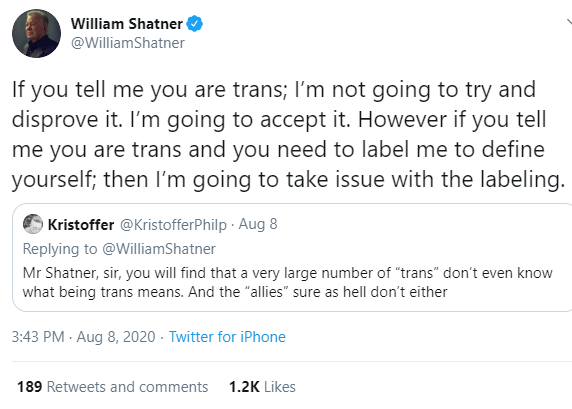
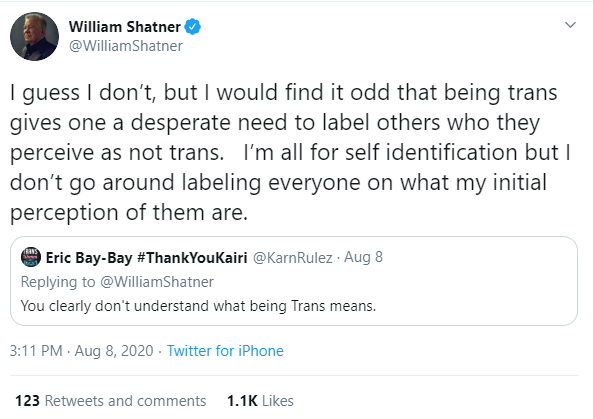
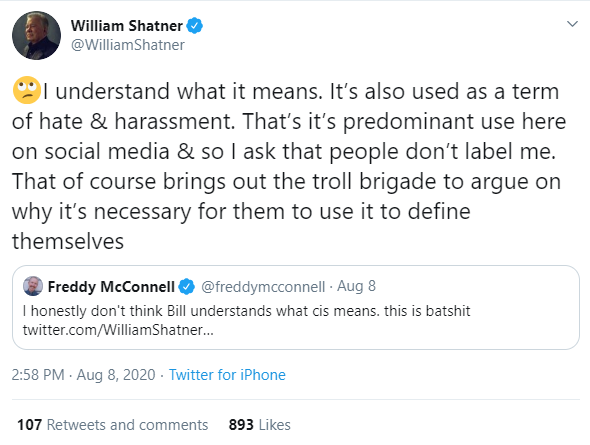
With that background, I noticed a recent series of Tweets by William Shatner (or Star Trek fame).  Shatner has drawn a line in the sand on this same issue. He does not want to be referred to as a "cis" or "cisgendered" man. Why? Because calling someone "cis" or cisgendered is a "slur." Shatner argues that it is debasing and often used as a term of hate.  This is my experience too.  Shatner spelled out his concerns in a long series of Tweets.  Here are some excerpts (in reverse chronological order):

Continue ReadingWilliam Shatner: Not a Cisgendered Man or a Cis Man

More About the Woke Version of 2 + 2

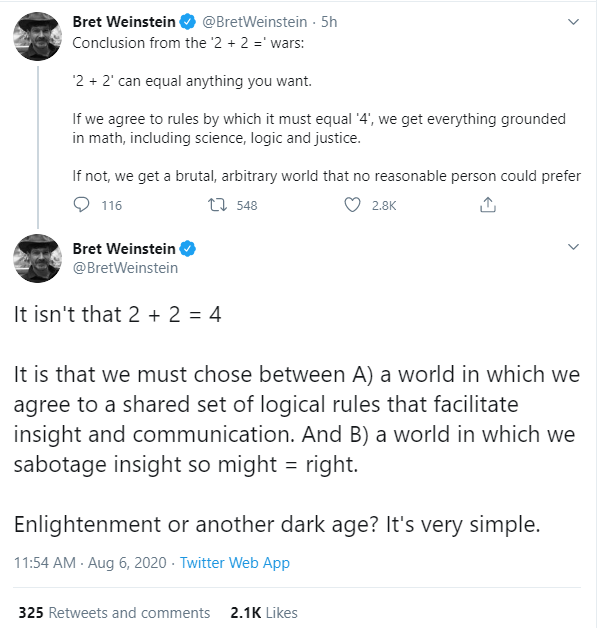
More on 2 + 2.   Whether you want to make it add up to 4 is, indeed, "a choice," as we are hearing from Woke-land. That choice, however, has the vast power Dan Dennett ascribed to his concept of "universal acid." That power can be either constructive or destructive. To the extent that we choose to teach (in classrooms and elsewhere) that 2 +2 ≠ 4, this creative choice would permeate everything. not only math. This fanciful and proudly rebellious choice would keep spreading to encompass everything else we believe too, because the explosive power of knowledge depends upon compounding. Our big impressive truths are exapted from our simplest of truths, even truths so simple that we verify them by counting fingers. This ability to compound our know-how from little grounded truths to much bigger truths allows us to discover vaccines and to design aircraft.

--

Yes, it's a choice, but it's a choice with ramifications. We can fuck around, acting like we can individually conjure up entirely new inert mental axioms willy-nilly each day, intentionally oblivious to verifiability, and oblivious to what anyone else is doing. Or we can collaborate in a mentally disciplined way using principles hard-gained from Enlightenment thinkers and others, such that there are correct and incorrect answers to many things based on A) whether those things actually function in predictable and meaningful ways and B) whether they further human flourishing.

I tend to see morality in terms of a personal aesthetic deeply tied to my vision for human flourishing. What does your personal sense of aesthetics (or morality) demand? A world where 2 + 2 equals 4? Or a world unhinged from any ability to collaborate with other sentient beings, a world where we pass the time organizing under rival warlords and throwing rocks at each other?

Continue ReadingMore About the Woke Version of 2 + 2

Science Re-Takes the Stage in the Gender Debate at NHS and BBC

From Julian Vigo's Aug 5, 2020 article at Quillette: "At the NHS and BBC, Important Steps Toward Restoring Balance in the Gender Debate." Politicians in the UK have regained their footing, relying upon the scientific method. They are moving forward based on the idea that they should "Do no harm.  Here is an excerpt:

BBC Woman’s Hour has reported that much of the language on the NHS website referring to gender dysphoria was removed or entirely reworded last week, so as to more accurately reflect science instead of ideology. Crucially, the NHS no longer repeats the fiction that puberty blockers such as Lupron are “reversible,” since there are few studies on the physical or psychological effects. (It has been known since 2017 that trials of peripubertal GnRHa-treatment, i.e., hormone blockers, in sheep reveal “permanent changes in brain development [and] raises particular concerns about the cognitive changes associated with the prolonged use of GnRHa-treatment in children and adolescents.”) Also removed from the NHS site: Emotionally loaded references to suicide, which had previously served to terrify parents into seeking rapid treatment, lest any delay lead a child to end their lives. The association of “gender identity” with regressive stereotypes also is gone. And the website no longer suggests that sex itself can be changed. Instead, we get more accurate language to the effect that “some people may decide to have surgery to permanently alter body parts associated with their biological sex.” That the NHS now uses the term “biological sex” at all is itself a huge win, even if such language is obviously appropriate on the level of science and medicine. . . .

As with so many other things, the campaign for trans rights began with good intentions. For some people, dysphoria is very real—the feeling of being in the wrong body. It’s a problem that has to be managed, and people who suffer from this condition should get the help they need. But rather than urge that dysphoria be treated in a humane and realistic way, many activists prefer to cast it as a vestige of an invented inner spirit called “gender identity,” which universally suffuses us all, like a spark of the divine.

Such fantasies are the basis of religion, and it is fine for people to believe in them. But over the last decade, this particular fantasy has been encoded into law—which is very much not fine. And it was only a matter of time before ordinary people realized that a fraud had been perpetrated on them under cover of human rights. . .

Of course, it’s taken too long, and much damage has been done in the interim. But for the sake of the many women and children who remain at risk, better late than never.

Continue ReadingScience Re-Takes the Stage in the Gender Debate at NHS and BBC