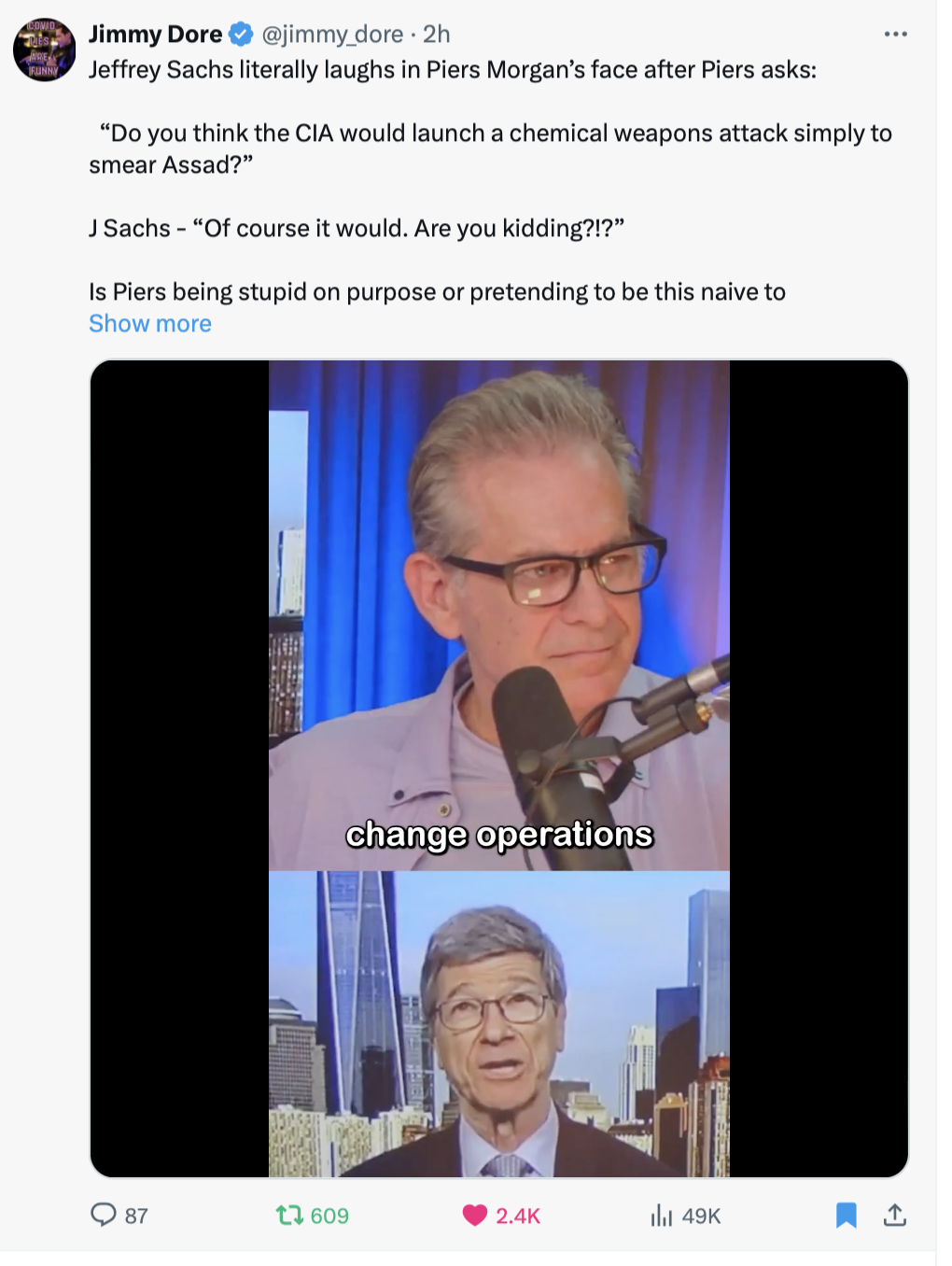
Jeffrey Sachs Discusses the Real World Game of Risk Featuring Deadly U.S. Foreign Policy

Jeffrey Sachs has calmly delivered short presentations that give context to the the Ukraine War that you will never hear on Corporate media. For most self-declared Democrats I know, the history of the Ukraine War started in 2022. They are off by a few decades, as Sachs Discusses (I created this transcript based on the following video:

Yesterday was the most important day for peace in maybe decades. Actually, this war in Ukraine resulted from a very bad idea of the United States taken in 1994 it's a project. The project was a project to expand NATO forever, anywhere. Just keep moving east. Keep moving, not only to the first wave, which was the Prime Minister's country, Hungary, Czech Republic and Slovakia, but then move eastward, closer to the former Soviet Union, into the former Soviet Union, surround Russia in the Black Sea region, go all the way to little country in the south caucuses, Georgia. It was mind boggling. Clinton signed onto that in 1994 it became what we call the deep state project, meaning it didn't really matter who the President was. Each president would come and basically would be informed NATO is moving eastward, you're part of that process.

So Clinton started it in 1994 and as Prime Minister Orban said, he mentioned briefly in 1990 on February 9, 1990 in unequivocal, clear as can be terms the United States, and said to President Michel Gorbachev NATO, will not move one inch eastward. And if you have any doubt about it, all the documents are now online available. You can scrutinize everything. Hans Dietrich Genscher, the US, the German foreign minister said the same thing same day. He's on tape actually explaining, no, no, I don't just mean within eastern Germany. I mean anywhere to the east. Clinton, being Clinton and the US Deep State, being the US Deep State, started this project in 1994 they already had the idea, by the way, in 1991 92 as soon as the Soviet Union ended, aha. Now we move now we move eastward. Now we control everything. Now we are the sole superpower.

So this has gone on for 30 years, and each president got into it. Under George Bush Junior, seven more countries were added, Estonia, Latvia, Lithuania, Slovakia, Slovenia, Bulgaria and Romania. Nine, in 2004 then in 2007 President Putin said at the summit that's taking place right now, the Munich Security Summit said, Stop! You told us no expansion, not an eastward expansion, even an inch, you said. You've now done 10 countries. Stop! Perfectly reasonable. Stop.

I don't think our president, Donald Trump, would much like to see China and Russia building their military bases up from Central America. You know, this was how the Russians saw this. Why are you coming to our border when you told us you weren't going to move? And there was one other thing that was very important in this which is probably the most decisive thing and almost not even recognized in 2002 the US did something really, really, really destabilizing, and that is it unilaterally left the anti ballistic missile treaty that was a core strategy to stop a nuclear war between the two super powers. Because . . . [More . . . ]

Continue ReadingJeffrey Sachs Discusses the Real World Game of Risk Featuring Deadly U.S. Foreign Policy

The U.S. Role on Producing Heroin in Afghanistan

Why was USAID funding the production of heroin in Afghanistan?

John Kiriakou, who exposed the CIA and went to prison for it: "I went to Afghanistan to do a study on on the heroin Poppy crop. And I'll tell you, nobody liked it. Afghanistan used to be a net food exporter, and as soon as the US takes over, they're producing 93% of the world's heroin. That's right. I'd like to know how the fuck that happened. I get to Bagram Air Base and I said, I'm gonna need a helicopter to Lashkar. We get down there, and it's a god-awful place, but man, I'm telling you, as far as your eye can see, all there is, is Poppy. So I make an appointment to go to this DEA secret site, and they were like, you're in over your head. "There are very powerful forces that want that Poppy to be cultivated." And I said, "Why? It's 93% of the world's heroin." And they said, "Because almost all of that heroin goes to Iran and to Russia, and we want them to be addicted to heroin. It weakens their societies." I'm writing all this up. And [John] Kerry's like, "We're not we're not publishing that." And I was like, ah, they got to him too."

Mike Benz offers the details and they include connections with USAID:

And more details from Benz, including connections to the innocent-sounding "US Institute for Peace:

"And why is USAID’s network partner, the US Institute of Peace, lobbying the Taliban to keep 95% of the world’s heroin supply flowing while taking $56 million from US taxpayers each year?"

Continue ReadingThe U.S. Role on Producing Heroin in Afghanistan

Why Neocon Foreign Policy Fails Over and Over

This goes for the Neocons who taok over Republic foreign policy and also those how commandeered the cabinets of Democrats such as Obama and Biden. Mike Dimino, a former CIA analyst and a fellow at Defense Priorities. He has been involved in Mideast policy, particularly under the Trump administration, where he has served as the Deputy Assistant Secretary of Defense for the Middle East. He hammers it here:

We could talk about sort of the military analysis all day, and I think it's really important to do that. But the bigger point here has to be, you know, we have now seen 20 years worth of evidence in Iraq, in Syria, in Libya, and Afghanistan that we cannot force liberal democracy at the end of a gun. Okay? Iran is a nation of 90 million people. Enough of the people in that country have to overcome what many sociologists and political scientists have called the collective action problem, right? The cost benefit analysis of organic political change, that calculation has to get to a point where change can happen. And that's how it has to work if it's going to last and if it's going to be meaningful. This idea that the United States should be using its military to go around the world and depose every single tin pot dictator that we find and bog ourselves down there to the tune of trillions of dollars to 1000s of American lives with no real goal or or purpose, where we are squandering our national resources in our bandwidth that need to be directed on far more pressing issues is just not really in America's interest. And that's, again, the biggest point that I would make here, is that, you know, this idea that you can, you know, send a couple of, you know, American stealth bombers, you know, over the border and kill all the ayatollahs and some kind of cinematic cutscene. And then, you know, some young woman stands up in a pantsuit and goes, you know, I'm ready to be the president of Iran now. I mean, life is not a Marvel movie and life is not, it's not Harry Potter. So as somebody that has spent a lot of time in the region and has worked on these issues as an intelligence officer, I could just tell you the idea that something like that is possible, I think, is what is in the heads of a lot of people like John Bolton and Mike Pompeo, and even a lot of the, you know, the Persian diaspora elsewhere, that is very against the regime. Again, I'm against the regime too, but it just doesn't work that way, where there's going to be some sort of perfect cutscene ending, and there's going to be, you know, overnight, some kind of new regime in Iran, we have learned that the world just doesn't work that way.

Continue ReadingWhy Neocon Foreign Policy Fails Over and Over

Is Christmas About Jesus? Residential Christmas Light Displays Offer a Clue

To what extent is Christmas about Jesus? On evening of Dec 18, I conducted a survey of Christmas lights in south St. Louis. I walked through neighborhoods to photograph residential Christmas displays. I walked through several neighborhoods (in the vicinity Ted Drews, for those of you from St. Louis).

I photographed every front yard that had a person or a thing on the front yard, excluding houses that merely had Christmas lights without figures. I also excluded houses with only Christmas tree images and those displaying only angels. I wanted to know the percentage of homes that displayed Jesus or the Nativity Scene. If a house displayed Jesus plus other figures, I counted it as a house that displayed an image of Jesus. I'm fully aware that this was not a scientific survey. There are likely many religious people who choose (for many reasons) to refrain from displaying images of Jesus in their Christmas front yard displays.

Out of 164 Christmas displays I photographed, only 13 (8%) displays a representation of Jesus.

At the end of this article I’ve listed many of the other personalities and objects you’ll find on neighborhood lawns to celebrate Christmas. In addition to Santas and reindeer, these figures include Harry Potter, penguins, unicorns, pigs wearing sunglasses and the Grinch.

Why would I do this survey? I was not trying to point out America’s loss of religiosity. I’m an atheist. My position is to each to his or her own. Feel free to follow a religion or no religion as long as you celebrate the right of all other people to celebrate their own religion (or no religion).

My purpose was inspired by the following passage by Thomas Sowell, from Knowledge and Decisions (1980):

Perhaps the most important feature of the first half of Knowledge and Decisions is simply its analysis of decision-making processes and institutions in terms of the characteristics and consequences of those processes themselves—irrespective of their goals. As noted in Chapter 6, this approach rejects the common practice of “characterizing processes by their hoped-for results rather than their actual mechanics.” “Profit-making” businesses, “public interest” law firms, and “drug prevention” programs are just some of the many things commonly defined by their hoped-for results, rather than by the characteristics of die decision-making processes involved and the incentives created by those processes. So called “profit-making” businesses, for example, often fail to make a profit and most of them become extinct within a decade after being founded. In Knowledge and Decisions the owners of such businesses are defined not as profit makers but as residual claimants to the firm’s income—that is, to what is left over after employees, suppliers, and others have been paid. Put this way, it is dear from the outset that what is left over may be positive, negative, or zero. There is no more reason to expect "drug prevention” programs to prevent drug usage or “public interest” law firms to serve the public interest than to expect that most “profit-making” enterprises will in fact make profits. Whether any of these organizations do or do not live up to their expectations or claims is a question of empirical evidence. Pending the presentation of such evidence, such organizations can be analyzed in terms of what they actually do, not what they hope or claim to achieve.

Is Christmas about Jesus? Somewhat, but evidence abounds suggesting that Christmas is, mostly, for most Americans, about other things, including an orgy of consumerism. A Martian anthropologist who objectively studied Christmas behavior, including America’s choices in Christmas lights, would probably agree with me. Yes, Jesus is discussed in churches, but where are figurines of Jesus in grocery stores and hardware stores? Is Jesus discussed to any meaningful degree at family dinner tables? How often do people spontaneously discuss Jesus at cocktail parties?

Christmas, as a national institution, is mostly not about Jesus. It’s mostly about other things. It is my belief that it has become more and more about things since my childhood (I was born in the mid-1950s) and it has been a slow imperceptible drift. Jesus is the frog in the pot.

But the institution of Christmas is merely one example of many such drifting institutions. It appears to me that most American Institutions have been hollowed out over the years. They no longer do what they claim to do. Hence, the caveat offered by Thomas Sowell.

Wikipedia, which claims to offer a “neutral” point of view, is one of these hollowed-out institutions. And see here. 

Also note this about Wikipedia's annual budget:

Consider also the FDA, which is almost completely captured by pharmaceutical money. Consider the Department of “Defense,” which has waged numerous wars of discretion for decades, all of these wars supported by corporate media marching in lockstep.

And speaking of the corporate “news” media, it is clear that one can expect mostly to be misguided and propagandized by these institutions, not well-informed. Here are more than 300 examples of that.

Is a school functioning as a school?  You need to dig in deep to figure it out.  Don't just read the word school on the building and assume that children are being educated inside.

In conclusion, I refer back to the wise words of Thomas Sowell. Don’t ever assume that an institution actually does what it claims to do. I’m from Missouri, the “Show Me” state and I recommend that we all take on this attitude.

I decided to do my Christmas light survey because it was easy: people reveal in lights what is on their mind about the reason for the season. It’s much more difficult to tell what is really going on with most other institutions. Whenever institutions make claims that they are doing good things for society, demand that they open up and show you. Sunshine is the best disinfectant.

Merry Christmas to all, whatever that might mean to you!

Continue ReadingIs Christmas About Jesus? Residential Christmas Light Displays Offer a Clue