
New Position on Transgender Surgeries by the AMA and ASPS

It has long been my position that adults can and should be able to do anything they want with their own bodies. With exceptions that would need to be extraordinary, rare and carefully considered in light of a detailed psychological analysis, I have simultaneously opposed irreversible transgender medical surgeries and injections done to minors that will make them sterile, prevent them from ever achieving orgasm and a host of other harmful physical outcomes. This is my position even if these procedures are supposedly done with the "consent" of minors (who are prohibited by age from getting a tattoo or voting).

In light of new evidence of the dangers of these surgeries, two major medical organizations have now voiced their concerns.

Nicolas Hauser's article is titled "Major Medical Organizations Retreat on Irreversible Gender Surgeries for Minors: The American Medical Association and the American Society of Plastic Surgeons move to defer irreversible gender surgeries in minors days after $2 million malpractice verdict for teen detransitioner." Excerpt:

This week, the American Medical Association (AMA) endorsed delaying gender-affirming surgeries until adulthood, just one day after the American Society of Plastic Surgeons (ASPS) recommended postponing breast/chest, genital, and facial surgeries until at least age 19. While framed as recommendations rather than binding clinical guidelines, the signal is unmistakable: irreversible surgical alteration of minors is facing growing resistance.
Continue ReadingNew Position on Transgender Surgeries by the AMA and ASPS

Steve Stewart-Williams explains his aversion to the term “Gender.”

Steve Stewart-Williams explains "Why I'm not a Fan of Gender." Excerpt from his upcoming bok, "A Billion Years of Sex Differences":

Many social scientists draw a distinction between sex and gender where, roughly speaking, sex refers to biological aspects of female and male, and gender refers to social aspects. ... I’m not a fan of the concept of gender, which I think confuses more than it enlightens.

There are several reasons for this. The first is that the term has multiple meanings. Sometimes gender refers to female–male differences that are (supposedly) shaped by nurture rather than nature; sometimes it refers to masculinity and femininity; sometimes it refers to psychological profiles that are more common in one sex than the other; sometimes it refers to widely held stereotypes of the sexes; sometimes it refers to the roles that society provides for females and males; sometimes it refers to people’s gender identity (their sense of themselves as a boy or a girl or a man or a woman); and sometimes it’s just a polite synonym for sex: a term that makes it clear that you’re talking about biological sex rather than the fun kind of sex. The profusion of partially overlapping meanings makes it difficult to know what people using the term are actually talking about. It’s like trying to juggle jelly.

A second reason I prefer not to partake of gender is that, even if we could agree on a definition, most of those on offer are profoundly flawed. Take, for example, the idea that gender refers to female–male differences due to nurture rather than nature. An initial problem is that this is invariably assumed rather than demonstrated; indeed, describing a female–male difference as a gender difference often seems to be a way to settle the nature–nurture issue by definitional stipulation rather than arguments and evidence. . . .

Other definitions of gender face similar problems. Consider, for example, the idea that gender refers to psychological profiles loosely linked to sex: Men tend to be stoic and assertive, for instance, whereas women tend to be caring and emotional. This definition is assumed by people who argue that there are multiple distinct genders, rather than just the two vanilla options of man and woman. Again, this doesn’t strike me as a useful way to construe things. The problem is that it involves imposing categories – even if more than just two – on what is actually continuous psychological variation. No two human beings have exactly the same psychological profiles, so the logical endpoint of this approach is that there are as many genders as there are human beings – and we’re really just talking about personality.

I've subscribed to Steve's excellent Substack for the past year and highly recommend it.

Continue ReadingSteve Stewart-Williams explains his aversion to the term “Gender.”

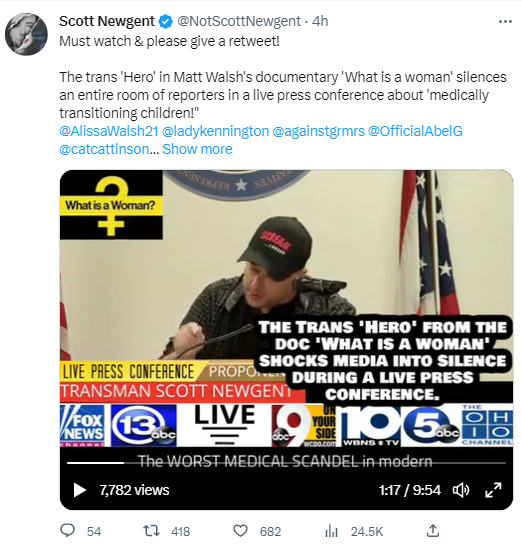
Scott Nugent, Featured in “What is a Woman,” Challenges the News Media to Ask Real Questions on Transgender Issues

Scott Nugent, mother, lesbian and trans man, giving an impassioned scolding to a room filled with reporters. Scott is challenging them to ask real questions about the claims of profit-seekers to help struggling children instead of naively accepting the rhetoric of trans activists.

Continue ReadingScott Nugent, Featured in “What is a Woman,” Challenges the News Media to Ask Real Questions on Transgender Issues

The New York Times Has Finally Acknowledged the Problem with Women

The NYT has finally crawled out of its cave to acknowledge a festering problem: The Political Left is shitting on women. Members of the Political Left are doing this through their words but also though their silence.

Why now, NYT? Is it because there are more and more of us creeping out into public to ask obvious questions and to state the problems we are seeing and hearing? Is it because Matt Walsh recently released his hard-hitting documentary (with which I find much merit, though I have my disagreements too): "What is a Woman?" Is it because one of the main missions of the NYT is to elect democrats and they have decided that NOW is the time to save the democrats from themselves by calling out bullshit on gender ideology? Maybe all of the above? Whatever the reason, an article like this was long overdue. I'm glad the NYT has published Pamela Paul's article. Maybe we can now have more real conversations on this topic of the mistreatment of women by the Political Left.

Here's an excerpt from "The Far Right and Far Left Agree on One Thing: Women Don’t Count.":

[T]he far right and the far left have found the one thing they can agree on: Women don’t count.

The right’s position here is the better known, the movement having aggressively dedicated itself to stripping women of fundamental rights for decades. . . .

Far more bewildering has been the fringe left jumping in with its own perhaps unintentionally but effectively misogynist agenda. There was a time when campus groups and activist organizations advocated strenuously on behalf of women. . . .But today, a number of academics, uber-progressives, transgender activists, civil liberties organizations and medical organizations are working toward an opposite end: to deny women their humanity, reducing them to a mix of body parts and gender stereotypes.

As reported by my colleague Michael Powell, even the word “women” has become verboten. Previously a commonly understood term for half the world’s population, the word had a specific meaning tied to genetics, biology, history, politics and culture. No longer. In its place are unwieldy terms like “pregnant people,” “menstruators” and “bodies with vaginas.”

Planned Parenthood, once a stalwart defender of women’s rights, omits the word “women” from its home page. NARAL Pro-Choice America has used “birthing people” in lieu of “women.” The American Civil Liberties Union, a longtime defender of women’s rights, last month tweeted its outrage over the possible overturning of Roe v. Wade as a threat to several groups: “Black, Indigenous and other people of color, the L.G.B.T.Q. community, immigrants, young people.” It left out those threatened most of all: women.

Continue ReadingThe New York Times Has Finally Acknowledged the Problem with Women

Not all Transgender “Affirmative Care” Have a Happy Ending

Excerpt from new article by Suzy Weiss (writing at Common Sense, the Substack of her sister, Bari Weiss). The article is titled "The Testosterone Hangover: The Biden administration says transgender kids are entitled to ‘gender-affirming’ medical care. These girls disagree. ‘I have this intense rage in me over the harm that was done to me.’"

Gender-affirming care, the president’s spokeswoman, Jen Psaki, explained at a recent press conference, was “best practice and potentially lifesaving.” The point was: If trans kids weren’t able to transition, not just socially, but medically with cross sex hormones, puberty blockers, and surgeries, they might well kill themselves.

The Biden policy was presented as commonsensical, but it is out of step with many progressive countries and some leading experts. Countries that have gone down the “gender affirming” road—like Norway, Sweden, France—are now reversing course in the absence of evidence that such care actually improves mental health outcomes for dysphoric children. Pioneering doctors, like Erica Anderson of the University of California San Francisco’s Child and Adolescent Gender Clinic—herself a transwoman who has helped hundreds of teens through their transitions—are warning of the dangers of this policy. Critics say that even the phrase "gender-affirming" is misleading—a euphemism for something closer to medical malpractice. When else do we trust children to self-diagnose and make lifelong medical decisions?

And then there is the growing chorus of young people, including Chloe, who had come to regret—deeply—the decisions they had made and the gender-affirming care they had received.

In the middle of this story are teenagers who are largely going unheard by a government and a medical establishment that’s plowing ahead. “I don’t think gender affirming care helps kids like me,” says Chloe. “There should be more regard to alternatives in treating dysphoria, especially when it comes to kids.”

Continue ReadingNot all Transgender “Affirmative Care” Have a Happy Ending