
It’s not all in the genes. Ask any epigeneticist. Ramifications for cloning.

Check out these identical twins:
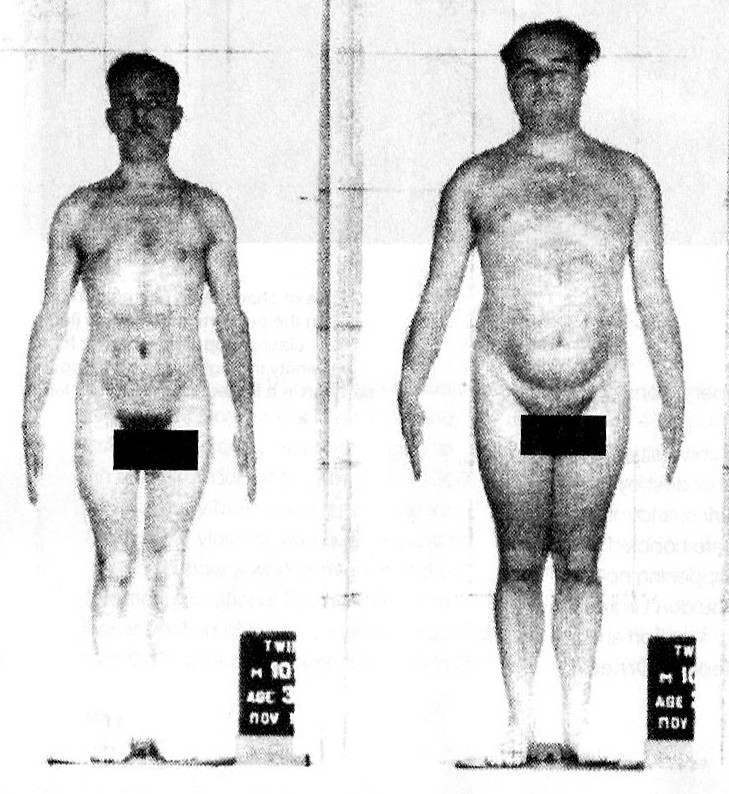
                    men identicle twins.jpg

They are really identical twins.  This photo is from the November 2006 issue of Discover Magazine.  See the related article: “DNA Is Not Destiny The new science of epigenetics rewrites the rules of disease, heredity, and identity.”

Though these two men are genetically identical, they were separated at birth.  The man on the left was malnourished for years.   Bone structure changes brought about by environmental factors is thus one of many ways (physical and behavioral) in which the environment can dramatically affect the way in which the genes express themselves

As the Discover article points out, the 25,000 genes of our human DNA are widely considered to be an instruction book for our bodies.  However, “genes themselves need instructions for what to do, and where and when to do it.”  These additional instructions are not in DNA, but

on it, in an array of chemical markers and switches, known collectively as the epigenome, that lie along the length of the double helix.  These epigenetic switches and markers in turn help switch on or off the expression of particular genes.

It has long been known that epigenetic switches are critical to the healthy development of organisms.  These can be dramatically tweaked by exposure to a vitamin, a toxin or even mothering, altering “the software of our genes in ways that affect an individual’s body and brain for life.”  Green tea, for example, has been shown to prevent the growth of cancers. 

New research has even …

Share

Continue ReadingIt’s not all in the genes. Ask any epigeneticist. Ramifications for cloning.

The Real Issue

Debate goes on, seeming forever, about the issue of religious belief in a secular society.  The validity of sacred texts becomes grist for the mill and sides line up over What Would Jesus Do bumper stickers.  We see competing fish on cars–Darwin fish with feet in answer to the unembellished christian fish symbol, then a bigger fish labeled Truth swallowing the diminutive Darwin fish, and on and on.

What is really at issue here hasn’t got one thing to do with who believes in god or evolution.  Belief is a self-contained, private matter.  The issue that gets lost in all the polemic is very simple: behavior.

Those who would sap the poison from the “inerrant word” crowd are defending their assumed right to live the way they want.  One might argue that belief in god doesn’t really limit people, and as far as it goes, that is true.  If you, as an individual, choose to believe in god, then you have elected to reform your life according to the tenets of your new faith.  You may adopt whatever modest or byzantine traditions and habits you wish.  After all, you have chosen this, you get to do it.

What you don’t get to do is tell everyone else to behave accordingly, and that’s where the meat of the issue lies.

Because fundamentalists–and we’re talking about fundamentalists here for the most part, of any stripe–do not adopt such an extreme view of faith out of intellectual curiosity or even spiritual need.  They …

Share

Continue ReadingThe Real Issue

Why does cloning scare people?

I just got an unsolicited, automated phone call from an organization fighting against stem cell research. NoHumanCloning.org is dedicated to raising fears and resisting biological research that furthers naturalistic understanding of who we are and how to artificially repair our ailments. The current battle is to prevent this type of…

Continue ReadingWhy does cloning scare people?

Do bad drivers (or bad eaters) make bad voters?

What kinds of voters are we?  It’s hard to tell by looking what kind of candidates we elect.  After all, we usually only have two viable choices; we often hold our noses and vote for the “lesser of two evils.”   Many potential candidates never appear on the ballot, thanks to our horrifically corrupt political system, a system that requires a candidate to have corporate money in order to seen as viable by the corporate-owned media. It is a ludicrous and vicious circle.

Even acknowledging the severely limited choices we have at the polls, how well do we vote? Do we prepare ourselves carefully before entering the voting booth?  Do we work hard to expose ourselves to a wide range of perspectives before voting or do we fall prey to the availability heuristic, voting on the basis of highly suspect political ads and intellectually vapid local “news”? Do most voters take time to carefully deliberate on the long-term risks and benefits of the political positions touted by the candidates?  Apparently not, based upon the ubiquity misleading attack ads that invite unreflective scorn rather than a deliberate consideration of the issues.

Another bit of evidence suggesting that many of us vote without enough preparation occurs whenever citizens vote for lesser known candidates and issues.  On numerous occasions, people have admitted to me that they voted for or against a particular candidate (or issue) about whom (which) they knew nothing at all.  In Missouri, this happens all the time when circuit judges seeking …

Share

Continue ReadingDo bad drivers (or bad eaters) make bad voters?

Godly Sex

On a lark, I looked up celibacy as it pertains to Roman Catholic priests.  OK, not on a lark.  I am a recovering Catholic, 35 years in remission.  But back to my story.  I had heard that many priests are actually married.  I wanted to know more.  Here’s what about.com has to say:

You aren’t likely to hear a great deal about married Roman Catholic priests, but they do exist. First there are the priests who are part of the Eastern Catholic Churches, also known as the Eastern Rite, who can be found in places like the Czech Republic, Hungary, Slovakia, the Ukraine, and other nations along the border between Western and Eastern Christianity. These churches are under the jurisdiction of the Vatican and they recognize the authority of the pope; however, their practices and traditions are much closer to those of the Eastern Orthodox Churches, and one of those traditions is allowing priests to marry.

They are Roman Catholic priests and many are married – so many, in fact, that some estimates place their number at around 20% of all Roman Catholic priests in the world. This would mean that 20% of all Roman Catholic priests are officially and legally married, even though celibacy continues to be a requirement. But marriage is not limited to priests who are part of the Eastern Catholic Churches – we can also find about 100 Catholic priests in America who are married and who are part of the Western Catholicism that comes

Share

Continue ReadingGodly Sex