How the Far Left Sees Masculine Men

Andrew Sullivan discusses men like Joe Rogan and Jordan Peterson who don't shy away from being masculine. They are commonly derided by the political Left, including the Woke Left. The title to his article: "Between The World And Men Truckers, Rogan, Peterson and the revolt of masculinity." Here's an excerpt:

No, the left is not calling all masculinity toxic. But they get pretty quiet when you ask for a definition of non-toxic masculinity that doesn’t end up sounding like being a woman. And, no, they’re not explicitly denying that there are biological differences between men and women — they just speak and act on the premise that there aren’t, that boys do not need a different kind of education than girls, that all-male groups are problematic, and that finding a way to direct masculinity to noble ends is somehow enabling the oppression of women, or gay people. The result is that men are subject to left derision, right machismo, and complete cultural derailment.

And that’s where Joe Rogan and Jordan Peterson come in. They too, of course, are mocked constantly, demeaned as chauvinists or white supremacists, etc. But what Rogan does is speak and talk the way men do with each other in private, which, in this media era, is a revelation. He doesn’t entertain the woke bromides of gender theory because he’s lived a life, clearly loves being a man as much as Adele says she loves being a woman, and believes, as he once put it, that “bad men are just bad human beings who happen to be men.”
Continue ReadingHow the Far Left Sees Masculine Men

What to Say When You are Asked for your Pronouns

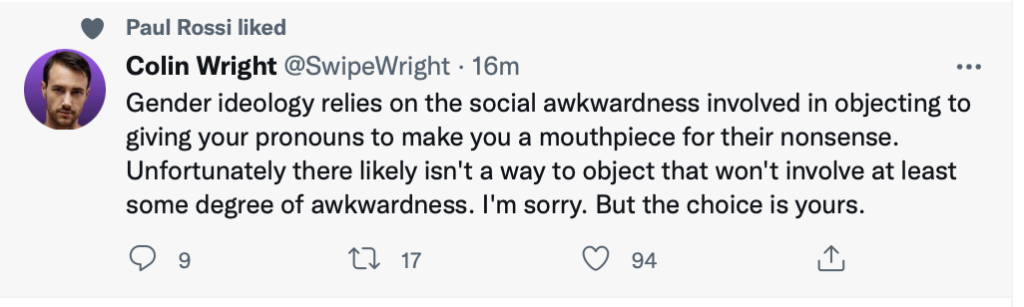
For those of us who understand that sex is a biological term that applies to possums, wolves, elephants and humans, what should we say when asked for our "pronouns"? Colin Wright says we should refuse to answer the question. I think a bare refusal is a bit rude. People asking for pronouns often don't mean any harm, even though they are implicitly asking you to buy into an ideology that conflicts with biology, often without awareness that they are doing this. I agree with Wright that a request for pronouns constitutes stereotyping.

What would I do next time I'm asked? I might respond by saying something like: “Sign me up as a human being who doesn't believe in stereotyping." If that triggers an awkward silence, perhaps I would follow up: "But by all means, I'm not telling anyone else how to respond . . ."

Wright's article appears in the Wall Street Journal. The title is "When Asked ‘What Are Your Pronouns,’ Don’t AnswerA seemingly innocuous question masks a demand for conformity with a regressive set of ideas." Here's an excerpt:

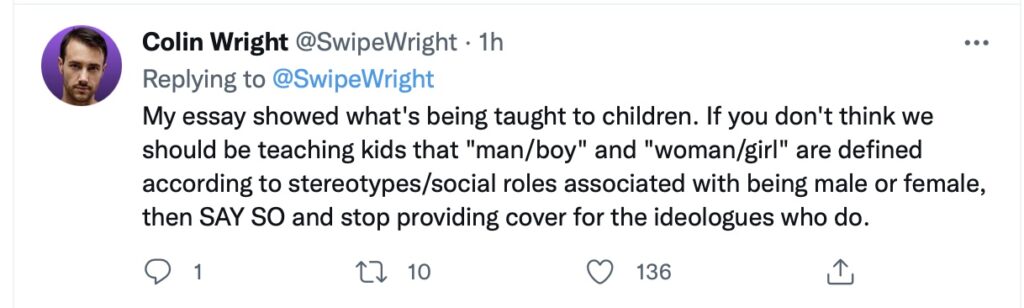
Gender activists believe that being a man or a woman requires embracing stereotypes of masculinity or femininity, respectively, or the different social roles and expectations society imposes on people because of their sex. Planned Parenthood explicitly states that gender identity is “how you feel inside,” defines “gender” as a “a social and legal status, a set of expectations from society, about behaviors, characteristics, and thoughts,” and asserts that “it’s more about how you’re expected to act, because of your sex.” . . .

So when someone asks for your pronouns, and you respond with “she/her,” even though you may be communicating the simple fact that you’re female, a gender ideologue would interpret this as an admission that you embrace femininity and the social roles and expectations associated with being female. While women’s-rights movements fought for decades to decouple womanhood from rigid stereotypes and social roles, modern gender ideology has melded them back together. . . .

Let me offer an analogy. [Imagine a] request from the American Federation of Astrologers encouraging everyone to begin conversations with, “Hi, I’m a Sagittarius. What’s your sign?” To respond with your own star sign would be to operate within and signal your tacit agreement with the belief system of astrology.

Here is a free pdf of Colin Wright's article.

Continue ReadingWhat to Say When You are Asked for your Pronouns

NYT Offers a Real Conversation about Transgender Medical Treatments

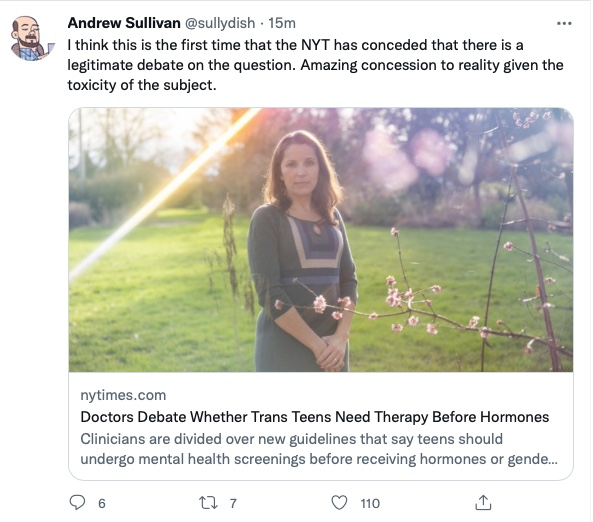
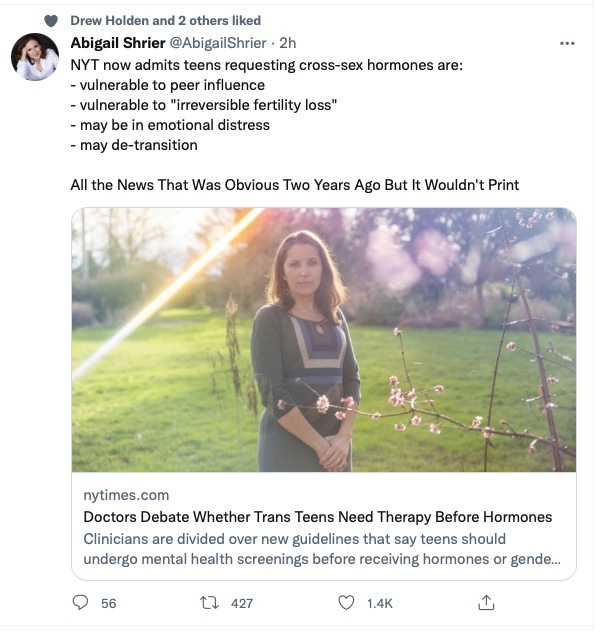
Andrew Sullivan points out that the NYT has finally decided to have a mature reasoned discussion about transgender medical treatments. Hopefully, reasoned discussion involving pro's and con's and real evidence will be the new narrative on this topic, now that Abigail Shrier has been treated like a piñata for two years for the crime of doing what the NYT is finally now doing.

An excerpt from this NYT article:

The new standards state that clinicians should facilitate an “open exploration” of gender with adolescents and their families, without pushing them in one direction or another. But the guidelines recommend restricting the use of medications and surgeries, partly because of their medical risks.

Puberty blockers, for example, can impede bone development, though evidence so far suggests it resumes once puberty is initiated. And if taken in the early phase of puberty, blockers and hormones lead to fertility loss. Patients and their families should be counseled about these risks, the standards say, and if preserving fertility is a priority, drugs should be delayed until a more advanced stage of puberty.

[Added Jan 14]

Andrew Sullivan:

"Here’s the truth that the NYT was finally forced to acknowledge: “Clinicians are divided” over the role of mental health counseling before making irreversible changes to a child’s body. Among those who are urging more counseling and caution for kids are ground-breaking transgender surgeons. This very public divide was first aired by Abigail Shrier a few months ago on Bari’s Substack, of course, where a trans pioneer in sex-change surgery opined: “It is my considered opinion that due to some of the … I’ll call it just ‘sloppy,’ sloppy healthcare work, that we’re going to have more young adults who will regret having gone through this process.” Oof.

The NYT piece also concedes another key fact: that puberty blockers are neither harmless nor totally reversible . . .

I would think that, just as a general rule, minors making permanent, life-changing decisions should receive more psychological treatment than adults. How on earth is this not the default? In what other field of medicine do patients diagnose themselves, and that alone is justification for dramatic, irreversible medication?"

Continue ReadingNYT Offers a Real Conversation about Transgender Medical Treatments

Richard Dawkins: Race is on a Spectrum, Sex is “Pretty Damn Binary.”

Richard Dawkins answers the "dangerous" question he asked in April 2021, the question that caused him to be disowned by the American Humanist Association. The title to his article at Areo: "Race Is a Spectrum. Sex Is Pretty Damn Binary."

Were race not a spectrum, Rachel Dolezal’s critics should have spotted that she wasn’t “really” black, simply by taking one look at her. It’s precisely because black Americans are a spectrum that it wasn’t obvious. With negligible exceptions, on the other hand, you can unwaveringly identify a person’s sex at a glance, especially if they remove their clothes. Sex is pretty damn binary.

If I chose to identify as a hippopotamus, you would rightly say I was being ridiculous. The claim is too facetiously at variance with reality. It’s marginally more ridiculous than the Church’s Aristotelian casuistry in identifying the “substance” of blood with wine and body with bread, while the “accidentals” safely remain an alcoholic beverage and a wafer. Not at all ridiculous, however, was James Morris’s choice to identify as a woman and his gruelling and costly transition to Jan Morris. Her explanation, in Conundrum, of how she always felt like a woman trapped in a man’s body is eloquent and moving. It rings agonizingly true and earns our deep sympathy. We rightly address her with feminine pronouns, and treat her as a woman in social interactions. We should do the same with others in her situation, honest and decent people who have wrestled all their lives with the distressing condition known as gender dysphoria.

Sex transition is an arduous revolution—physiological, anatomical, social, personal and familial—not to be undertaken lightly. I doubt that Jan Morris would have had much time for a man who simply flings on a frock and announces, “I am now a woman.” For Dr Morris, it was a ten-year odyssey. Prolonged hormone treatment, drastic surgery, readjustment of social conventions and personal relationships—those who take this plunge earn our deep respect for that very reason. And why is it so onerous and drastic, courageously worthy of such respect? Precisely because sex is so damn binary! Changing sex is a big deal. Changing the race by which you identify is a doddle in comparison, precisely because race is already a continuous spectrum, rendered so by widespread intermarriage over many generations.

Continue ReadingRichard Dawkins: Race is on a Spectrum, Sex is “Pretty Damn Binary.”