
The Affect of Overall Wealth and Egalitarianism on Sex Based Differences

Where would you expect to find sex based differences in career choice most diminished? If you guessed in countries with more wealth and egalitarian culture, you would be wrong. David Geary discusses and interprets the data in his article, "The Nurture of Evolved Sex Differences: Why favorable conditions produce larger sex differences." In wealthy countries like Norway, increased numbers of women pour into fields that are "people oriented" rather than "thing oriented." Consider, first, this data:
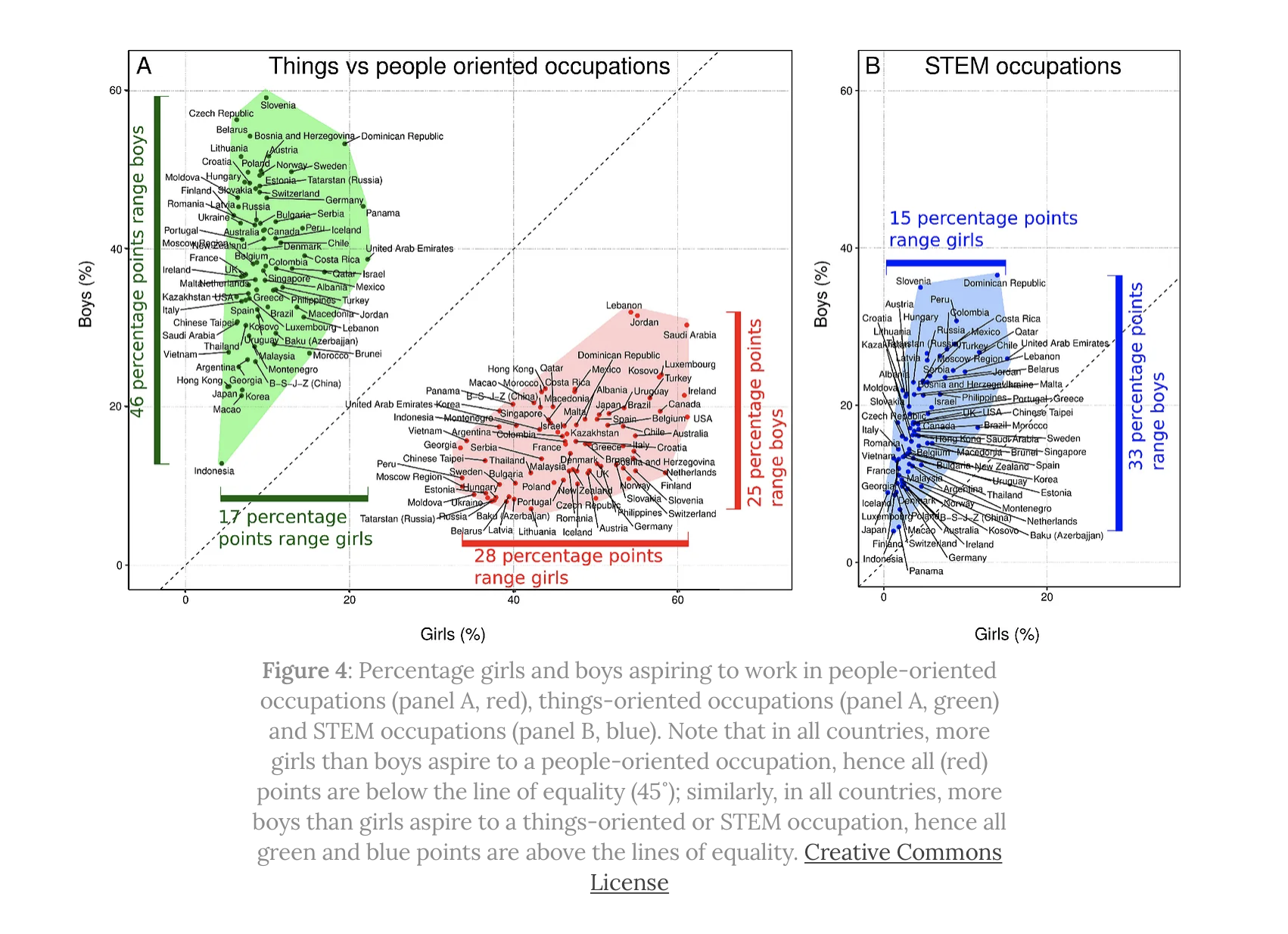
As reviewed by Schmitt and colleagues [33], sex differences in many aspects of personality, self-esteem, and cognitive and psychological functioning are larger in WEIRD, gender equal countries. For instance, women are generally more cooperative and agreeable than men and men are more Machiavellian than women, on average. These differences are larger in more egalitarian countries. One potential reason is that religious prohibitions and proscriptions increase social cooperation and decrease self-serving behaviors in men and this in turn reduces the sex differences in these areas. The release of these prohibitions enables fuller expression of underlying differences; in this case, a decrease in men’s agreeableness and an increase in their use of Machiavellian social strategies [34].

Occupational segregation also increases in WEIRD, gender equal countries, presumably due to underlying differences in preferences for working with and helping people as contrasted with working with things [35]. Girls’ and women’s greater interest in other people and relationships follows from their greater investment in children and their need to develop BFF (best friends forever) relationships that serve as a source of social and emotional support. Boys’ and men’s greater interest in things likely follows from an evolutionary history of tool making, most of which is done by men.

[More . . . ]
Continue ReadingThe Affect of Overall Wealth and Egalitarianism on Sex Based Differences

The Return of Transexual

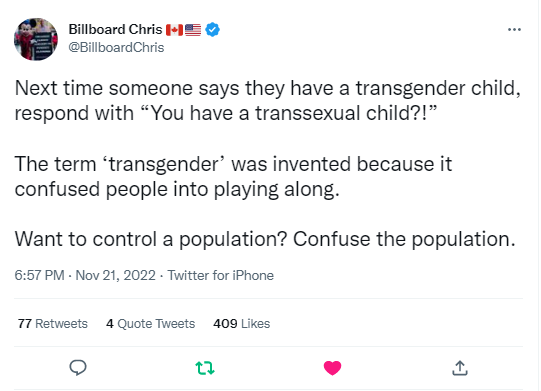
Billboard Chris recommends that we give up on the word "gender." I agree. At its worst, it is an invitation to engage in old and reprehensible stereotypes (because girls who like to play with trucks are 100% girls). At its best, it is a meaningless word. At one point it was a polite way to avoid saying "sex."

By returning to "transexual," we recognize that there are only two sexes and that a person of one sex is presenting as the other. It is not a pejorative. It is recognizing some basic fact. Everyone out there, including people with sexual dysphoria who present themselves as the opposite sex, deserve kindness, respect and full legal rights as a person. Therefore, using "transexual" is truly not an insult. The benefit of using "transexual" is that we are recognizing basic biology and avoiding massive confusion associated with gender ideology. What confusion, you might ask?  How about this chart published by (believe it or not) Scientific American.

Two years ago I was scolded and told it was impolite, but I now disagree. I'm imagining the conversation when I start using transexual again. It will probably come down to a discussion (probably an argument) about who has the final say over how we use words. I'll see how it goes.

Continue ReadingThe Return of Transexual

Three Reasons Why There are Two–and Only Two–Biological Sexes.

Zach Elliot is an author of two books on sex and gender and a producer of 20+ animated videos on sex differences. Here is the intro to his article: "What Are Sexes? There is much confusion in our current culture as to what sexes are and what they are not."

There is much confusion in our current culture as to what sexes are and what they are not. When biologists make a claim about the number of sexes in a species, they are not making a claim about chromosomes, body types, or personal identity; rather, they are making a claim about the number of distinct reproductive strategies in that species.

A reproductive strategy is an evolved system for propagating genes and forming a new individual. In sexually reproducing species, producing a new individual requires the combination of at least two distinct and complementary reproductive strategies. These strategies are fulfilled through the delivery of genetic material in sex cells called gametes, which have half the genetic material of the parent. When two gametes fuse, they form a genetically unique individual with a full set of chromosomes.

Some species reproduce through gametes of the same size (isogamy) and can have many unique reproductive strategies called mating types, which control what gametes can fuse with one another, but their differences do not go far beyond the molecular level. On the other hand, most species in the plant and animal kingdoms reproduce through gametes of differing size and form (anisogamy), where there is an asymmetry in size and behavior between the interacting gametes and often the individual organisms themselves.

When gamete sizes are differentiated (anisogamy), there are typically exactly two sexes, no more and no less. In such systems, the reproductive strategy that produces the smaller gametes is designated as male and the reproductive strategy that produces the larger gametes is designated as female. It is not the physical size of the gametes themselves that differentiates the male and female reproductive strategies, but rather what those size differences represent.

Continue ReadingThree Reasons Why There are Two–and Only Two–Biological Sexes.

Colin Wright Offers a Front Row Seat to a Seminar Featuring Gender Ideology

Colin Wright is a biologist who has followed transgender issues for years and who is not afraid to ask obvious questions. He recently attended an online workshop directed to parents, facilitated by two purported experts in transgender issues. The name of May 26, 2022 workshop was “Supporting Your Trans/Non-Binary Youth: A Starter Guide for Parents and Caregivers." Wright's article sets forth the content of the the seminar along with his criticisms and concerns. You can read Wright's entire article here: "EXPOSED: Gender Workshop for Parents Supporting Trans/Non-Binary Youth Gender “experts” say that children are the real experts." These were experts who could not even tell Colin the difference between a man and a woman or a boy and a girl.

Here is Wright's summary:

This workshop represents the standard introduction into transgender issues. It is not an outlier in terms of content and ideology. The only thing that makes this workshop somewhat unique is the fact that I was there asking the questions that your standard believer never does in order to force the presenters to grapple with fundamental issues with gender ideology.

Are gender identities based on stereotypes? How are “man” and “woman” defined? How can we expect children to understand concepts that people with masters degrees claim is beyond their capacity to understand? These questions should not be viewed as aggressive or out of bounds. These are fundamental questions that any gender “expert” should be able to easily answer, but they can’t. Yet they somehow remain so sure of the truth of what they believe that they’re willing to shuttle children down the path to irreversible hormone and surgical treatments to conform to identities they readily admit are “arbitrary words to describe experiences.”

Children are not the paragons of wisdom and self-knowing that gender “experts” claim they are. Children lack the life experience and perspective to make radical permanent decisions about extreme body modification. It is the duty of parents to apply their real life experience and perspective in order to ensure their children make it through childhood with healthy bodies and minds.

Gender ideology indoctrination does the exact opposite.

Continue ReadingColin Wright Offers a Front Row Seat to a Seminar Featuring Gender Ideology

The Hurdles Faced by Science Teachers

Biologist Luana Maroja, is deeply concerned about hurdles science teachers are facing. Here article is "An Existential Threat to Doing Good Science: What scientists are able to teach and what research we can pursue are under attack. I know because I’m living it.". Here is an excerpt:

We each have our own woke tipping point—the moment you realize that social justice is no longer what we thought it was, but has instead morphed into an ugly authoritarianism. . . .

One of the most fundamental rules of biology from plants to humans is that the sexes are defined by the size of their gametes—that is, their reproductive cells. Large gametes occur in females; small gametes in males. In humans, an egg is 10 million times bigger than a sperm. There is zero overlap. It is a full binary.

But in some biology 101 classes, teachers are telling students that sexes—not gender, sex—are on a continuum. At least one college I know teaches with the “gender unicorn” and informs students that it is bigoted to think that humans come in two distinct and discrete sexes.

Even medical schools and the Society for the Study of Evolution have issued statements suggesting that sexes are on a “continuum.” If this were true, the entire field of sexual selection would be baseless, as its bedrock insight lies in the much larger female investment in reproduction, explaining the demonstrated choosiness in females (who have more to lose) and competitiveness in males (the “abundant” sex in most species, one male can fertilize multiple females). Published papers (see here, for example) ask us to be “inclusive” by limiting the sex discussion to the few species of algae and protists (such as amoebas) that have equal size gametes—even when that has no relevance to any animal or vascular plant.

In psychology and public health, many teachers no longer say male and female, but instead use the convoluted “person with a uterus.” I had a colleague who, during a conference, was criticized for studying female sexual selection in insects because he was a male. Another was discouraged from teaching the important concept of “sexual conflict”—the idea that male and female interests differ and mates will often act selfishly; think of a female praying mantis decapitating the head of the male after mating—because it might “traumatize students.” I was criticized for teaching “kin selection”—the the idea that animals tend to help their relatives.

Continue ReadingThe Hurdles Faced by Science Teachers