Should We Look to Biology or Ideology When Trying to Answer Biological Questions about Transwomen?

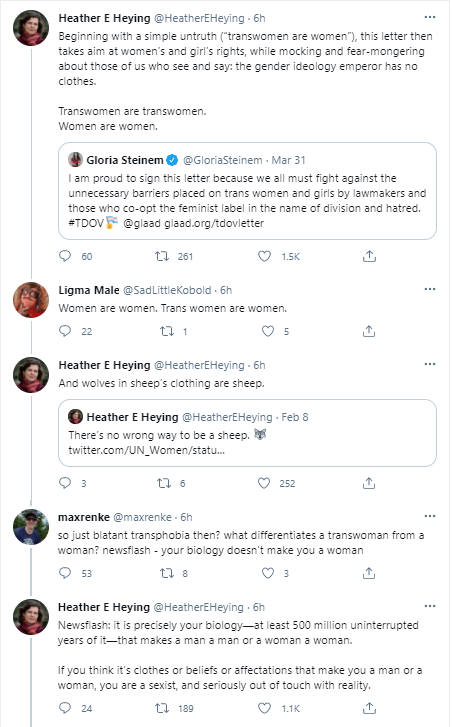
This fascinating exchange starts with a Tweet by Gloria Steinem, to which biologist Heather Heying responds with a science lesson. Some legislatures are bringing this issue to a head and it remains unclear whether we will (as a society) resolve this debate with biology or ideology. Perhaps the battleground will be the dictionary. As Heying says,

Transwomen are transwomen.
Women are women.

Somehow, writing these two sentences is being construed by the Woke as bigotry, with no end in sight as to how or whether this dispute can be resolved.

And as I review this thread, I keep shaking my head, given that a Tweet by Gloria Steinem started this discussion. For many of us, one of the most important parts of feminism is the tenet that the things that you like to do (whether climbing trees or cooking or fixing cars) don't determine whether you are a fully man or woman. These things are irrelevant to your sex. You can be fully a woman even though you like to engage in activities typically associated with men. Yet I keep seeing writings by TRA's that a girl who likes "boy" things is dysphoric, potentially meaning that she should take testosterone and cut off her breasts. Jesus! This is from the same types of people who, 15 and 20 years ago railed at cultures who practiced clitorectomies because it because it is so grotesque to massacre a healthy female body. The TRA's argue that even young teenagers (who are too young to vote or drive) should be granted total deference when social pressures are appearing to be the main thing convincing them to make permanent changes to their bodies that will likely result in sterility. That that is where we are . . .

And the fringe left has pushed its ideology so hard that we are now supposed to think that there is no difference between a woman and a transwoman. There is a clear factual difference, as Heying explains.

None of what I am writing suggests that transwomen aren't entitled to legally and socially present themselves as women in most situations (though I would make exceptions for women's shelters, prisons and sports participation). Transwomen are entitled to our respect. They are human beings every bit as much as the rest of us. Because they are fully human, we owe them the respect of disagreeing with them when their claims violate basic principles of biology.

Here's the beginning of the Twitter Thread:
Continue ReadingShould We Look to Biology or Ideology When Trying to Answer Biological Questions about Transwomen?

What is Passing for Science These Days at Scientific American . . .

If you are looking for science at Scientific American, you'll need to look a litter harder. This is from a Scientific American article titled "It's Time to Take the Penis off Its Pedestal: A culture of phallus worship has slanted the science in crucial and sometimes unexpected ways."

Yet thanks to the assumption that anything large and powerful must be male, a phallus with more imposing qualities—like the hyena’s—gets dubbed a “pseudopenis,” "masculinized" or “malelike.” Those who spend a lot of time with human genitalia see it differently. “What I’ve come to realize is that everything a man has a woman has; everything a woman has, a man has, anatomically,” says Dr. Marci Bowers, a gender affirmation surgeon in Palo Alto who has done more than 2,000 male-to-female surgeries. “The penis is just a large clitoris. In fact, I don’t know why they don’t just call it a large clitoris.” Here’s why: because human biases shape scientific knowledge, and much of what we know about our nether regions has been shaped by lazy, antiquated stereotypes about what men and women are.

On Twitter, biologist Colin Wright is barely holding it together after spotting this article. That's probably because he specializes in writing "old-fashioned" biology article suggesting antiquated things like his claim that there are two biological sexes and that men are different than women. And see here.

In the meantime, back at Twitter, "M" responded to Wright's Tweet with this:

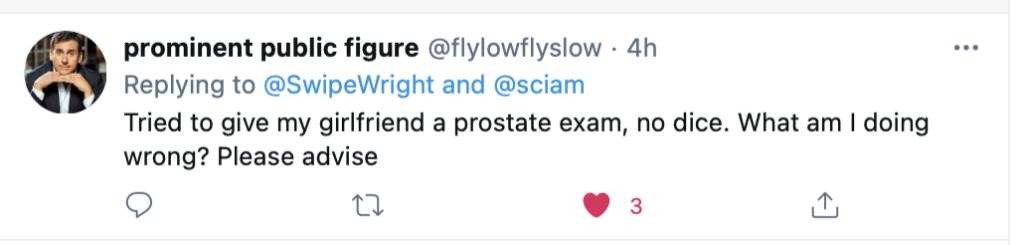
And then "Prominent Public Figure responded with this:

And there were dozens of other responses whose witticisms rivaled in intensity their frustrations of seeing Scientific American's loss of respectability.

Finally, I wanted to know more about Rachel E. Gross, who wrote this "science" article. To my dismay, I noticed that she also wrote for Smithsonian Magazine, though (thankfully) not recently. She has even written about the challenge of getting evangelicals to understand evolution, but that was before her apparent conversation to the religion of Wokeness.

Continue ReadingWhat is Passing for Science These Days at Scientific American . . .

The Kinds of Things You Can Learn About Your Family for $99

Here's a rather amazing thing I recently learned about myself from 23 & Me: "You inherited a small amount of DNA from your Neanderthal ancestors. Out of the 7,462 variants we tested, we found 257 variants in your DNA that trace back to the Neanderthals." 23 & Me further told me I have up to 2% of Neanderthal DNA in my genome.

I've also checked out many hundreds of my 4th-6th cousins. They have many hundreds of last names and, based upon the profile photos, they come in every size, shape and skin color. They reside in dozens of countries all over the world. I have numerous relatives born in Africa, Asia and Australia. Six of my relatives are Egyptian. 34 of my closest 5,000 relatives are at least 25% Ashkenazi Jews.

As I'm learning these things, I'm recalling the joyous presentation A.J. Jacobs made about his expansive family tree at this TED talk.

That a company can reliably tell me these things for $99 would have been unfathomable even a few decades ago--It wasn't until 2003 that scientists could read the complete genetic blueprint for building a human being (the Human Genome Project). These findings and this modest cost to learn these things are stunning. So stunning that, as I found ever more about my family tree tonight, I even chuckled a little Neanderthal chuckle.

Continue ReadingThe Kinds of Things You Can Learn About Your Family for $99

What You Should be Thinking as You Fill Out Your Paperwork at the Doctor’s Office

When you arrive at the doctor's office to check in with the receptionist, you are often handed a small pack of paperwork to fill out. Until that moment, you have probably been focused on your own ailment or your own medical worries. Luckily, for most of us--most of the time--our own health concerns will more or less resolve and life will more or less go on.

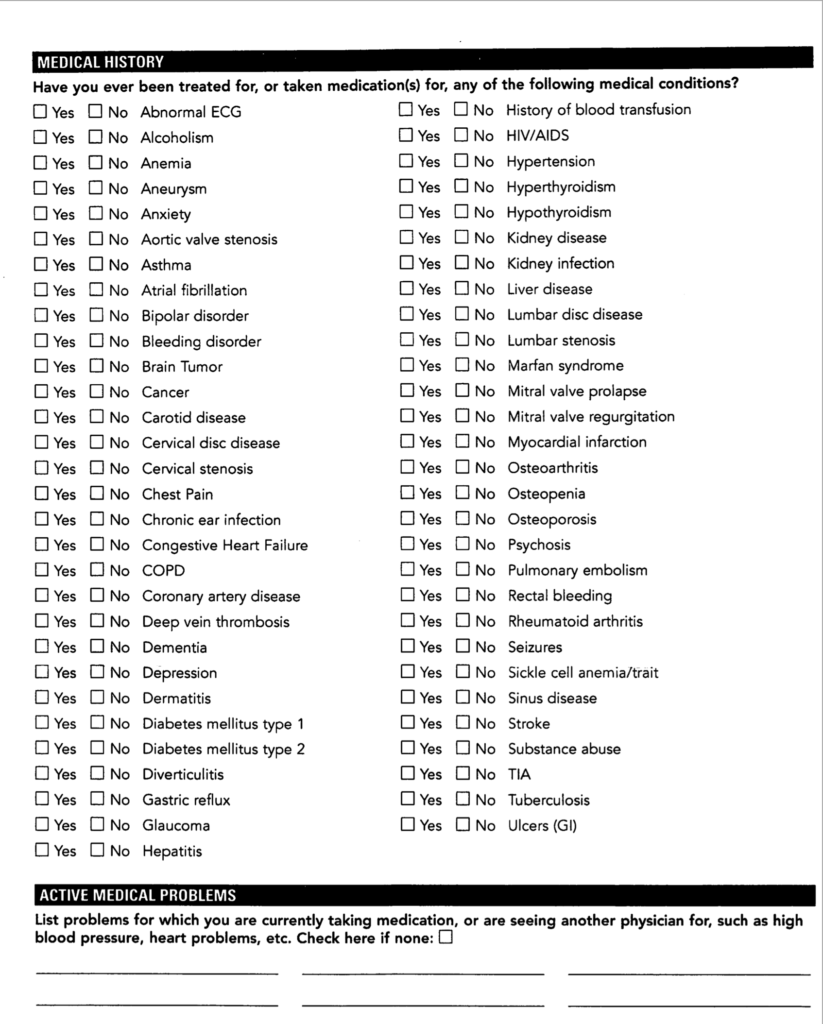
For all of us, however, that typical pack of doctor office paperwork contains a magic page that has the power to boost our happiness through the roof, if only we employ the correct frame of gratitude.  I'm referring to the page that looks something like this:

This page gives us the opportunity to breathe a cosmic sigh of relief that we do not have most of those ailments on that list.  That's how I try to see it as I check off all most of those boxes with a "no." Thank goodness I don't have most of those medical problems. And this is merely the beginning of what I'm proposing as a journey of gratitude.

Instead of thinking about my own health problem, instead of being frustrated that my own body is not operating perfectly, the above page is a reminder that my body is an extraordinarily complex adaptive system--lots of little parts have self-organized into something so complicated that it seems miraculous. No humans could possibly make a tongue or an eye or a liver as high functioning or as elegant as the natural versions.

Imagine that humans in the distant future worked very hard and came much closer to making a reasonably functioning robotic human. Then imagine their supervisors sending down a new work order to make sure that this robot is also sentient.  Imaging the groaning you would hear from the engineering team! Then imagine that the supervisors send down another new work order to make sure that this artificial human could also repair itself if it became damaged!  Imaging louder groaning, especially when the supervisors remind the team that this self-repair must respond to hundreds of millions of microscopic threats and do it as well as the human immune system. 

Then imagine that the supervisors send down yet another work order advising the team that they must design their human so that it runs on almost anything that it puts in its mouth.  Even louder groaning.  Mutiny is threatened.

Finally, thousands of years later, when millions more engineers (and their great great great great grand-engineers) have successfully created a passable artificial human, the supervisors call down with one more new request:  Make sure that these artificial humans can create tiny artificial humans the size of a pinpoint that will grow, within the body of one of the robots, into large artificial humans who become wise through their interactions with any of dozens of environments.  Then imagine all the engineers quitting their jobs.

At the doctor's office, our question should not be "Why doesn't my body work perfectly?"  We shouldn't even complain that we sometimes have one or more of those ailments on the long checklist handed to us by the doctor's receptionist. A better question is "How is it possible that the actions of countless individual molecules self-organize into trillions of cells that result in emergent coordinated macroscopic behaviors such as the ability to walk into a doctor's office?"  Even more simply, the first question should always be "How is it possible that human bodies work at all, ever?"

Answer not forthcoming.

Continue ReadingWhat You Should be Thinking as You Fill Out Your Paperwork at the Doctor’s Office