
How to Be a Human Animal, Chapter 7: Your Amazing Body

Chapter 7: Your Amazing Body

Hello again, newborn baby. I’m here again to give you advice on many important topics. This is our seventh visit, the seventh chapter to this 100-chapter story.

Today we are going to talk about your amazing human animal body. First of all, you don’t have a body. Rather, you are a body. “You” is shorthand for trillions of cells that somehow work together. When “you” decide you are hungry, that is actually trillions of microscopic cells coordinating their separate energies into a few macroscopic actions: crying for milk, sucking and then swallowing the milk. How did that miracle of coordination happen? Honest people don’t claim to know.

All of this is pre-verbal for newborns like you—done without the use of words. This seemingly makes you brilliant but actually this puts you into the same predicament as chimpanzees, pigs, mice and earthworms. Your amazing body almost entirely takes care of itself without needing any words at all. And when you finally develop language, you’ll have only the illusion that those words are pulling the strings, whereas your words are only an epiphenomenon. Whenever you “decide” to say “hello,” something else made you “decide.” Your words don’t cause your words, because that would be an eternal regress. We will save the rest of this dangerous topic for another day, however.

People think they know their bodies, but they know almost nothing. We don’t even know how it is that “we” control our breathing or how the body does this automatically when “we” ignore it. We don’t even know how we think thoughts or imagine the ocean. We don't know how we keep from falling over as we run down the sidewalk on our two peg legs. We don’t even know how it is that we are able to start peeing. Or how we digested yesterday’s meal.

Some people will protest and claim that we do know a lot of things. I agree. We know a LOT of things and it is wonderfully useful to know those things. This knowledge allows us to invent smartphones, medicines and rockets. But we never get totally to the bottom of anything. We think we are explaining, but we are only describing. As I was once told by philosopher Andy Clark, “An explanation is a description that makes us feel good.” We have only thin explanations in a deep world. As Nietzsche said,

Just beyond experience!– Even great spirits have only their five fingers breadth of experience – just beyond it their thinking ceases and their endless empty space and stupidity begins.

Maybe we don't fully and deeply understand anything but certainly we can make things, right? Not really. We can only rearrange things. As Carl Sagan said, ““If you wish to make an apple pie from scratch, you must first invent the universe.” Making things worse, when we do rearrange things, they always eventually fall apart, as Heraclitus noticed thousands of years ago.

We appear to be dynamic patterns rather than bodies. The stuff of the universe moves in and out of us, yet somehow the pattern and form our bodies more or less remains. We are thus like flames, though far more complex. We turn bananas into poop to assist our largely subconscious effort to pass our genes to the next generation. How's that for complexity, especially when we figured out how to transport our bananas to our city from 1,000 miles away by using a flying aluminum tube?

We like to say that we understand basic things like how our body works, but that is mostly to keep our sanity. We say lots of things to reassure ourselves, yet we don't even know how our words convey meaning from person to person. We blithely accept words as substitutes for deep understanding because we must. We are experts at concealing our ignorance of our own bodies. Nietzsche had a lot to say about this self-ignorance:

Does nature not conceal most things from him-even concerning his own body, in order to confine and lock him within a proud deceptive consciousness, aloof from the coils of the bowels, the rapid flow of the bloodstream, and the intricate quivering of the fibers! She threw away the key. And woe to that fatal curiosity which might one day have the power to peer out and down through a crack in the chamber of consciousness and then suspect that man is sustained in the indifference of his ignorance by that which is pitiless, greedy, insatiable, and murderous-as if hanging in dreams on the back of a tiger.

Now, back your body. It is more complex than you will ever be able to imagine, multiplied by fifty trillion. Your liver is an immense chemical factory packed into one side of your abdomen and it works extremely well even though we don’t have any deep knowledge of how it works. We notice correlations and we attribute causation, but the magic is in the complex fluid movements and as we drill down from biology to physics to quantum physics, the ultimate “things” we would like identify as the objects of our explanations smear into wave patterns.

OK. Maybe that is too esoteric. Let's simplify. Have you ever considered your ankles? Mundane ordinary ankles. They are a collection of bones so small you can almost wrap your hand around them, yet they hold up your body all day long and they can last for 100 years. Even one ankle can hold up your entire body weight, even if you hop. How is that possible. If they get injured they usually fix themselves. How is that possible?

How is it possible that the body is so good at patterns of actions such as peristalsis, vomiting, sneezing and orgasms, where the body orchestrates a complex cascade of mini-actions? And we haven’t yet mentioned the brain, three pounds of such “mind-blowing” complexity that it allows us to fire up our memory and imagine walking through our house! We can generate mental representations in such exquisite detail that we can find our keys while lying in bed with our eyes closed! “I left my keys on the back porch!” And it doesn't help us to blithely say that our brain is like a computer. Our brain does not work like a modern computer. It doesn't have architecture anything like a computer. Further, everything thought we think is infused with emotional valence.

Instead of working like a store-bought computer our brain seem to run on connectionist architecture that excels at pattern matching. We’re “good at frisbee, but bad at math.” That’s another observation by Andy Clark. We have thinking meat in our brains. How does meat think? How is that possible? If all of this unnerves you, perhaps you would rather conclude that thinking goes on somewhere other than in a body, perhaps in a disembodied soul. That is a dramatic fail.As neuroscientist Antonio Damasio concluded: "There is no such thing as a disembodied mind. The mind is implanted in the brain, and the brain is implanted in the body."

We have immune systems that are factories of natural selection (and much more) within our own bodies. They identify and neutralize complex threats without requiring us to think about those threats. How powerful are immune systems? When someone dies, their body starts to “rot” within a few hours. But the bugs and microorganisms that devour bodies at death are always trying to devour our living bodies too, but bodies, relying on their immune systems, usually beats the invaders decisively. That’s how powerful your immune system is. Without a functioning immune system, a newborn baby like you would never make it to two days of age.

On a microscopic level, there is probably a lot more going on in our bodies than we even want to know. Yesterday, for example, you were oblivious that your body defeated pre-cancerous cell that would have replicated and killed you in a year. Again, it’s probably a really good thing that “you” aren’t needed to keep your body running well. If you were in charge of your body, all of the harrowing microscopic things going on underneath your skin would scare the shit out of you and you wouldn’t have a clue about what to do about any of this.

As you grow up, look at your hands often and marvel at them. Think about how amazing they are, giving you the power to grasp and sense and fight and caress. The hand: a multi-function tool if there ever was one. Your hands are all the evidence you need that your body is extraordinary.

And now please note that we’ve only discussed a few of your amazing body parts. There are hundreds more, including your tiny ear bones which, millions of years, ago served as jaw bones in our reptile ancestors.

Take care of your body. It’s more amazing than anything a science-fiction writer could imagine. Be good to it. Thank the stars that you inherited something so incredibly complex and functionl that defies deep explanation.
Continue ReadingHow to Be a Human Animal, Chapter 7: Your Amazing Body

How to Be a Human Animal. Chapter 4: You are (Indeed) an animal.

Chapter 4: You are an animal.

I need you to listen very carefully because most of the people who enter your life are extremely uncomfortable with the thing that I’m about to tell you.

You are an animal, a human animal. You are a tail-less primate, an ape. Your DNA is 99% the same as the DNA of a chimpanzee. We have great great great . . . grandparents who are also the great great great grandparents of modern day chimpanzees, and that’s just the beginning. We are cousins with every other living thing. You and that potted peace lily hanging near the window are biologically cousins. We are part of an extremely complex web of life, not separate from it or in charge of it in any meaningful way because that web includes our bodies. And even this deep relatedness to every other living thing is only the tip of the iceberg because, as Carl Sagan noted, we are made of materials that were manufactured by ancient stars.

Our Sun is a second- or third-generation star. All of the rocky and metallic material we stand on, the iron in our blood, the calcium in our teeth, the carbon in our genes were produced billions of years ago in the interior of a red giant star. We are made of star-stuff. . . . The cosmos is within us. We are made of star-stuff. We are a way for the universe to know itself.”

There are real-life consequences to being made of elements and being part of a vast ecosystem. Mostly, life is not like a video game. You will get only one body and if you ruin it, you don’t get a another body. You’ll need to take care of your body or the laws of physics and biology will cause your body to be ruined and nature does not care about your feelings. If you fail to take care of your body, you’ll become miserable and you might even die young. You would think that these well-demonstrated risks would cause all of the human animals to take care of their bodies, but everywhere you look, you’ll notice a lot of other human animals ruining their bodies by over-eating, seeking out addictions and acting recklessly. For example, you won’t believe how badly many people drive. Many of them willingly take their eyes off the road while their car is streaking down the highway in order to watch cat videos or to check the stock market.

Here are some additional amazing things. All of us carry around clear evidence that we descend from other animals and sometimes the evidence is especially clear. For instance, some of us have vestigial tails and gills. As Neil Shubin reminds us, we each have an "Inner Fish." We have evolved to who we are and we continue to evolve, as evidenced by lactose tolerance in many of us. You would think that this overwhelming evidence, including our exquisite resemblance to the other great apes, would make it clear to everyone that we are, indeed, animals. But many of the human animals you will meet are extremely uncomfortable with that thought. They think of themselves as above the other animals on the “chain of being.” Perhaps it is due to their fear of death, which they work hard to paper over with various types of tribal pursuits and ideology.

There are mere bandaids because you don’t have much say in who you are. Your trillions of cells are interacting in complex ways with each other and with the outside world and you don’t have a clue as to what is going on with most of this action. Your brain will like do a good job (like it does for most other human animals) of convincing you that Life is essentially simple and understandable. Someday, you can read about the many experiments that have been done to demonstrate that fear of death triggers massively creative and energized denial of death. That area of study is called "terror management theory."

Your complex biological and physical properties mean that your thoughts and actions have deep causal chains far away from you and inaccessible to that person you think of as “you.” To the extent that there is a meaningful “you” is another topic for another day, however.

To summarize, you are the beneficiary of a great gift: a human body. Use it wisely because you only have about 1,000 months to use it and then your time is up.

You are also the recipient of an immense cultural basket of gifts. All of the ideas that have survived the test of thousands of years will be yours for the asking. All kinds of things like language, math, art. Treasures beyond belief will be offered to you. You are probably excited to hear this. But then you’ll notice that many, perhaps most people ignore most of these treasures. Many of them would rather rant on social media or engage in tribalistic endeavors like watching millionaire athletes for many hours per week.

Given our immense biological and cultural inheritance, you would think almost all of us would should great gratitude for how lucky we are every day in many ways. We are an odd species, however. We are difficult to predict, hard to please, impatient, insecure and generally unwilling to live in accordance the sacred principles we utter. We’ll talk again tomorrow. There is nothing simple about this precious life you are just starting to live.

Continue ReadingHow to Be a Human Animal. Chapter 4: You are (Indeed) an animal.

How the Far Left Sees Masculine Men

Andrew Sullivan discusses men like Joe Rogan and Jordan Peterson who don't shy away from being masculine. They are commonly derided by the political Left, including the Woke Left. The title to his article: "Between The World And Men Truckers, Rogan, Peterson and the revolt of masculinity." Here's an excerpt:

No, the left is not calling all masculinity toxic. But they get pretty quiet when you ask for a definition of non-toxic masculinity that doesn’t end up sounding like being a woman. And, no, they’re not explicitly denying that there are biological differences between men and women — they just speak and act on the premise that there aren’t, that boys do not need a different kind of education than girls, that all-male groups are problematic, and that finding a way to direct masculinity to noble ends is somehow enabling the oppression of women, or gay people. The result is that men are subject to left derision, right machismo, and complete cultural derailment.

And that’s where Joe Rogan and Jordan Peterson come in. They too, of course, are mocked constantly, demeaned as chauvinists or white supremacists, etc. But what Rogan does is speak and talk the way men do with each other in private, which, in this media era, is a revelation. He doesn’t entertain the woke bromides of gender theory because he’s lived a life, clearly loves being a man as much as Adele says she loves being a woman, and believes, as he once put it, that “bad men are just bad human beings who happen to be men.”

Continue ReadingHow the Far Left Sees Masculine Men

What to Say When You are Asked for your Pronouns

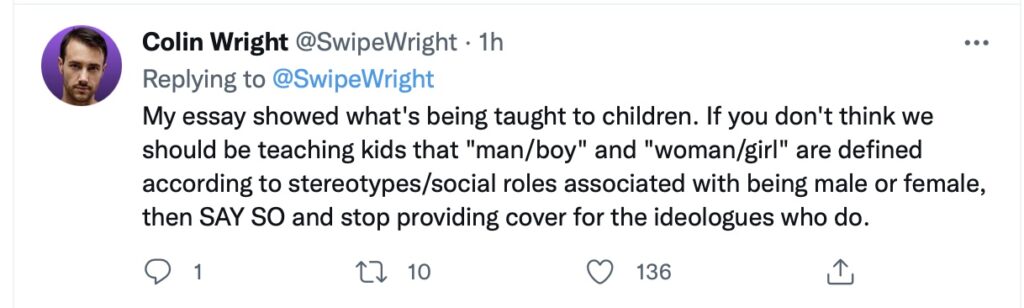
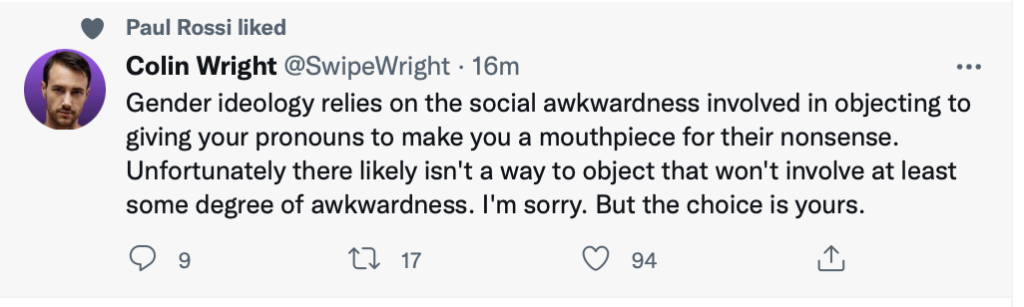
For those of us who understand that sex is a biological term that applies to possums, wolves, elephants and humans, what should we say when asked for our "pronouns"? Colin Wright says we should refuse to answer the question. I think a bare refusal is a bit rude. People asking for pronouns often don't mean any harm, even though they are implicitly asking you to buy into an ideology that conflicts with biology, often without awareness that they are doing this. I agree with Wright that a request for pronouns constitutes stereotyping.

What would I do next time I'm asked? I might respond by saying something like: “Sign me up as a human being who doesn't believe in stereotyping." If that triggers an awkward silence, perhaps I would follow up: "But by all means, I'm not telling anyone else how to respond . . ."

Wright's article appears in the Wall Street Journal. The title is "When Asked ‘What Are Your Pronouns,’ Don’t AnswerA seemingly innocuous question masks a demand for conformity with a regressive set of ideas." Here's an excerpt:

Gender activists believe that being a man or a woman requires embracing stereotypes of masculinity or femininity, respectively, or the different social roles and expectations society imposes on people because of their sex. Planned Parenthood explicitly states that gender identity is “how you feel inside,” defines “gender” as a “a social and legal status, a set of expectations from society, about behaviors, characteristics, and thoughts,” and asserts that “it’s more about how you’re expected to act, because of your sex.” . . .

So when someone asks for your pronouns, and you respond with “she/her,” even though you may be communicating the simple fact that you’re female, a gender ideologue would interpret this as an admission that you embrace femininity and the social roles and expectations associated with being female. While women’s-rights movements fought for decades to decouple womanhood from rigid stereotypes and social roles, modern gender ideology has melded them back together. . . .

Let me offer an analogy. [Imagine a] request from the American Federation of Astrologers encouraging everyone to begin conversations with, “Hi, I’m a Sagittarius. What’s your sign?” To respond with your own star sign would be to operate within and signal your tacit agreement with the belief system of astrology.

Here is a free pdf of Colin Wright's article.

Continue ReadingWhat to Say When You are Asked for your Pronouns

Richard Dawkins: Race is on a Spectrum, Sex is “Pretty Damn Binary.”

Richard Dawkins answers the "dangerous" question he asked in April 2021, the question that caused him to be disowned by the American Humanist Association. The title to his article at Areo: "Race Is a Spectrum. Sex Is Pretty Damn Binary."

Were race not a spectrum, Rachel Dolezal’s critics should have spotted that she wasn’t “really” black, simply by taking one look at her. It’s precisely because black Americans are a spectrum that it wasn’t obvious. With negligible exceptions, on the other hand, you can unwaveringly identify a person’s sex at a glance, especially if they remove their clothes. Sex is pretty damn binary.

If I chose to identify as a hippopotamus, you would rightly say I was being ridiculous. The claim is too facetiously at variance with reality. It’s marginally more ridiculous than the Church’s Aristotelian casuistry in identifying the “substance” of blood with wine and body with bread, while the “accidentals” safely remain an alcoholic beverage and a wafer. Not at all ridiculous, however, was James Morris’s choice to identify as a woman and his gruelling and costly transition to Jan Morris. Her explanation, in Conundrum, of how she always felt like a woman trapped in a man’s body is eloquent and moving. It rings agonizingly true and earns our deep sympathy. We rightly address her with feminine pronouns, and treat her as a woman in social interactions. We should do the same with others in her situation, honest and decent people who have wrestled all their lives with the distressing condition known as gender dysphoria.

Sex transition is an arduous revolution—physiological, anatomical, social, personal and familial—not to be undertaken lightly. I doubt that Jan Morris would have had much time for a man who simply flings on a frock and announces, “I am now a woman.” For Dr Morris, it was a ten-year odyssey. Prolonged hormone treatment, drastic surgery, readjustment of social conventions and personal relationships—those who take this plunge earn our deep respect for that very reason. And why is it so onerous and drastic, courageously worthy of such respect? Precisely because sex is so damn binary! Changing sex is a big deal. Changing the race by which you identify is a doddle in comparison, precisely because race is already a continuous spectrum, rendered so by widespread intermarriage over many generations.

Continue ReadingRichard Dawkins: Race is on a Spectrum, Sex is “Pretty Damn Binary.”