Thought for the day
"In politics, absurdity is not a handicap." - Napoleon Bonaparte (1769 - 1821)

"In politics, absurdity is not a handicap." - Napoleon Bonaparte (1769 - 1821)
I don’t like the magazine Psychology Today. Instead of presenting the latest psychological findings in a layman-friendly format, the monthly instead peddles relationship advice and thinly-veiled book advertisements. So while I wouldn’t recommend a subscription to anyone (you’d better serve yourself by subscribing to a division of the APA), the magazine did feature one article in February 2005 that piqued my interest: Psychology’s Top Ten Misguided Ideas.
Composed by the Cambridge Center for Behavioral Studies Director Dr. Robert Epstein, the ten-part list includes many psychological buzzwords and memes that the pop psych crowd (like most Psychology Today readers) still consider legitimate. I’d like to discuss a portion of Epstein’s list below:
1. Projective Tests
The popular images of psychology and psychiatry have a few iconic mainstays. You know the therapist cliché: a patient laid on a long couch, rambling about childhood trauma to a near-silent facilitator scribbling away. In nearly equal footing, many people associate projective tests, such as word association and Rorschach ink blots, with legitimate psychology.
The logic behind projective tests says that a therapist can quickly dig into a client’s preoccupations and mindset based on their knee-jerk responses to ambiguous things. This assumes that a patient would always see the same thing in the same ink blot; a sex addict would always recall lewd scenes; a veteran with Post-Traumatic-Stress-Disorder would always recognize carnage.
But projective tests neglect the effect of priming entirely. A wide variety of psychological studies have demonstrated that earlier access …

At this Cape Cod history and genealogy page, you can find a collection of hundreds of quotes regarding superstition and reason. I had not seen many of these quotes before. Here's a sampling: A fanatic is one who can't change his mind and won't change the subject. - Winston Churchill You…
To say that the corrupted interests of massive corporations have twisted and perverted the social and political system into a flimsy chessboard sounds, of course, paranoid and highly cynical. No wonder then that casual observers of the democratic process scoff at claims of widespread corporate corruption as an outlandish conspiracy…
Last week, at Washington University, I attended a lecture by architect Edward Mazria, who speaks nationally and internationally on the subject of climate change and architecture. Mazria’s organization, Architecture2030 is dedicated to “slowing the growth rate of greenhouse gas emissions and then reversing it over the next ten years.” His proposals are getting lots of attention among architects.
As he states at his website, it is imperative that we deal seriously with CO2. It will
require immediate action and a concerted global effort. As Architecture 2030 has shown, buildings are the major source of demand for energy and materials that produce by-product greenhouse gases. Stabilizing emissions in this sector and then reversing them to acceptable levels is key to keeping global warming to approximately a degree centigrade (°C) above today’s level.
Mazria began his talk with a PowerPoint presentation that largely paralleled Al Gore’s presentation in “An Inconvenient Truth.” Here’s how he sizes things up currently:
Two profound, life changing events are converging to create the most significant crisis of modern time— the warming of the earth’s atmosphere by burning fossil fuels, and the rapid depletion of global petroleum and natural gas reserves. As these events intensify over the coming years, they will dramatically change how we live and how we relate to the natural world.
Here’s how Architecture2030 illustrates the warming of the earth (see the Architecture2030 site for better resolution):
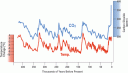
As you can see, CO2 levels (the upper blue line) have never been as high as they …