FAIR’s Pro-Human Pledge

I fully support the mission of the Foundation Against Intolerance and Racism (FAIR). That mission is expressed in "The Pro-Human Pledge" of FAIR:

Fairness. “I seek to treat everyone equally without regard to skin color or other immutable characteristics. I believe in applying the same rules to everyone, and reject disparagement of individuals based on the circumstances of their birth.”

Understanding. “I am open-minded. I seek to understand opinions or behavior that I do not necessarily agree with. I pursue objective truth through honest inquiry. I am tolerant and consider points of view that are in conflict with my convictions.”

Humanity. “I recognize that every person has a unique identity, that our shared humanity is precious, and that it is up to all of us to defend and protect the civic culture that unites us.”

For more information on FAIR and to sign the pledge, you are invited to visit FAIR.

Continue ReadingFAIR’s Pro-Human Pledge

A Robust Defense of Color-Blindness by Coleman Hughes

Coleman Hughes warns that the claims of many activists that those of us who seek color-blindness are claiming that we don't see different shades of skin color. This argument is disingenuous. Given that I'm a photographer, I need to set my camera and lights to capture flattering portraits of all kinds of people and skin color can be a factor in how I set my equipment. Further, beautiful people come in all colors. Here are a few excerpts from Coleman's article, "Actually, Color-Blindness Isn't Racist."

"“Color-blind” is an expression like “warm-hearted”: it uses a physical metaphor to encapsulate an abstract idea. To describe a person as warm-hearted is not to say something about the temperature of that person’s heart, but about the kindness of his or her spirit. Similarly, to advocate for color-blindness is not to pretend you don’t notice color. It is to endorse a principle: we should strive to treat people without regard to race, in our public policy and our private lives.

. . .

In the early 1960s, there was an elite consensus that color-blindness was the goal of race politics. Then the race riots of the late 1960s led politicians and corporations to perform an about-face. They began implementing race-based policies as a hasty and pragmatic response to the riots—much like governments and corporations did in response to the riots of 2020. Today, you can scarcely find a professor in an elite institution who would defend color-blindness.

This is a grave mistake. Color-blindness is the best principle with which to govern a multiracial democracy. It is the best way to lower the temperature of racial conflict in the long run. It is the best way to fight the kind of racism that really matters. And it is the best way to orient your own attitude toward this nefarious concept we call race. We abandon color-blindness at our own peril."

Continue ReadingA Robust Defense of Color-Blindness by Coleman Hughes

The Problem with Many DEI Trainings

Jesse Singal raises many red flags regarding DEI trainings in his article, "What if Diversity Trainings Are Doing More Harm Than Good?" I agree with many of his concerns, but I don't think it took any research to be wary of these trainings. In fact, the default should have been to not hold any such "trainings" until they could be shown to be effective in encouraging human flourishing. That was not done, of course, so now we have a multi-billion dollar industry that is self-interested in promoting these struggle sessions in order to maintain continued employment, often at absurd levels of compensation.

D.E.I. trainings are designed to help organizations become more welcoming to members of traditionally marginalized groups. Advocates make bold promises: Diversity workshops can foster better intergroup relations, improve the retention of minority employees, close recruitment gaps and so on. The only problem? There’s little evidence that many of these initiatives work. And the specific type of diversity training that is currently in vogue — mandatory trainings that blame dominant groups for D.E.I. problems — may well have a net-negative effect on the outcomes managers claim to care about." ....

Many popular contemporary D.E.I. approaches meet these criteria. They often seem geared more toward sparking a revolutionary re-understanding of race relations than solving organizations’ specific problems. And they often blame white people — or their culture — for harming people of color. For example, the activist Tema Okun’s work cites concepts like “objectivity” and “worship of the written word” as characteristics of “white supremacy culture.” Robin DiAngelo’s “white fragility” trainings are intentionally designed to make white participants uncomfortable. And microaggression trainings are based on an area of academic literature that claims, without quality evidence, that common utterances like “America is a melting pot” harm the mental health of people of color. Many of these trainings run counter to the views of most Americans — of any color — on race and equality. And they’re generating exactly the sort of backlash that research predicts.

Continue ReadingThe Problem with Many DEI Trainings

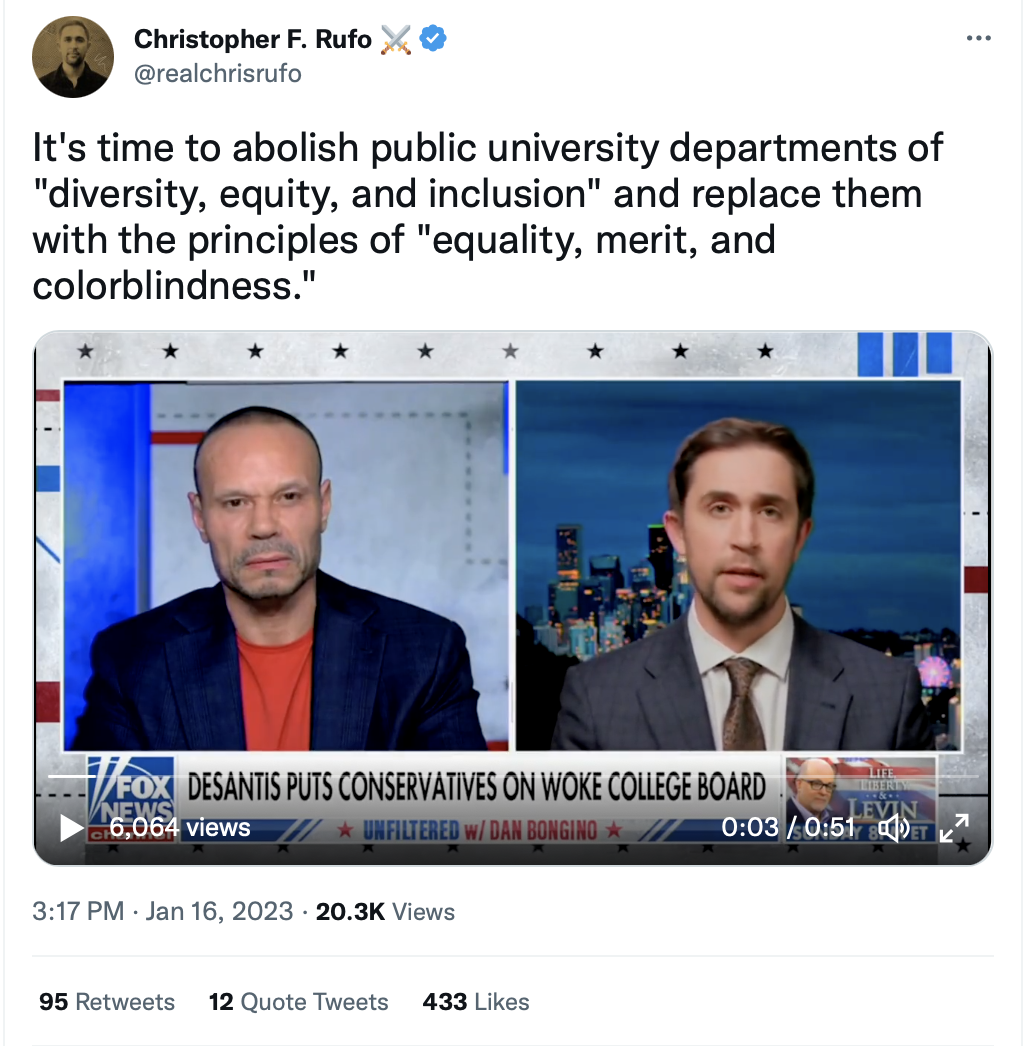
It’s Time to Abolish, Redefine and Rebuild University DEI Departments.

The people of the United States need to have a robust and wide-open conversation on this proposal. I don't know that a meaningful conversation would be possible, however, given that so many people now support censorship, cancellation, ad hominem attacks, words-are-harmful, Manicheanism and the idea that we should divide all people into two--count'm, two--"colors." I think Chris Rufo is correct in his prediction that a large majority of Americans would support his proposal.

In the meantime, the annual DEI budget for the University of Michigan is $18M.

The university’s vice provost for equity and inclusion, Tabbye Chavous Sellers, is the highest-paid DEI staffer. Sellers, the wife of former DEI provost Robert Sellers, makes $380,000. Seventeen DEI staffers make more than $200,000 in total compensation, according to the data. Ninety-five staffers make more than $100,000 in total compensation.

That annual expenditure would be enough money to pay the instate tuition for 1,075 students.

Continue ReadingIt’s Time to Abolish, Redefine and Rebuild University DEI Departments.

FAIR Discusses its Mission

End of Year Message by Bion Bartning, Founder of FAIR (Foundation Against Intolerance and Racism), discussing the genesis and mission of FAIR:

When I was a child growing up in Newton, Massachusetts, I was passionate about civil rights. I wanted to do my small part to help “heal the world”—and move us ever closer to the promise outlined in the Declaration of Independence: that every person was created equal, and that we are all entitled to unalienable rights including “life, liberty and the pursuit of happiness.”

Martin Luther King Jr. was a hero to me, and still is. I remember the day several years ago that I first shared his ‘I Have a Dream’ speech with my two young children. He spoke the truth about our shared humanity, equal protection under the law, access to equal opportunity for all, and why it was important to treat our fellow Americans with dignity and respect. I thought, growing up, that everybody shared these values.

As a young teenager in 1988, I did not understand why our governor at the time was pilloried as a “card-carrying member of the ACLU”—which I viewed as an organization committed to standing up for the individual civil liberties that are promised to all Americans under the Constitution. Freedom of speech. Freedom of religion. Equal protection under the law. I saw the ACLU as a vigilant guardian, fighting to protect our hard-won individual rights and freedoms.

Perhaps that was true at one time—but, as I discovered a few years ago, and many recognized much earlier, the ACLU is no longer the vigilant and nonpartisan civil liberties organization that we desperately need. Rather, it is a highly partisan fundraising machine that contributes to the ever-increasing polarization in our culture, while bringing in almost $400 million per year through the ACLU and ACLU Foundation, plus millions more through its state-level chapters.

And where does the ACLU spend all of the money that it raises from individuals and corporations? In 2021, Anthony Romero, CEO of the ACLU, was paid over $1 million. This is an astounding amount for a nonprofit organization to spend on one person—and, together with the significant salaries of the other key employees, shows the degree to which, perhaps, money and a careerist mindset motivates and drives the people at the top of the ACLU.

As founder and CEO of FAIR, I have never taken, and will never take, any salary or compensation. In fact, FAIR’s total payroll, for its entire team of paid staff members combined, is substantially less than the $1 million that the ACLU spends on its CEO alone. For almost two years I have donated, and will continue to donate, my time, energy, and money to support FAIR. The same is true of the other volunteers and donors involved in building FAIR since its launch last March—including Letitia Kim, head of the FAIR legal network, our chapter leaders, Board of Advisors, and hundreds of other courageous individuals.

Why do so many of us choose to be part of this? While we may not agree on every issue, we are all passionate about FAIR’s nonpartisan mission, and to advancing the values, principles—and individual freedoms—that are the foundation of a healthy, functioning, pluralistic society. I was compelled to found FAIR after seeing how the same illiberal and intolerant ideology that had infected my children’s school had caused the ACLU and other civil rights organizations to stray from their missions. I saw the urgent need for a new, truly nonpartisan, organization committed to advancing individual civil rights and liberties for all Americans—and that is exactly what we are building, with your support and involvement, at FAIR.

Continue ReadingFAIR Discusses its Mission