
Ignorant Educators Disparaging IQ Facts

No, I don't like that some people are innately more intelligent than others. It doesn't seem fair. If I were the creator of the universe, I would have given everyone the same tools for learning and achieving. That said, I often read and hear people disparage IQ as a measurement. Without any basis, they claim that it is a poor measure of intelligence when IQ is actually one of the most valid and reliable measurements in all of psychology. Next time I hear that it is a poor measure, I'll ask the person: "Assume that you are about to start a new for-profit company in a competitive industry. You need to hire 100 employees. You can either hire 100 people with IQs of 90 or 100 people with IQs of 130. Now choose."

BTW, I don't know my own IQ. Therefore, I'm not writing this article from any sort of perch. And I guarantee that whatever my IQ might be, there are many people out there with significantly higher IQs than me.

I don't know what drives this belief among teachers, but it does seem to be another instance of social contagion, much like "phonics is bad" and "gender affirming care for children is good and necessary." Just because it's taught in school by well-meaning teachers doesn't mean that it's true.  There is also a vast literature disparaging IQ as an illegitimate measure. My first encounter with a strong attack on IQ was Stephen J. Gould's The Mismeasure of Man. 

What's the truth about IQ? Steve Stewart-Williams Recently commented on Education's Elephant in the Room, by Russell T. Warne (at Quillette), offering these excerpts:

The differences among students’ educational achievement start early and increase as children grow. By 5th grade, the average American classroom has children whose achievement in mathematics and reading ranges from the 2nd grade level to the 8th grade level or higher. It is simply impossible for a single teacher to prepare lessons in every subject that allow every student to learn new information. Some sort of ability grouping, in which students at similar levels of achievement are taught together, is necessary...

What causes these individual differences in intelligence and achievement that educators are so determined to deny, downplay, or ignore? …

This is where educators get really nervous, because the major cause of individual differences in intelligence seems to be genetics. The heritability of IQ varies, but in wealthy, industrialised countries, it approaches .80 in adults, which indicates that eighty percent of individual differences in IQ are associated with individual genetic differences. In young children, heritability of IQ is lower, but it hits .50 at about age ten and continues to increase into adulthood before levelling off…

In a British survey, only 29 percent of teachers thought that genes were one of the top three factors affecting student achievement. In other words, the scientific research shows that genes are usually more important than every environmental cause combined, and yet most teachers don’t even believe that genes rank in the top three causes of educational achievement…

I subscribe to the website of Steve Stewart-Williams, The Nature-Nurture Nietzsche Newsletter. He offers lots of rigorous research along with citations and his own insightful commentary. I highly recommend his work, including his article, "12 Things Everyone Should Know About IQ: here's a lot of IQ misinformation out there." '' He comments:

But like many ideas in psychology, IQ is the subject of a lot of misunderstandings and misinformation. Some believe that IQ tests are basically meaningless - that they don’t measure intelligence in any real sense or tell us anything about IQ-test takers except how good they are at taking IQ tests. Others go further, arguing that IQ research is malign pseudoscience aimed only at justifying discrimination.

None of these claims is true! Psychologists studying IQ have learned a great deal about this form of intelligence over the last century, and have an excellent track record of replicating their results. They know how to measure IQ; they know how nature and nurture help shape IQ; and they know how IQ helps shape people’s lives.

In this post, I’ll outline twelve key findings from IQ research that everyone ought to know. Whether you’re a fan of IQ or a skeptic, I hope you’ll find something here to surprise and challenge you!

His first topic (of the 12) dovetails with Warne's article:

1. IQ is one of the most heritable psychological traits – that is, individual differences in IQ are strongly associated with individual differences in genes (at least in fairly typical modern environments). IQ is nearly as heritable as physical traits like height. And the only other psychological traits with similar heritability levels are psychiatric conditions like autism and schizophrenia.

Below I am setting out the other eleven topics, but I recommend the article in its entirety:

2. The heritability of IQ increases from childhood to adulthood.

3. IQ scores have been increasing steadily for the last century or so, a phenomenon known as the Flynn effect.

4. IQ predicts many important real-world outcomes

5. Higher IQ is associated with a lower risk of death from most causes

6. Higher IQ is associated with lower rates of most forms of mental illness.

7. More generally, IQ tests are among the most reliable, predictive measures in psychology – one of the field’s crowning achievements.

8. Despite its excellent psychometric properties, many people are allergic to the concept of IQ. Ironically, this includes many intellectuals.

9. Perhaps as a result of the academic allergy to IQ, there’s some evidence that researchers are less likely to publish studies showing a link between IQ and students’ grades: the reverse of the usual publication bias for positive findings.

10. The antipathy to IQ is unfortunate.

11. IQ tests have other potential benefits.

12. Last but not least, here’s a list of ten common myths about IQ, from Stuart Ritchie’s book Intelligence: All That Matters.
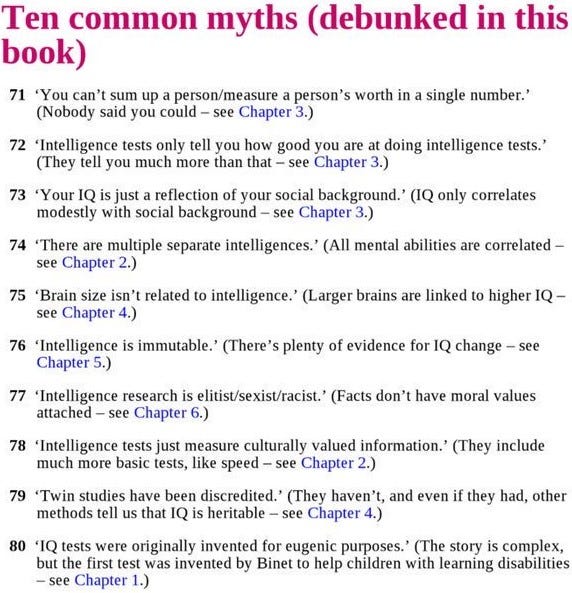
Continue ReadingIgnorant Educators Disparaging IQ Facts

About Our Societal Death Spiral . . .

Gad Saad writes:

A fundamental question that I ask people when I'm gauging their intellectual honesty is to describe for me what the evidence would need to look like in order for them to alter a given position that they hold. With that in mind, is there any reality that would cause the West to snap out of its parasitic ideological rapture and implement the necessary cataclysmic auto-corrective measures? If yes, we must still have some hope to hold on to. If not, it is going to be a painful death spiral.

Let's start by trying to convince people to use basic induction to convince them that A = A. That would be a good start. It's the basis for the Rule of Law.

Continue ReadingAbout Our Societal Death Spiral . . .

The Lies that Destroy Institutions

Do you ever wonder what is keeping you from saying the simple, good-hearted and obvious statement: "All Lives Matter"? It's the modern version of woke totalitarianism. Through the use of lies and cancel culture, it is destroying most of America's institutions.

Michael Shellenberger, author of "Totalitarian Manipulation Of Language Behind Woke Destruction Of Harvard, New York Times, And Other Elite Institutions. It's time for counter-Wokeism."

Investigative reporters have exposed a pattern of plagiarism by Harvard’s president, Claudine Gay, that directly violates the university’s policy. . . .

The first salient feature of the above episodes is the willingness of institutional leaders to lie about what they are doing. The first response from Harvard’s Board of Directors was to deny that President Gay had committed any instance plagiarism and to threaten the New York Post with a lawsuit if it reported the opposite of that. The New York Times similarly lied about the op-ed piece it had published and effectively asked the oped page editor to lie about his departure. And similarly, the AAA falsely claimed that the anthropologists who wanted to discuss biological sex on a conference panel had not accurately represented their topic.

In each case, the institutional leaders lied in order to cover up unethical behavior. Harvard was covering up both the plagiarism of its president and the unwillingness of Harvard to do anything about it. The New York Times misrepresented the substance of the op-ed in order to disavow it and, perhaps, to justify forcing out the op-ed page editor. And the AAA lied about what the dissident anthropologists did in order to justify its blatant censorship.

And those lies and unethical behaviors all rest upon a set of underlying lies. Harvard lied when it claimed that it had selected its president on the basis of her qualifications, even calling Gay a “scholar’s scholar” despite her having a below-average scholarly record. The New York Times and the Harvard president, when she was still the Dean of Arts and Sciences, had been misrepresenting Black Lives Matter protests as peaceful and driven by a genuine epidemic of police killings. And AAA’s cancelation of the panel was based on the organization’s claim that biological sex is a spectrum rather than dimorphic. All of this lying is characteristic of totalitarian regimes...

Woke totalitarianism advances values that are contrary to the ones it espouses. It claims to be opposed to racism and sexism and yet promotes them through perpetuating the idea that people, by dint of their race or sex, are either victims or oppressors. It claims to be liberatory and empowering of those individuals designated victims while promoting the idea that they cannot escape their victim identity. And Woke totalitarianism promotes the notion that it is wise and truthful despite promoting such monstrous lies."

What is the solution? It's not going to be pleasant or easy, but we need to confront those who are tearing down our institution with their corrupted language.

Once we understand Woke activists and leaders in elite institutions as being in the grip of an anti-social and dehumanizing dogma which uses dishonest esoteric language to manipulate emotions and people, we can know to take them seriously, but not literally. At an interpersonal level, the best way to deal with narcissists is to ignore them, thereby depriving them of the attention they seek; at an institutional level, they must be confronted in a public way.

Continue ReadingThe Lies that Destroy Institutions

About Sasha Stone’s Podcast

This week, a friend introduced me to one of his favorite podcasts: "Sasha Stone's Free Thinking Through the Fourth Turning."

I jumped right into Sasha' most current podcast, "The Mugshot Heard Round the World: Did the Democrats finally make a Trump voter?"" Sasha is intensely and creatively thoughtful and her non-partisan ideas will emotionally move for those of us who are not completely enraptured with one political tribe. Hence, the "Free Thinking" part of the title to her podcast.

Despite the paltry and insulting offerings to American voters year after year, the challenge is still to vote for the lesser of two evils, right? What is the lesser of two evils in 2024, at the point where the Democrats have repeatedly shat upon the rule of law, desperately embraced censorship and become louder cheerleaders for endless war than even the Republicans?

And will this be the year when black voters thoroughly reject the political party that has repeatedly taken them for granted, often in insulting ways? I'm speaking of the Democrats. I'm basing this question on several conversations I've recently had over the past month, but Sasha also sees a wider trend based on her own research.  And I don't think that most loyal democrats have the faintest inkling that these tectonic plates are dramatically shifting.

In this single episode, Sasha repeatedly challenged me, forcing me to reframe some of my long-held ideas. I immediately became a subscriber. I invite you to listen if you are looking to be challenged.

Continue ReadingAbout Sasha Stone’s Podcast

Ressentiment Redux

Nietzsche, painted a vivid image of ressentiment that is applicable in modern times:

They monopolize virtue, these weak, hopelessly sick people, there is no doubt of it: "We alone are the good and just," they say, "we alone are homines bonae voluntatis.*" They walk among us as embodied reproaches, as warnings to us--as if health, well-constitutedness, strength, pride, and the sense of power were in themselves necessarily vicious things for which one must pay some day, and pay bitterly: how ready they themselves are at bottom to make one pay; how they crave to be hangmen. There is among them an abundance of the vengeful disguised as judges, who constantly bear the word "justice" in their mouths like poisonous spittle, always with pursed lips, always ready to spit upon all who are not discontented but go their way in good spirits. Nor is there lacking among them that most disgusting species of the vain, the mendacious failures whose aim is to appear as " beautiful souls" and who bring to market their deformed sensuality, wrapped up in verses and other swaddling clothes, as "purity of heart": the species of moral masturbators and "self-gratifiers." The will of the weak to represent some form of superiority, their instinct for devious paths to tyranny over the healthy--where can it not be discovered, this will to power of the weakest!

--Genealogy of Morals, Third Essay, Section 15 (1887)

Translation by Walter Kaufmann (1967)

*Men of good will

Continue ReadingRessentiment Redux