Greg Lukianoff Recommends Martin Gurri’s “The Revolt of the Masses”

I just spotted this review of The Revolt of the Masses by Greg Lukianoff." Greg's review has convinced me to order my own copy of The Revolt of the Masses.

Excerpts:

“The Revolt of the Public” explains that the shifts in media technologies that we believe accelerated American political polarization and played havoc with young people’s mental health were actually part of a much larger global transformation that Gurri calls “The Fifth Wave.” Essentially, the empowerment of vast multitudes of people to communicate directly with the world and with each other has genuinely transformed society. Unfortunately, in its current state, this media revolution has only been able to tear things down; institutions, ideas, and yes, even people (a.k.a. cancel culture). This idea is what Gurri calls “negation.”

. . . . Gurri shows how this manifested in the 2011 Arab Spring and how it has had ripple effects in Spain, Israel, and the American Occupy Wall Street movement. Gurri also argues that these movements generally were rich with targets: people, institutions, and ideas that needed to be torn down, but those same movements were often very hesitant to offer constructive solutions or realistic reforms. This hopeless point of view amounted to a kind of nihilism, according to Gurri—usually not the kind of nihilism of the philosophers, but a de facto nihilism in which nothing constructive is proposed to replace what needs to be torn down.

You can see this in American society in everything from “End the Fed,” to “abolish the police,” to cancel culture on both the right and the left, and to the absolute negation of all assumptions represented by the QAnon conspiracy.

One thing that must be said about the “crisis of authority” we find ourselves in due to the overwhelming power of negation is that very often what critics have discovered is that our existing “knowledge” was truly based on some pretty thin evidence, bad assumptions, and sometimes not much more than the pieties of some elites. Understanding the crisis of authority as only being wrongfully destructive of expertise is to miss that, frankly, we are often asking far too much of expertise and experts, and oversight itself has not been all that rigorous. Negation is indeed tearing things down that needed to be torn down; unfortunately, it seems to be taking everything else with it.
Continue ReadingGreg Lukianoff Recommends Martin Gurri’s “The Revolt of the Masses”

An Inert People is “the Greatest Menace” to our Republic

Voting is obviously important. But as citizens of these United States, one of our most sacred obligations is to work hard between the elections.  We need to talk with each other or else we will not be a united community, but only an ugly place were "factions" fight each other. For the Founders factions were one of their biggest fears.  Here are Madison's words from "The Federalist No. 10":

Among the numerous advantages promised by a well constructed Union, none deserves to be more accurately developed than its tendency to break and control the violence of faction. The friend of popular governments, never finds himself so much alarmed for their character and fate, as when he contemplates their propensity to this dangerous vice. He will not fail therefore to set a due value on any plan which, without violating the principles to which he is attached, provides a proper cure for it. The instability, injustice and confusion introduced into the public councils, have in truth been the mortal diseases under which popular governments have every where perished . . .

By a faction 1 understand a number of citizens, whether amounting to a majority or minority of the whole, who are united and actuated by some common impulse of passion, or of interest, adverse to the rights of other citizens, or to the permanent and aggregate interests of the community. ...

There are two methods of curing the mischiefs of faction: the one, by removing its causes; the other, by controlling its effects....

The latent causes of faction are thus sown in the nature of man; and we see them every where brought into different degrees of activity, according to the different circumstances of civil society. A zeal for different opinions concerning religion, concerning Government and many other points, as well of speculation as of practice; an attachment to different leaders ambitiously contending for pre-eminence and power; or to persons of other descriptions whose fortunes have been interesting to the human passions, have in turn divided mankind into parties, inflamed them with mutual animosity, and rendered them much more disposed to vex and oppress each other, than to co-operate for their common good. So strong is this propensity of mankind to fall into mutual animosities, that where no substantial occasion presents itself most frivolous and fanciful distinctions have been sufficient to kindle their unfriendly passions, and excite their most violent conflicts. But the most common and durable source of factions, has been the various and unequal distribution of property.

Madison viewed "pure democracy" as a dangerous thing.

[More . . . ]

Continue ReadingAn Inert People is “the Greatest Menace” to our Republic

David Talbot’s Deep-Dive into the Corruption of the CIA

I'm reading The Devil's Chessboard, David Talbot's 2015 page-turner about Alan Dulles and the CIA. Excerpts:

In the view of the Dulles brothers, democracy was an enterprise that had to be carefully managed by the right men, not simply left to elected officials as a public trust....

[W]hen Allen Dulles served as the United States’ top spy in continental Europe during World War II, he blatantly ignored Roosevelt’s policy of unconditional surrender and pursued his own strategy of secret negotiations with Nazi leaders....

Allen Dulles outmaneuvered and outlived Franklin Roosevelt. He stunned Harry Truman, who signed the CIA into existence in 1947, by turning the agency into a Cold War colossus far more powerful and lethal than anything Truman had imagined. Eisenhower gave Dulles immense license to fight the administration’s shadow war against Communism, but at the end of his presidency, Ike concluded that Dulles had robbed him of his place in history as a peacemaker and left him nothing but “a legacy of ashes.” Dulles undermined or betrayed every president he served in high office....

Dulles would serve John F. Kennedy for less than a year, but their briefly entwined stories would have monumental consequences. Clearly outmatched in the beginning by the savvy spymaster, who beguiled Kennedy into the Bay of Pigs disaster, JFK proved a quick learner in the Washington power games. He became the first and only president who dared to strip Dulles of his formidable authority. But Dulles’s forced retirement did not last long after Kennedy jettisoned him from the CIA in November 1961. Instead of easing into his twilight years, Dulles continued to operate as if he were still America’s intelligence chief, targeting the president who had ended his illustrious career. The underground struggle between these two icons of power is nothing less than the story of the battle for American democracy....

Continue ReadingDavid Talbot’s Deep-Dive into the Corruption of the CIA

My Current Default Position About COVID Booster Vaccines

I received two COVID shots as well as a booster. Then, about six months ago I got COVID, which had me feeling down in the dumps for 3 days, which also left me with a loss of strength and balance for a few weeks after that. I'm hearing a lot about the alleged need for all of us to get more and more boosters lately. Should I? I'm not a scientist. I don't know how to read the medical research with confidence. I thought we would all have clear answers about COVID and boosters by now, but it has never been less clear. And now we have Twitter Files indicating that the U.S. government has been warping the conversation about COVID and vaccines, even having a hand in shutting down well-decorated medical professionals who disagree with the national narrative of "get lots and lots of booster shots." I wish we had dependable information about the following:

1. Whether boosters are meaningfully effective

2. Whether boosters are safe; and

3. Whether the risks of boosters (according to some) outweigh the benefits of booster (according to others).

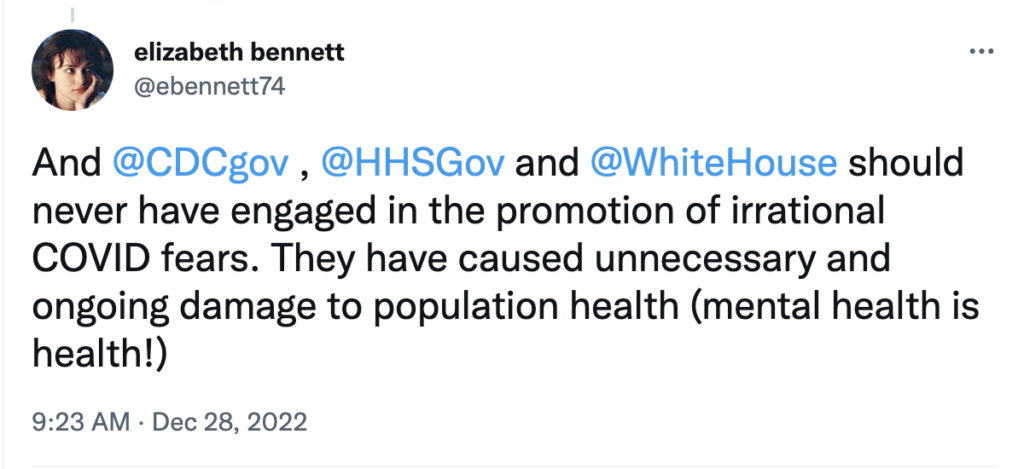
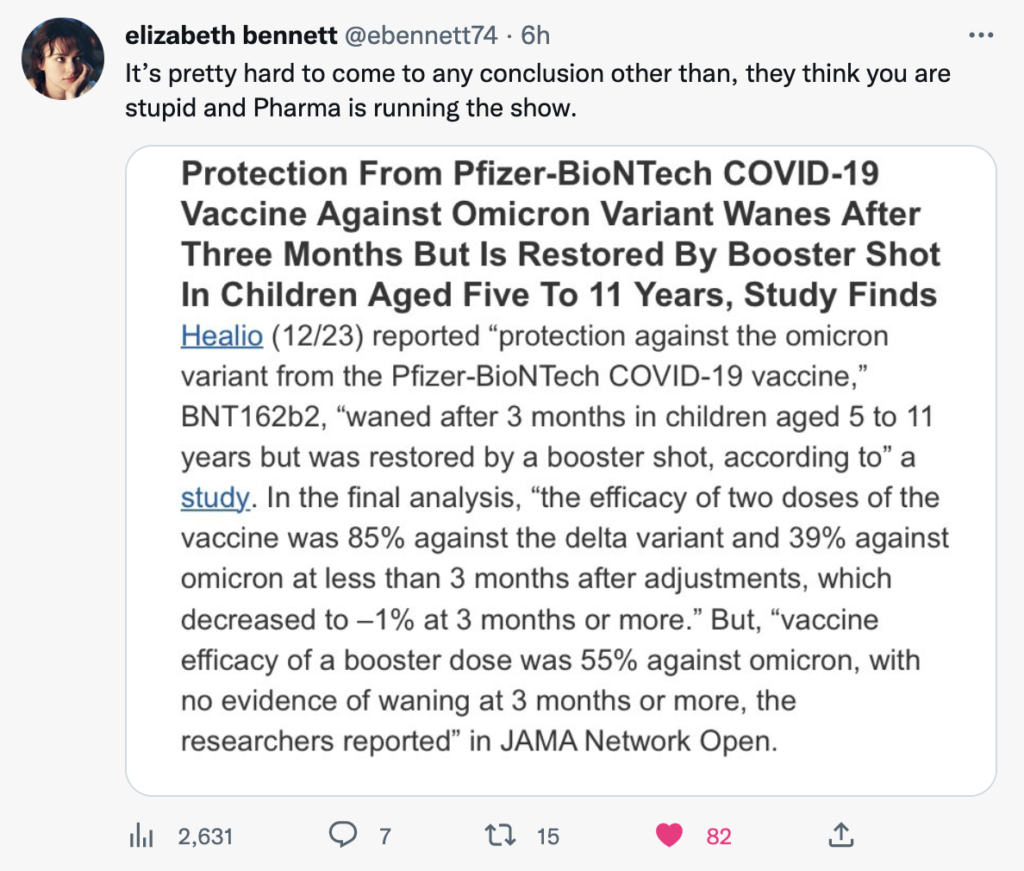
It doesn't help that public health officials and CDC have been so wrong about so many things over the last few years. The evidence on this includes the internal reversals of CDC policy (e.g., No need for a mask, then you must wear a mask; getting the jab will keep you from getting COVID, then not so much). Every time there is a new pronouncement reversing a prior pronouncement, it is presented with equal confidence. Thus, it is not surprising to see recent statistics showing that ever greater numbers of Americans are refusing to get the newest boosters. But also consider comments by doctors such as "Elizabeth Bennett" on Twitter:

I am one of the many people who are now somewhere between disoriented, distrusting and disgusted with the state of COVID information. I am not alone:

In the absence of reliable information and wide-open vigorous conversation among our medical professionals, the rest of us need to act on assumptions and guesses. I am assuming that I am at more risk if I get yet another new booster than if I refuse it. I'm open to new information, of course, but I'm highly concerned that doctors and researchers with legitimate concerns about the boosters are still being shut out of the conversation. I've seen ample confirmation of this censorship--many doctors and researchers being completely shut down by Twitter for instance.  I also see many serious sounding accusations like these.  I would like to know a lot more information. I would like to have credible answers to these 130 highly specific concerns assembled by Steve Kirsch.

In the meantime, no more boosters for me.

Continue ReadingMy Current Default Position About COVID Booster Vaccines