
Cost of our new high-speed trains is dwarfed by the tax dollars we waste in our Afghanistan and Iraq “wars.”

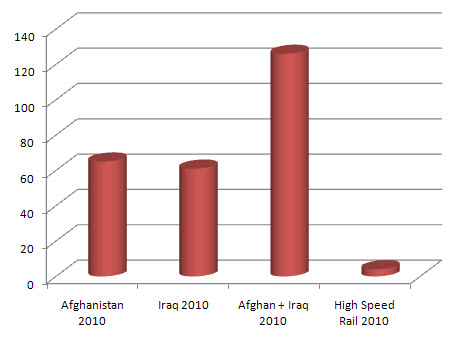
President Obama has recently announced that he will allocate $8 billion ($4 billion each year, over two years) to develop a new system of high-speed passenger rail service. This is an excellent idea. The new rail lines will be created within 10 geographical corridors ranging from 100 to 600 miles long. Note, however, that the high-speed rail line system will be an extremely expensive project, and that the $8 billion bill will need to be paid by 138 million tax-paying Americans. Dividing the $8 billion cost by the number of taxpayers, we can see that, on average, each taxpayer will pay almost $60 ($30 per year, for two years) to support this massive new high-speed rail service. Again, this high-speed rail project will cost an immense amount of money. Consider, though, how small this pile of rail money looks when compared to the amount of money we are wasting in the "wars" in Iraq and Afghanistan. For 2009, the United States spent approximately $87 billion for Iraq and $47 billion for Afghanistan. The fiscal 2010 budget requests $65 billion for Afghanistan operations and $61 billion for Iraq. the cost of these two "wars" together is $126 billion for 2010. Compare these expenditures on a bar chart: Graph by Erich Vieth
Continue ReadingCost of our new high-speed trains is dwarfed by the tax dollars we waste in our Afghanistan and Iraq “wars.”

Wikileaks struggles to stay alive

Wikileaks has shut down, hopefully temporarily, for lack of money. Here's what you'll see if you visit the site:

The Sunshine Press (WikiLeaks) is an non-profit organization funded by human rights campaigners, investigative journalists, technologists and the general public. Through your support we have exposed significant injustice around the world—successfully fighting off over 100 legal attacks in the process. Although our work produces reforms daily and is the recipient of numerous prestigious awards, including the 2008 Economist Freedom of Expression Award as well as the 2009 Amnesty International New Media Award, these accolades do not pay the bills. Nor can we accept government or corporate funding and maintain our absolute integrity. It is your strong support alone that preserves our continued independence and strength.
To help out, visit Wikileaks and make a donation. I just donated, because Wikileaks has proven itself to be a critically important resource for allowing us to really know what is going on and I wanted to do my part.

Continue ReadingWikileaks struggles to stay alive

The Politics of War Crimes

I sometimes can't shake the feeling that everything is wrong. Down is up, wrong is right, war is peace, and lies are truth. Take, for example, the issue of torture. We as a society have regressed to the point where we find it acceptable to use torture. We use it explicitly, openly, without any concern for the consequences. Of course, some of the consequences (like increasing terrorism) are inevitable, whether we choose to be concerned with them or not. But that's really beside the point-- the simple point that I am amazed by right now is that we torture people. That, and the fact that it's not a major controversy. The Land of the Free, the Home of the Brave, with tyranny and torture for all. Since the usual arguments against our torture policy have proven ineffective, I want to elaborate a bit. The usual arguments involve questions of efficacy-- that is, whether torture is effective or not. (It's not). In fact, the CIA officer who argued that waterboarding was so effective that it cracked hardcore terrorists the first time (and within 30 seconds!) has now recanted his story. When he came out with the story of how waterboarding worked so well, he was called the "Man of the Hour", but now hardly anyone is mentioning that it was all lies. Go figure that a CIA guy would lie to his own countrymen, right? In any case, the issue of waterboarding, or any of the various "enhanced interrogation techniques", is a red herring. The truth is that we are engaged in far worse abuses.

Continue ReadingThe Politics of War Crimes

NASCAR Patches for Congressmen

I heard one new idea in last night's State of the Union. In response to the Supreme Court deciding that multi-national corporations should have all the rights of individual breathing citizens -- allowing them to spend whatever they want to influence elections (as reported here) -- Obama suggested that all contacts between lobbyists and public servants be publicly documented. This includes the identity of the client corporations and amounts of money and time involved. The applause were uneven. This morning a new FaceBook group appeared: 'Our Corporate Congress': Make NASCAR-type patches mandatory Congress-wear. I'm not much of a joiner, but I like this idea. Allow the Congressman from Exxon to proudly wear the oil patch right next to his Monsanto and Pfizer badges. Let the senator who filibusters public transit bills proudly show his AAA patch and Ford logo.

Continue ReadingNASCAR Patches for Congressmen

Howard Zinn, Author of People’s History, deceased.

Back in the late 70's I was profoundly moved when I read Howard Zinn's People's History of the United States. It was a critically important head-twisting contrast to the history that I had been taught in grade school and high school. Howard Zinn died today at the age of 87. Here is an excerpt of Amy Goodman's interview of Howard Zinn in May, 2009 (video available at this same site):

You know, should we tell kids that Columbus, whom they have been told was a great hero, that Columbus mutilated Indians and kidnapped them and killed them in pursuit of gold? Should we tell people that Theodore Roosevelt, who is held up as one of our great presidents, was really a warmonger who loved military exploits and who congratulated an American general who committed a massacre in the Philippines? Should we tell young people that? And I think the answer is: we should be honest with young people; we should not deceive them. We should be honest about the history of our country. And we should be not only taking down the traditional heroes like Andrew Jackson and Theodore Roosevelt, but we should be giving young people an alternate set of heroes. Instead of Theodore Roosevelt, tell them about Mark Twain. Mark Twain—well, Mark Twain, everybody learns about as the author of Tom Sawyer and Huckleberry Finn, but when we go to school, we don’t learn about Mark Twain as the vice president of the Anti-Imperialist League. We aren’t told that Mark Twain denounced Theodore Roosevelt for approving this massacre in the Philippines. No. We want to give young people ideal figures like Helen Keller. And I remember learning about Helen Keller. Everybody learns about Helen Keller, you know, a disabled person who overcame her handicaps and became famous. But people don’t learn in school and young people don’t learn in school what we want them to learn when we do books like A Young People’s History of the United States, that Helen Keller was a socialist. She was a labor organizer. She refused to cross a picket line that was picketing a theater showing a play about her. And so, there are these alternate heroes in American history.
One of Zinn's themes is that we can't depend on "the government" to lead us. We need always to carry the burden ourselves. Governing well is always self-governing.
[Martin Luther] King believed—and this actually is one of the themes of our people’s history, is that you cannot depend on presidents, and you cannot depend on elections and voting to solve your problems. People themselves, organizing, demonstrating, clamoring, they are the only ones who can push the President and push Congress into change. And that’s what we have to do now with Obama. We have to point to what Obama said in the course of the campaign, when he said we not only have to get out of Iraq, we have to get out of the mindset that brought us into Iraq. Obama, himself, has not gotten out of that mindset yet. And I think we, the people, have to speak to him about that.

Continue ReadingHoward Zinn, Author of People’s History, deceased.