The Underlying Cause of the Immigrant Crisis: Attempted Election Rigging

What are we to do with the many millions of people who poured over the border during the Biden Administration, while the Biden Administration denied that it was happening and then denied that it could do anything to stop the flow of unvetted people over American borders?

I know this is a complex issue at this point, but it has been more and more clear to me that this movement of migrants across our borders was orchestrated by the Biden Administration for the purpose of electing Democrats in swing states. What to do with millions of people who are illegally here now? Especially given the negative impact mass unvetted immigration has had on many parts of the US, including increased crime. It's a big mess, but it's important to understand what happened and why. Joe Rogan sums it up well when discussing the possibility that Kamala Harris might run for president in 2028:
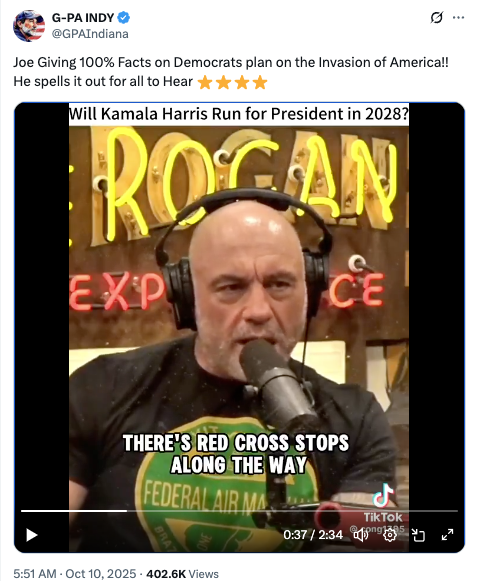
I'll ask [Harris] controversial things, man. It's all I have to do is ask you, Why [was] the border open?" We can talk about that for three hours. Oh my gosh. What are you trying to do? Right? You could close that border. Trump closed that border in a day. Amazing. In a day. You could say I hate what's going on with ice, and I don't like it either. I don't like this thing of like taking people.

And here's the thing, well, they should have done it the right way. But if you're poor and you live in a third world country, that's not an available option. Okay? What is an available option is this one administration over four years was encouraging people to go through, not only encouraging you to go through. There's Red Cross stops along the way. They give you maps. They tell you how to do it. People are being, they're funding people getting in. They're paying for air flights. They're flying people in. They're moving people into swing states. They're getting them on Medicare. They're getting them on Social Security.

We talked about this one lady who did an interview. She was being told to try to get people on permanent disability. So she was told to ask them, "Do you have back problems?" They're like, yes, okay, great, personal disability. Now that she she said I was told to view them as a client now, And so you're trying, essentially to bribe people to Now, once you get them in to move to swing state. Then they count on the census. Once they count on the census, it adds congressional seats. So it's like you're rigging elections by bringing in immigrants, and then you're giving them money.

And all these people that live in these poor communities, they're like, "Hey, where was all this money for us? Where was all this money for the people in Chicago? In Chicago? Where was all this money the people in Baltimore?" No, no, they're doing it because they're trying to manipulate the election. It didn't work. You know, it didn't work. Like, I got into an argument someone about it. But, yeah, it didn't work, though. I go, Yeah, but they tried to do it. It didn't work.

But they did move people to swing states. They did leave the border open for four years. They did let in millions of people. They don't even know how many. They don't know how many people got through. That's crazy. Once they got them here, they did give them EBT cards. They did give them cell phones. They did. They moved them into the fucking hotel, that Roosevelt Hotel in New York City, this luxury hotel filled with migrants. They paid for their food. They did do this. They encouraged people. They did have sanctuary cities where they weren't going to arrest them. They let them come in.

Every bit of the above is easily substantiated by searching first hand accounts on X. Almost none of it can be found in corporate media outlets. Therefore, there's no way to discuss it civilly with people "across the aisle" since, factually speaking, we come from two almost non-overlapping informational ecosystems.

Continue ReadingThe Underlying Cause of the Immigrant Crisis: Attempted Election Rigging

Julian Assange Discusses Trump and Russia; Hillary Clinton and Russia

Julian Assange has proven himself highly principled and courageous. He has broken more meaningful stories in the past 20 years than all corporate media combined. in this video he discusses his findings regarding Donald Trump and Russia, as well as Hillary Clinton and Russia.

As summarized by RealRobert:

As Secretary of State, Hillary Clinton accepted a $3 million bribe from the Kremlin. Simultaneously, her top advisor and campaign chairman, Pizzaman John Podesta, received a $35 million bribe through Rusnano—a company widely known as “Putin’s Child.”

The price? Control over twenty percent of the United States’ uranium supply, surrendered to foreign interests.

Uranium—the critical element for nuclear weapons.

The cost? Treason at the highest level.

Continue ReadingJulian Assange Discusses Trump and Russia; Hillary Clinton and Russia

RFK, Jr.: Three Rules About Totalitarianism

[Transcription by Camus on X]

RFK Jr: " And I would tell you there are three rules that we should all remember.

One is that when a government takes a power from us, a right from us, it will never voluntarily relinquish it.

Number two, any power the government takes from us, it will ultimately abuse to the maximum extent possible.

Number three, nobody ever complied their way out of totalitarianism.

We need to resist, resist, resist."

Continue ReadingRFK, Jr.: Three Rules About Totalitarianism

The Continuing Cover-Up of Russiagate

I know more than a few people who swear that Donald Trump colluded with Russia to win the 2016 election. They "know" this because they limit their informational ecosystem to the New York Times, Washington Post and other corporate media outlets. When the Columbia Journalism Review published its August 1 paean to the New York Times, Matt Taibbi took exception to the many well-documented lies and distortions published by the NYT on this topic and also called out the CJR. Here's an excerpt of Taibbi's well-deserved response to the CJR, titled "Open Letter to the Columbia Journalism Review, on the Atrocious New York Times: The ostensible high priests of journalism should be able to detect the difference between passable coverage and epic, historic failure":

Letter to Bill Grueskin, former Dean of the Columbia Journalism School, on his recent article in the Columbia Journalism Review

Mr. Grueskin,

Regarding your August 1 article, “Knowing: Still Only Half the Battle,” which lauds Charlie Savage of the New York Times for having “dissected and eviscerated” Director of Intelligence Tulsi Gabbard’s claims about corruption of intelligence in the Trump-Russia investigation:

You praised Savage’s article, “New Reports on Russian Interference Don’t Show What Trump Says They Do,” as an example of the work of an “experienced beat reporter” who can distill complex stories into a “coherent, compelling whole.” Your sub-headline stressed the importance of “showing receipts” in journalism, where “most people don’t follow stories very closely,” but “they can learn a lot when an experienced beat reporter helps them sort out what’s important and what’s chaff.”

Chaff.

Except — and you should know this because the Columbia Journalism Review published over 20,000 words on the subject in January 2023 — Savage and his colleagues at the Times have badly miscovered this story for nearly a decade, and continue to do so. The 2018 Pulitzer Prize the paper won on the topic along with the Washington Post will go down as the same kind of “disgrace” as its 1932 Pulitzer for Walter Duranty’s breathless coverage of Stalin’s Russia. In this case, the Times drifted so far from its traditional mission that it became an animating motive for Gabbard and other investigators in Donald Trump’s administration.

It is critically important to remember here that in 2023, Jeff Gerth excoriated the NYT for its "coverage" of Russiagate.

Jeff Gerth's article critically examined how the media, particularly The New York Times, amplified the "Russia thing" narrative, often relying on anonymous sources and incomplete context, such as the Times' reporting on a February 2017 story about Trump campaign contacts with Russian intelligence, which Comey later criticized as “almost entirely wrong.” Gerth argued that the NYT often lacked rigor, contributing to a polarized public perception and Trump’s distrust of the press, as evidenced by his “enemy of the American people” rhetoric.

The piece also critiques the media’s handling of leaks, such as Comey’s memos, and the subsequent appointment of Special Counsel Robert Mueller, suggesting that sensationalized reporting fueled a narrative that sometimes outpaced evidence. Gerth points to specific examples, like the Times’ failure to fully retract or clarify disputed stories, and contrasts this with other outlets like The Washington Post, which included more context in their reporting. Through interviews and analysis, Gerth underscores a broader pattern of media overreach, arguing that the lack of accountability and reliance on uncorroborated sources damaged credibility.

Continue ReadingThe Continuing Cover-Up of Russiagate