How did democracy cease to be in Iran?

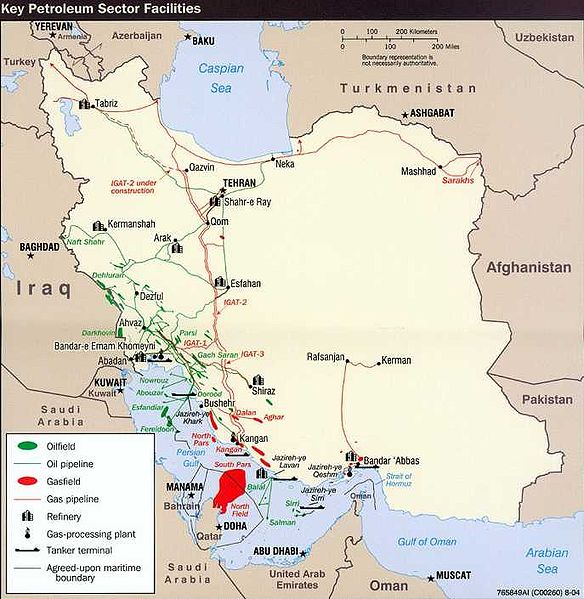
What happened to democracy in Iran? It didn't die a natural death. Iranian democracy was killed by well known actors that included British Petroleum and the United States. You can learn more by listening to Stephen Kinzer, former New York Times reporter, who was iran-oil-creative-commonsinterviewed by Amy Goodman of Democracy Now (video interview). From the 1920's through the 1940's Great Britain controlled all of the oil in Iran, thanks to "a corrupt deal that they had struck with a few representatives of the old declining Iranian monarchy, all of whom had been paid off." The troubles began when Iran began to assert ownership of its own oil:

[A]fter World War II, when the winds of nationalism and anti-colonialism were blowing throughout the developing world, Iranians developed this idea: we’ve got to take our oil back. And that was the general—the kind of national passion that brought to power Mohammad Mosaddegh, who was the most prominent figure in the democratic period of Iran during the late '40s and early ’50s. It was Mosaddegh's desire, supported by a unanimous vote of the democratically elected parliament of Iran, to nationalize what was then the Anglo-Iranian Oil Company. They carried out the nationalization. The British and their partners in the United States fiercely resisted this. And when they were unable to prevent it from happening, they organized the overthrow of Mosaddegh in 1953. So that overthrow not only produced the end of the Mosaddegh government, but the end of democracy in Iran, and that set off all these other following consequences. The Shah ruled for twenty-five years with increasing repression. His rule produced the explosion of the late '70s that produced the Islamic regime. So, it was to protect the interests of the oil company we now know as BP that the CIA and the British Secret Service joined together to overthrow the democratic government in Iran and produce all the consequences we've seen in Iran over the last half-century.img_0083
Why was the United States willing to get involved in this despicable overthrow? Kinzer suggests that the U.S. was more than willing to believe that there were "communists" in Iran, despite any supporting evidence. The British merely took advantage of this American paranoia. Therefore, the U.S. facilitated the overthrow of a sovereign Middle Eastern country without any justification.

Continue ReadingHow did democracy cease to be in Iran?

Deepwater horizon: an event horizon for the oil age?

In a speech given earlier this year, the Chief Economist for BP made his case that fears about peak oil were overblown.

"One factor is resources. They are limited, and a barrel can only be produced once. But ideas of peak oil supply are not true. Doomsayers have exaggerated the issue. The bell-shaped curve of production over time does not apply to the world's oil resources," he told the seminar in Alkhobar city. "Those who believe in peak oil tend to believe that technology and economics don't matter, and I think this is false.The application of technology, the innovation of new technology and economic forces especially mean that recoverable oil resources can increase. If there is a peak in oil, it will come from the demand side. There are always fears, but these remain overstated and exaggerated."
A barrel can only be produced once, this is true. And technology has allowed us to tap into oil reservoirs that were unthinkable a few decades ago. Yet as the catastrophic ongoing oil geyser in the Gulf of Mexico shows us, technology is not the savior the oil majors would have us believe. Advanced technology may allow us to drill for oil a mile under water, but it obviously does not offer any easy solutions when things go horribly awry as they have on the Deepwater Horizon rig, which has been spewing hundreds of thousands of barrels of oil into the Gulf of Mexico for over a month. [More . . . ]

Continue ReadingDeepwater horizon: an event horizon for the oil age?

Finish the job, Mr. Obama.

At the NYT, Paul Krugman is making it clear that even Obama rhetoric and mixed-signals are enraging the financial sector. Check out these numbers:

Look, for example, at the campaign contributions of commercial banks — traditionally Republican-leaning, but only mildly so. So far this year, according to The Washington Post, 63 percent of spending by banks’ corporate PACs has gone to Republicans, up from 53 percent last year. Securities and investment firms, traditionally Democratic-leaning, are now giving more money to Republicans. And oil and gas companies, always Republican-leaning, have gone all out, bestowing 76 percent of their largess on the G.O.P. These are extraordinary numbers given the normal tendency of corporate money to flow to the party in power. Corporate America, however, really, truly hates the current administration. Wall Street, for example, is in “a state of bitter, seething, hysterical fury” toward the president, writes John Heilemann of New York magazine.
Therefore, Mr. Obama, finish the job. Your attempts to straddle a middle position has lost most of your financial sector money. Give it up, because it is political crack cocaine. Quickly get behind meaningful financial reform. Use that bully pulpit to show that you really mean it when you speak for regular folks and for main street. Get passionate and loud, if you really mean want to reform Wall Street. I should tell you that I voted for you, but I'm just about to write you off on financial reform. Why aren't you outlawing banks that are too big to fail? Why aren't you pushing furiously for re-enactment for Glass-Steagall?

Continue ReadingFinish the job, Mr. Obama.

Who elected British Petroleum to be our government?

No one elected BP to run any level of American government. But we are a government by the money, not the People, so that is a big invitation to British Petroleum to control entire beaches to prevent the news media from from reporting the full extent of the damage resulting from the Gulf of Mexico oil leakage. Mother Jones reports. In the meantime, most Americans passively sit and watch, along with our politicians, giving a well-documented irresponsible company endless opportunity to operate in relative secrecy while 65 miles of delicate Gulf Coast ecosystem has been ruined by oil. If a "terrorist" with brown skin from the Middle East had caused all of this immense damage, we would have declared yet another "war." But it's a bunch of Caucasian men wearing suits who crapped up the Gulf waters and beaches, and they have given huge amounts of money to Congress, so it's all so very very different . . . And keep in mind that this disaster does not simply affect the Gulf Coast. Did you see the photos of the oil-soaked pelicans? The "White Pelicans" aren't simply "Gulf Coast" birds--they migrate all the way from the Gulf Coast up to Minnesota--it has been quite the spectacle to see them passing through St. Louis twice each year. We'll see how many survive to fly next year. And that's merely one species. There is no reason for trusting that BP will do the clean-up job correctly, putting the environment before its profits. From the Mother Jones article (above), we've seen that BP will "fix" the problem by hiding information. News is now breaking that the oil has now penetrated 12 miles into the Louisiana marshes. I'm feeling sick about this disaster and sick about the lack of action by our federal government--Why is the Obama Administration continuing to defer to the "government" of British Petroleum? As soon as the first drops of oil escaped into the Gulf waters, this was no longer BP's disaster; it became an immense American tragedy. You've heard of "too big to fail." Lots of bank money is making sure that we will continue to have "too big to fail banks." If these Gulf oil rigs are too dangerous to fail, we shouldn't have them either (here's the obvious alternative). But no logic, no evidence and no earnest well-directed passion to preserve the environment will overcome huge corporate election contributions. I'm feeling the frustration of Chris Matthews:

Continue ReadingWho elected British Petroleum to be our government?

The vast power of political money

If large concentrated chunks private money were not controlling our Congress, we'd have meaningful financial reform, but the critical issues are not even getting a vote. And I'm officially out of patience with President Obama. When is he going to step up and take ownership of the the problem with Wall Street's reckless and corrupt ways? His repeated silence at critical moments of this debate speaks loudly that Obama represents Wall Street, not Main Street and not most of the people who got so excited about electing him. He knows where the bully pulpit is, and he has chosen to now use it. You can easily see why so many citizens have given up on being politically active and given the foxes free access to the hen house.

Continue ReadingThe vast power of political money