Snapshot of the the Prevailing Democrat Position on the Ukraine
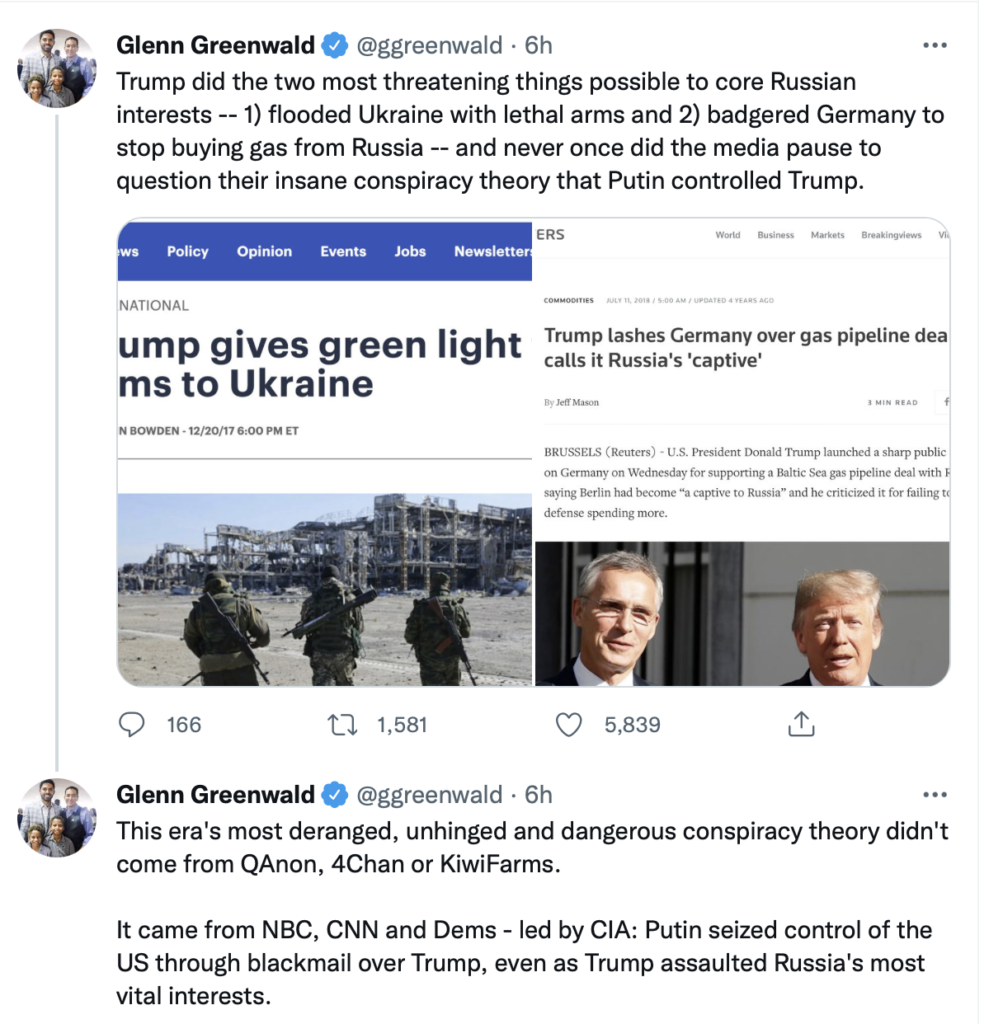
These two tweets channel my feelings today re Ukraine:
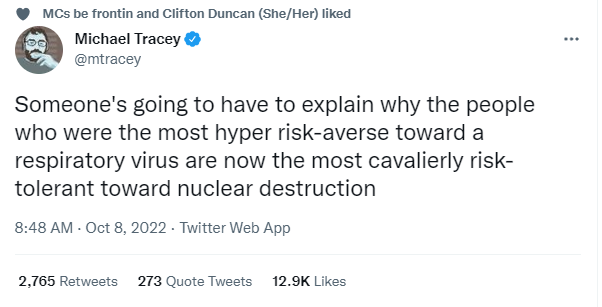
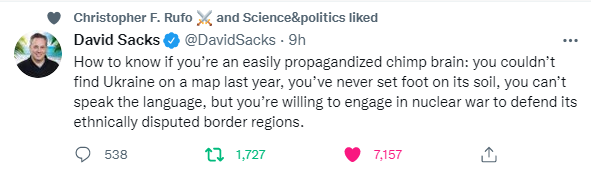

These two tweets channel my feelings today re Ukraine:
Matt Taibbi interviews Katie Halper, recently fired from The Hill. An excerpt:
The controversy began when Michigan Democrat Rashida Tliab spoke at an online seminar on September 20th and said, “It has become clear that you cannot claim to hold progressive values, yet back Israel’s apartheid government.” Tliab gave her talk in the wake of the shooting of Palestinian-American journalist Shireen Abu Akleh, who was killed in the West Bank City of Jenin in May. Abu Akleh’s family met with Secretary of State Anthony Blinken in July, and asked the International Criminal Court to open a case two weeks ago, simultaneous to Tlaib’s seminar.
Tliab’s comments inspired an immediate reaction from the Anti-Defamation League, which deemed them anti-Semitic. CEO Jonathan Greenblatt ripped Tliab for ostensibly telling “American Jews they must pass an anti-Zionist litmus test to participate in progressive spaces.” The ADL reaction got wide play on stations like CNN.
Katie’s “Radar” argues Tliab’s comments laid bare what has long been a source of tension among self-described progressives, who often tiptoe around the subject of occupied Palestine. As you’ll see above, she approached her subject with great care, leaning on statements from groups like Amnesty International and Human Rights Watch. Agree with her or not, her editorial certainly wasn’t fake news, or flippant, or gratuitous. It’s what the media business normally wants: a decisive, well-argued opinion.
However, the Hill thought otherwise, and what makes the situation unusual is a media company saying the proverbial quiet part out loud. When editors refused to run the “Radar,” Katie asked flat-out if the problem was the subject of Israel. Though there was some hemming and hawing (at one point she was told the problem was that the show’s focus was on domestic and not foreign policy, despite running content about Brazilian elections, Italy’s new prime minister, and multiple Ukraine pieces that week), eventually they just told her that was, in fact, the case. The next day, she was let go via a curt email ending, “We wish you all the best.”
Michael Schellenberger makes a strong case for journalism malpractice and warns us that prominent news outlets are working hard to prevent meaningful conversations.
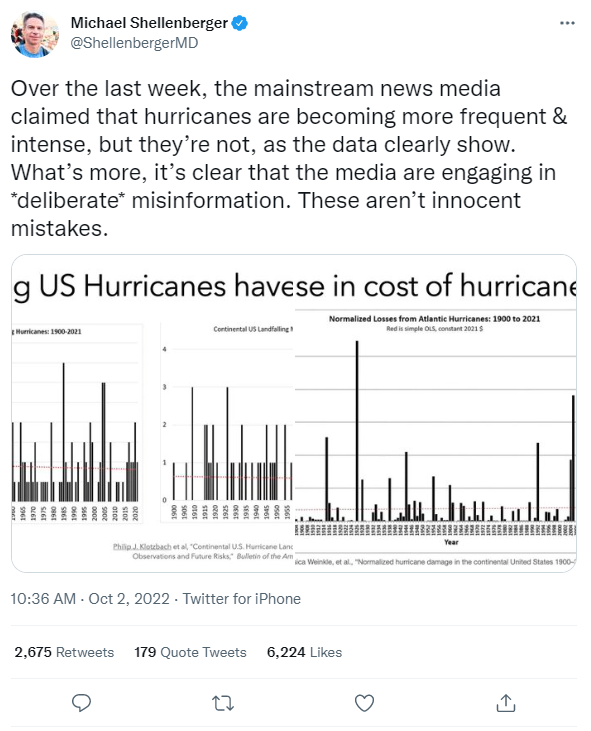
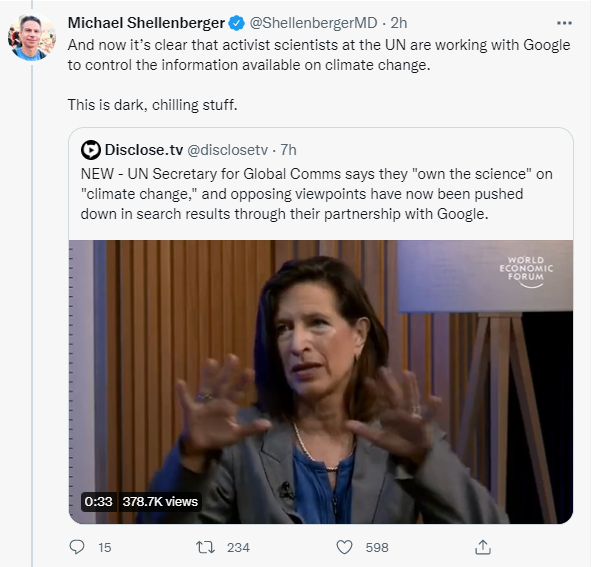
Glenn Greenwald points out that no evidence was needed for left-leaning news outlets to conclude that Trump was in Putin's pocket.
I write this as someone who has almost no respect for both the Democrats, the Republicans and for their respective media teams.
Today's Netchoice opinion out of the 5th Circuit stuns Big Tech, which claimed that it had a First Amendment right to muzzle viewpoints of users. No you don't, said the Court. An excerpt:
A Texas statute named House Bill 20 generally prohibits large social media platforms from censoring speech based on the viewpoint of its speaker. The platforms urge us to hold that the statute is facially unconstitutional and hence cannot be applied to anyone at any time and under any circumstances.
In urging such sweeping relief, the platforms offer a rather odd inversion of the First Amendment. That Amendment, of course, protects every person’s right to “the freedom of speech.” But the platforms argue that buried somewhere in the person’s enumerated right to free speech lies a corporation’s unenumerated right to muzzle speech.
The implications of the platforms’ argument are staggering. On the platforms’ view, email providers, mobile phone companies, and banks could cancel the accounts of anyone who sends an email, makes a phone call, or spends money in support of a disfavored political party, candidate, or business. What’s worse, the platforms argue that a business can acquire a dominant market position by holding itself out as open to everyone—as Twitter did in championing itself as “the free speech wing of the free speech party.” Blue Br. at 6 & n.4. Then, having cemented itself as the monopolist of “the modern public square,” Packingham v. North Carolina, 137 S. Ct. 1730, 1737 (2017), Twitter unapologetically argues that it could turn around and ban all pro-LGBT speech for no other reason than its employees want to pick on members of that community, Oral Arg. at 22:39–22:52.
Today we reject the idea that corporations have a freewheeling First Amendment right to censor what people say. Because the district court held otherwise, we reverse its injunction and remand for further proceedings.
In the meantime, during Congressional testimony, Facebook admits that it has been coordinating with the Whitehouse & CDC to censor FB users' constitutionally protected speech.