
NYT Forced to Acknowledge U.S. Spy Efforts due to Third Party Release of Leaked Documents

In Daniel Ellsberg's day, the NYT was seen as a place friendly to whistle-blowers and those who have documents exposing secret government activities. No longer. Further, the NYT refuses to post a link to the leaked documents, only linking to its own hand-wringing articles. Nowadays, secret documents are leaked elsewhere and the NYT needs to play catch-up, coupling its reluctant acknowledgement with a warning about the damage that could be caused by leaks about secret U.S. activity:

The leak has the potential to do real damage to Ukraine’s war effort by exposing which Russian agencies the United States knows the most about, giving Moscow a potential opportunity to cut off the sources of information. Current and former officials say it is too soon to know the extent of the damage, but if Russia is able to determine how the United States collects its information and cuts off that flow, it may have an effect on the battlefield in Ukraine.

The leak has already complicated relations with allied countries and raised doubts about America’s ability to keep its secrets. After reviewing the documents, a senior Western intelligence official said the release of the material was painful and suggested that it could curb intelligence sharing. For various agencies to provide material to each other, the official said, requires trust and assurances that certain sensitive information will be kept secret.

On the other hand, if you are part of the U.S. security state, the NYT is more than happy to post your propaganda, as it did in the case of the Nord Stream Pipeline. Unbelievably, knowing that it's "explanation" of the pipeline destruction is bullshit, the NYT suggests it's not a good idea to dig further into who destroyed the pipeline:
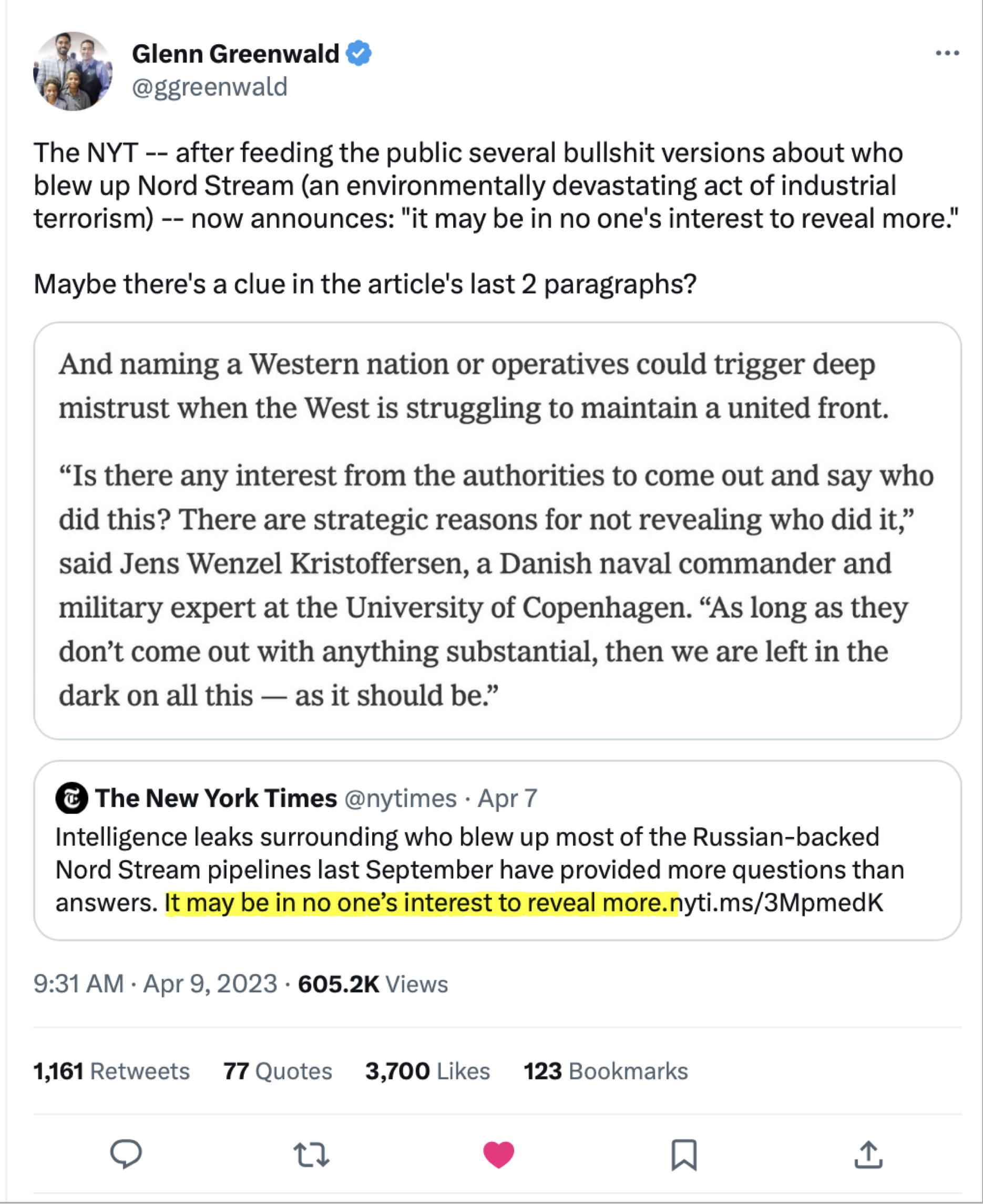
It's a good day to celebrate the immense good fortune of NYT reporters who get to draw big salaries while not having to do the difficult work of actually practicing journalism.
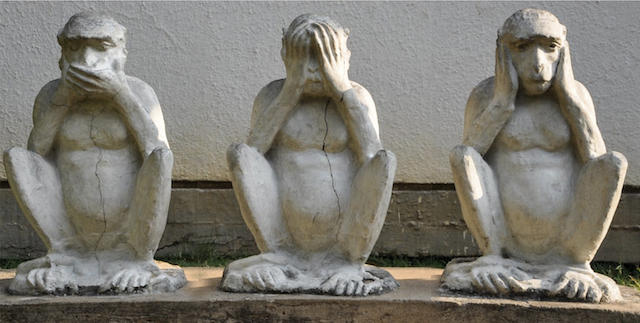
Proposed new Mission Statement for the New York Times: Pay No Attention to the Man Behind the Curtain.

Joe Biden promised to disable the pipeline prior to its destruction:

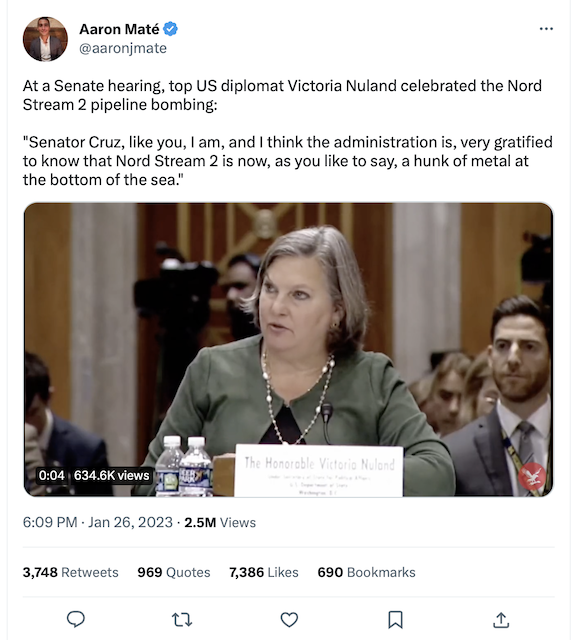
Biden's neocon crony, Victoria Nuland, helped to lead the post-destruction cheerleading, as Aaron Maté reminds us, but, again, Pay No Attention to the Man Behind the Curtain.
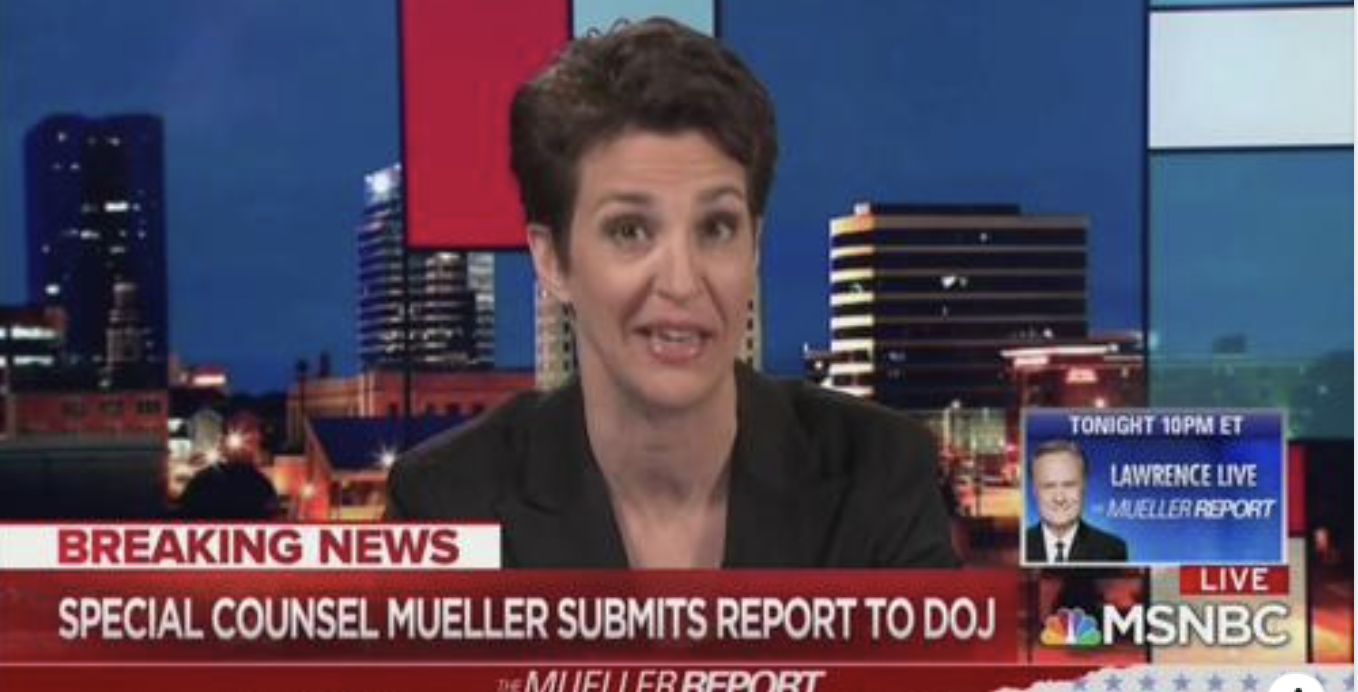
No wonder the corporate media and their U.S. government partners hate Twitter 2.0...
Continue ReadingNYT Forced to Acknowledge U.S. Spy Efforts due to Third Party Release of Leaked Documents

Matt Taibbi’s Patience with MSNBC Runs Out

Excerpt from Matt Taibbi's latest article, "Eat Me, MSNBC: Reviewing the last six years at the network that claims now to be concerned with integrity and accuracy":

[Corporate news outlets] could either keep doing what reporters had done since the beginning of time, confining themselves to saying things they could prove. Or, they could adopt a new approach, in which you can say anything is true or confirmed, so long as a politician or intelligence official told you it was.

Continue ReadingMatt Taibbi’s Patience with MSNBC Runs Out

The Little Sailboat that Destroyed the Nord Stream Pipeline

1. Joe Biden promises he will make Nord Stream pipeline inoperable. Someone then destroys the pipeline. Biden then denies that he had anything to do with this act of war. 2. Next, Seymour Hersh publishes detailed investigative article showing how the U.S. destroyed the pipeline. 3. Germany, co-owner of the pipeline, displays what has got to be the most vivid case of Stockholm Syndrome in human history. 4. U.S. news media ignores the Hersh story. 5. The CIA cooks up an absurd alternative story that not-Joe-Biden destroyed the pipeline. The pipeline was destroyed using "Pro-Ukrainian" group that uses a 49 foot sailboat. 6. The NYT, which has now begrudgingly acknowledged Hersh's blockbuster story, laps up the CIA story. 7. Seymour Hersh destroys the NYT-CIA story with a handful of simple questions.

Excerpt from Hersh's newest story, "THE NORD STREAM GHOST SHIP: The false details in the CIA's cover story":

My initial report received coverage around the world but was ignored by the major newspapers and television networks in the United States. As the story gained traction in Europe and elsewhere abroad, the New York Times on March 7 published a report quoting US officials asserting that American intelligence had accumulated information suggesting that a pro-Ukrainian group sabotaged the pipelines. The story said officials who had “reviewed” the new intelligence depicted it to be “a step toward determining responsibility” for the pipeline sabotage. The Times story got worldwide attention, but nothing more has been heard since from the newspaper about who did what. In an interview for a Times podcast, one of the three authors of the article inadvertently explained why the story was dead on arrival. The writer was asked about the involvement of the alleged pro-Ukrainian group: “What makes you think that’s what happened?” He answered: “I should be very clear that we know really very little. Right?”

Continue ReadingThe Little Sailboat that Destroyed the Nord Stream Pipeline

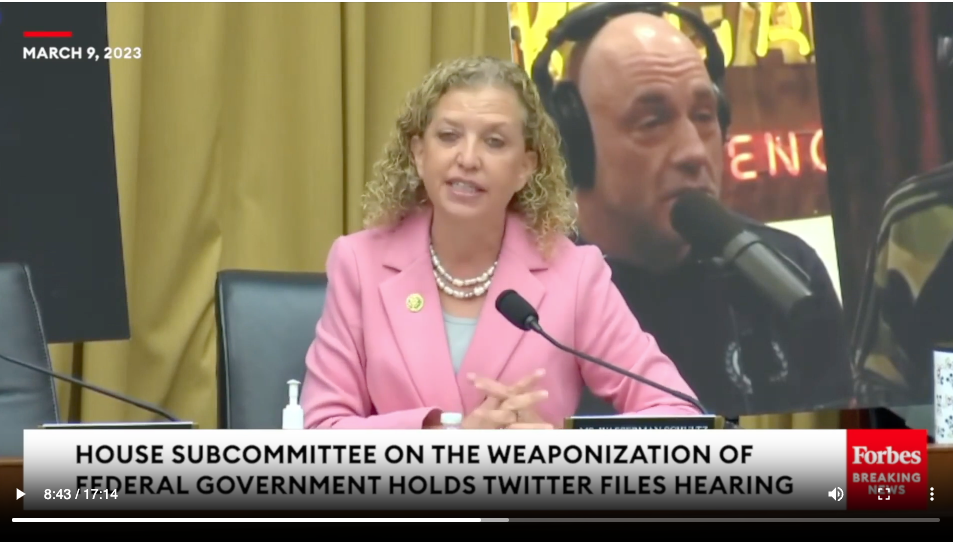
About Two “So-Called” Journalists and the Corrupt Congresswoman who Attacked Them

Russell Brand, as animated as ever, showcases the corrupt history of Debbie Wasserman-Schultz as he simultaneously advocates for free speech. Brand didn't appreciate that Wasserman-Schultz called Matt Taibbi and Michael Shellenberger "so-called reporters." Got him a bit riled up. I had the same reaction when I watched the hearings live . . .

Continue ReadingAbout Two “So-Called” Journalists and the Corrupt Congresswoman who Attacked Them

About Being a Liberal

What does it mean to be a "Liberal"?

What follows is an excerpt from Peter Weiner's article in The Atlantic: "Jonathan Haidt Is Trying to Heal America’s Divisions: The psychologist shares his thoughts on the pandemic, polarization, and politics."

Haidt says, “we’ve messed up the word liberal and we’ve used it to just mean ‘left.’ I’ve always thought of myself as a liberal, in the John Stuart Mill sense. I believe in a society that is structured to give individuals the maximum freedom to construct lives that they want to live. We use a minimum of constraint, we value openness, creativity, individual rights. We try hard to maximize religious liberty, economic liberty, liberty of conscience, freedom of speech. That’s my ideal of a society, and that’s why I call myself a liberal.”

But on the left, Haidt said, “there’s been a movement that has made something else sacred, that has not focused on liberty, but that is focused instead on oppression and victimhood and victimization. And once you get into a framework of seeing your fellow citizens as good versus evil based on their group, it’s kind of a mirror image of the authoritarian populism on the right. Any movement that is assigning moral value to people just by looking at them is a movement I want no part of.”

Haidt went on: “I think this is a very important point for us to all keep in mind, that left and right in this country are not necessarily liberal and conservative anymore. On the left, it’s really clear that there are elements that many of us consider to be very illiberal; and on the right, it’s hard to see how Trump and many of his supporters are conservatives who have any link whatsoever to Edmund Burke. It’s very hard for me to see that. You know, I would love to live in a country with true liberals and true conservatives that engage with each other. That, I think, is a very productive disagreement. But it’s the illiberalism on each side that is making our politics so ugly, I believe.”

Continue ReadingAbout Being a Liberal