
Why Sensationalize an Already Sensational Event?

Scientific American reports, Radiation leaking from Japan's quake-hit nuclear plant as part of the devastation in Japan from the record setting earthquake. Sure, four out of five nuclear facilities immediately shut down safely. But of one unit at the fifth, they say

The blast raised fears of a meltdown at the facility north of Tokyo as officials scrambled to contain what could be the worst nuclear disaster since the Chernobyl explosion in 1986 that shocked the world.

Uh, yeah. Actually, this looks more like the Three Mile Island "disaster" to me. Chernobyl used a reactor technology that was considered too unstable outside of the Manhattan project or the U.S.S.R. that involved a big pile of carbon graphite to regulate the reaction. Graphite burns. Chernobyl burned. Chernobyl also exploded wide open. People stood miles away touristically looking directly into the reactor core, and then dying from the gamma ray exposure. The G.E. reactors in Japan are water filled steel containers. They don't burn.They didn't burst. The reactor was idled within hours. The quake broke the outer concrete containment structure (but not the inner steel one) and also interrupted all three safety backup systems. So the reactor overheated before they got it under control, and they had to vent some probably radioactive steam to prevent the inner containment from also rupturing. I say "probably radioactive" because the cooling water certainly contains tritium (Hydrogen-3) and traces of other isotopes. But so far there are no reports of measurable radiation beyond the reactor premises. I'm sure there will be. Personally, I take this as a sign that we really need to move beyond the 1970's style Cold War reactors to the 1990's style ones now being specified in Europe. These are designed to fail safe even if all the active safety systems fail. Sure, they cost a little more to build. But they are pretty much proof against flood, earthquake, and bomb attacks short of nuclear warheads releasing radiation. I have also advocated building next generation fast neutron reactors that can use depleted uranium, thorium, and most current generation reactors waste as fuel. A past post of mine: Whatever Became of Thorium? These reactors are also inherently safer, because they are using less volatile fuel. This should be an opportunity to discuss the future safer implementation of this inevitable successor to coal power, rather than to propagate, "Gee whiz, isn't noocular power dangerous?"
Continue ReadingWhy Sensationalize an Already Sensational Event?

How bad is the Gulf? How bad is American media?

Secretary of State Hillary Clinton has endorsed Arab news organization Al Jazeera as offering "real news", superior to ersatz U.S. news which is full of commercials, talking-heads and soundbites that are "not particularly informative to us." Perhaps that explains a part of the reason why U.S. audiences are largely unaware of the continuing ecological disaster in the Gulf of Mexico in the aftermath of BP's Deepwater Horizon blowout last year. Al Jazeera, on the other hand, brings us this story of sickness and death on the Gulf Coast.

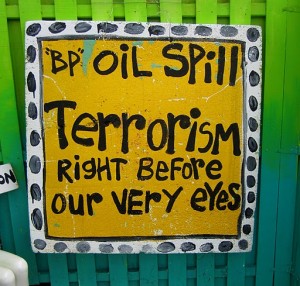
[caption id="attachment_16980" align="alignright" width="300" caption="Eco-terrorism in Gulf of Mexico. Image via Leoma Lovegrove (creative commons)"][/caption] "I have critically high levels of chemicals in my body," 33-year-old Steven Aguinaga of Hazlehurst, Mississippi told Al Jazeera. "Yesterday I went to see another doctor to get my blood test results and the nurse said she didn't know how I even got there." Aguinaga and his close friend Merrick Vallian went swimming at Fort Walton Beach, Florida, in July 2010. "I swam underwater, then found I had orange slick stuff all over me," Aguinaga said. "At that time I had no knowledge of what dispersants were, but within a few hours, we were drained of energy and not feeling good. I've been extremely sick ever since."
[More . . . ]

Continue ReadingHow bad is the Gulf? How bad is American media?

Robert McChesney on federal support for public broadcasting

The co-founder of Free Press, Robert McChesney, discussed U.S. support for public broadcasting with Amy Goodman on today's episode of Democracy Now. The episode begins with Hillary Clinton's recent statement that Al Jazeera and other foreign news sources are offering real news--useful information--unlike America's corporate news. Here's an excerpt of Clinton's testimony before the Senate Foreign Relations Committee last Wednesday:

Viewership of Al Jazeera is going up in the United States because it’s real news. You may not agree with it, but you feel like you’re getting real news around the clock instead of a million commercials and, you know, arguments between talking heads and the kind of stuff that we do on our news, which, you know, is not particularly informative to us, let alone foreigners.

Robert McChesney agreed with Ms. Clinton's disparagement of America's new media. He disagrees with her proposal for addressing this serious problem. Clinton is proposing to increase funding for America's foreign media operations. According to McChesney, we should scrap the plan to increase international propaganda and, instead, provide better support for America's domestic public media. The current federal support for Public Broadcasting and support for community broadcast stations, is $420 million. This amounts to one one−hundredth of one percent of the total federal budget, (i.e., that is one ten-thousandth of the federal spending for 2010) and this only about half the amount ($750 million) that the federal government pays to support various international broadcasts (Voice of America and other international media operations). McChesney recommends that we combine these monies into a single first-rate public-supported media that will treat the United States just like it treats other countries. It should be a network with no double-standard and no blatant propaganda (BTW, I recently noticed that American media outlets call opponents of a government "rebels" when it approves of them but "insurgents" when it doesn't). McChesney proposes that this new government-funded public media should produce the type of information that other countries trust to such an extent that they will value it and rely on it; we should thus make this new public-funded entity's news freely available to the rest of the world. Wouldn't that be a fundamental change? I certainly haven't seen any indication that the world flocks to see the jingoistic arguing-head-pundit "news" that our electronic currently specializes in producing. McChesney reminded Amy Goodman's audience that those concerned with media reform should consider attending the upcoming National Conference for Media Reform, April 8 - 10, in Boston, Massachusetts. I will be there; I've attended prior national conferences by Free Press and they present numerous critically important topics, including reform of corporate media and lots of encouragement for citizen journalists. Admission to the entire conference is $175. Here's what one can expect at the upcoming conference, according to McChesney:

[T]his will be the fifth National Conference for Media Reform, in Boston. I’m more excited about this one than any of the other four, because I think politically in this country right now, with what’s happening in Wisconsin, with what is happening with the battle over public media, with the battle for an open and uncensored internet, the network neutrality fight, I think this is going to be an organizers’ conference. This is going to be an activists’ conference. This is going to be a conference for people to get engaged with issues and learn how to effectively fight, because I think what we’re learning now is that on issue after issue, the vast majority of the American people support us. They care about these issues. And all they need to do is drop a match on that prairie, and we’re going to have a fire. And that’s what we’re going to be doing in April in Boston. It’s going to be an extraordinary event.

Continue ReadingRobert McChesney on federal support for public broadcasting

Who cares about Egypt when we can talk about war?

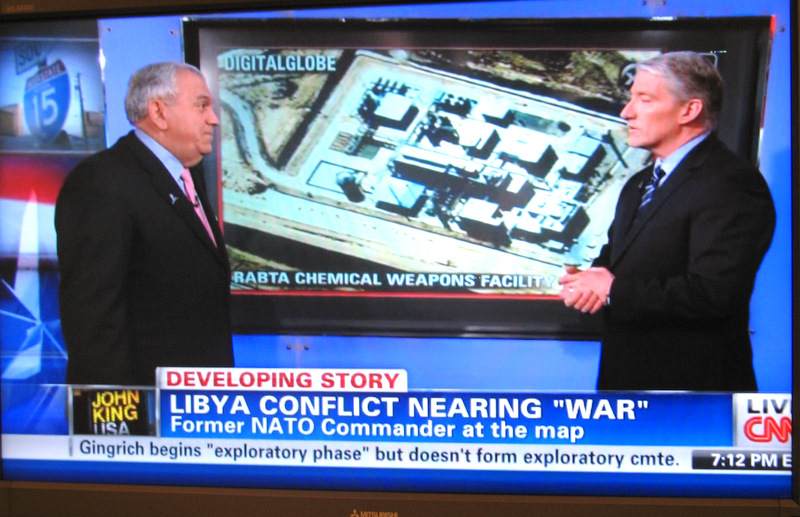
You won't find headlines regarding Egypt in the American mass media anymore, because the much easier to take gawk-worthy videos and pictures demonstrating conflict and violence in Libya. And further, it would take some real work to produce serious stories regarding Egypt's fledgling democracy. Bonus points for covering Libya instead: Reporters can simultaneously discuss U.S. military intervention. Bring on those retired generals! America's itchy aircraft-bomb-dropping finger is already on the hair trigger! We are indisputably the land of War Made Easy and Conflict Pornography.

Continue ReadingWho cares about Egypt when we can talk about war?

The “news”

Here is a modern FOX interview--the "interviewer" is Megyn Kelly. It's seven minutes long. Can you make it all the way to the end without having your mind wander from the topic of the alleged interview to the state of the media?

Continue ReadingThe “news”