Ukraine, U.S. Foreign Policy and the Problem with Whataboutism

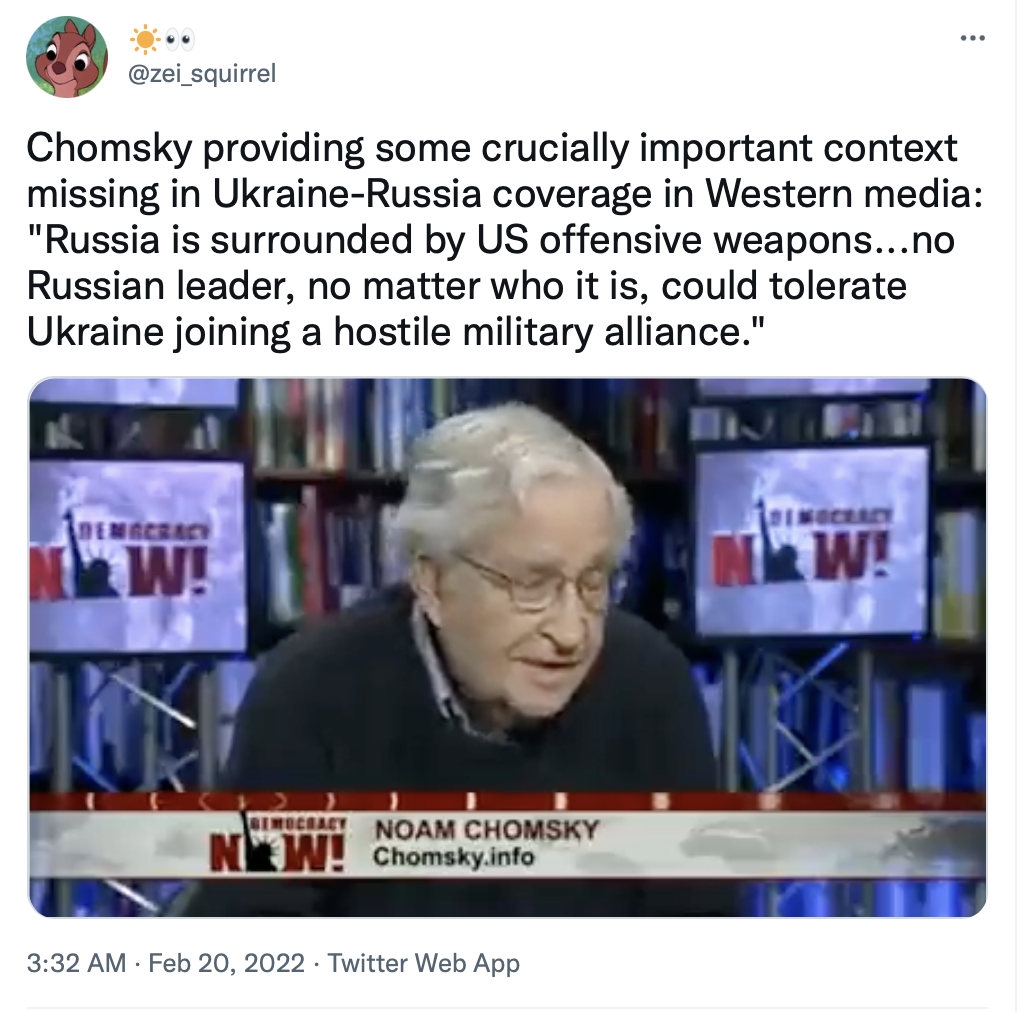
I'll start by saying that Putin is a bad actor who is acting aggressively and killing innocent people. But I also need to add that George W. Bush and Dick Cheney are war criminals. Is there really a problem saying both of these things? Turns out that I'm going light on the United States here. As Noam Chomsky recently stated, the United States thinks that it owns the entire world.

What's good for the goose is good for the gander. Except in today's tribal crazed environment, where the U.S. is entitled to protect its borders through its militarily-enforced hyper-extended sphere of influence but Russia is not allowed to resist NATO's death machines from being parked on its own borders, "because Putin is Hitler." End of Argument. Freddie DeBoer expands on a story about mass hysteria, fact-denial and hypocrisy that risks getting all of us physically roasted in a nuclear holocaust:

The people who say “whataboutism” don’t want to talk about carpet bombing in Cambodia. They don’t want to talk about death squads in El Salvador. They don’t want to talk about reinstalling the Shah in Iran. They don’t want to talk about the murder of Patrice Lumumba in the Congo. They don’t want to talk about giving a hit list to rampaging anti-Communists in Indonesia. They don’t want to talk about the US’s role in installing a far-right government in Honduras. They don’t want to talk about US support for apartheid in South Africa. They don’t want to talk about unexploded ordnance that still kills and maims in Laos. They don’t want to talk about supporting the hideously corrupt drug lord post-Taliban regime in Afghanistan. They don’t want to talk about aiding literal Nazis and Italian fascists in taking over the government in Albania. They don’t want to talk about giving support to the far-right government’s “dirty war” in Argentina. They don’t want to talk about the US-instigated far-right coup in Ghana. They don’t want to talk about our illegal bombing of Yugoslavia. They don’t want to talk about centuries of mistreatment of Haiti, such as sponsoring the coup against Aristide. They don’t want to talk about sparking 36 years of ruinous civil war, and attendant slaughters of indigenous people, in Guatemala. They don’t want to talk about our drone war in Pakistan. They don’t want to talk about how much longer this list could go on. So when do we talk about that stuff, exactly? . . .

Well, OK, fine: I denounce Putin. I denounce his invasion. I support neither and have never suggested I did. Now will you, dear reader, denounce the oceans of blood the United States has spilled in pursuit of its own selfish interests, in the past century? Or do you have some jury-rigged excuse for every American crime I listed above and all the ones I didn’t have space to fit?

If you want the world to operate under the principle of self-determination of countries, you need to start with the country that is the indisputably most powerful and influential country on earth. And if you’re American your first priority and greatest influence lies in America’s government. I will repeat myself in saying that, if you don’t want to acknowledge our role in the world, it’s so much better simply to say, “I’m an American, I think America comes first, I don’t care about the wrong we do, love it or leave it.” That’s not a very enlightened attitude, but it has the benefit of a certain grim integrity, of plainfaced honesty. To insist that you care about self-determination and the principles of non-interference, and to maintain that the United States has the moral authority to opine about them, and to ignore our bloody history… for me, personally, it’s a bridge too far.
Continue ReadingUkraine, U.S. Foreign Policy and the Problem with Whataboutism

Has Russiagate Nudged Us to the Brink of Nuclear War in Ukraine?

Glenn Greenwald warned us about this risk of Russiagate several years ago.

Now that the U.S. is actively engaged in high-stakes brinksmanship with Russia over Ukraine, I can't rule out that Russiagate hysteria has been a significant factor. Admittedly, Russiagate is not the only factor. We are risking civilization-annihilating nuclear war for other reasons too.  For instance, decades of U.S. warmongering and profiteering.  Also, conflict pornography by our "news" networks, right and left wing, which constantly feature war-obsessed military officials and members of the spy state, often without disclosing their conflicts of interest. There is a profit-motive behind this media behavior too.

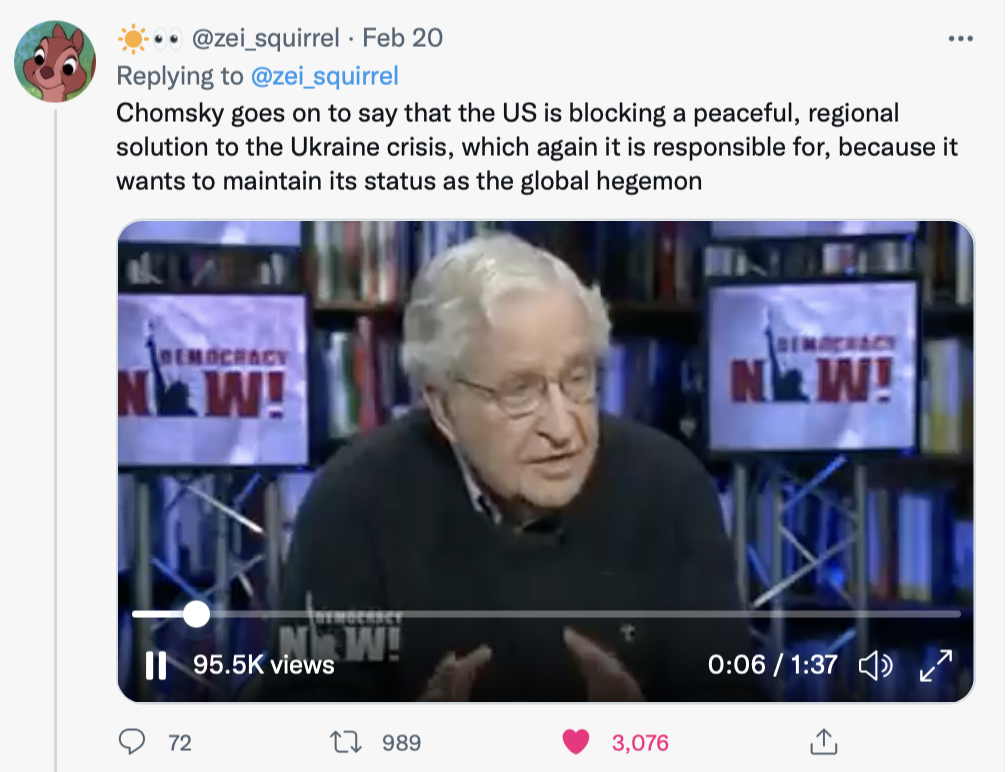
Equally troubling is the failure of our "news" outlets to offer viewpoints criticizing the dominant pro-war narrative. For instance, where are the voices advocating strongly for negotiation and peace?  Viewpoints like those of Noam Chomsky.

Chomsky: "This is part of the concept that [the United States] owns the world"

And how about our ignorance of history? The United States has a well-established track record of using our military to "save" countries by launching invasions that end up destroying countries financially, politically and socially. This is the sad state of U.S. foreign policy and the "news" industry that enables it, IMO.

Continue ReadingHas Russiagate Nudged Us to the Brink of Nuclear War in Ukraine?

Ukraine: Forbidden Discussions

I'm despondent that the mainstream news outlets are so intensely jingoistic, so focused on the logistics of war, so unwilling to look into the mirror. This is not surprising given the vast numbers of retired military and spy state talking heads who now work for the left leaning MSM. It's also unsurprising given that this is how war propaganda always works, illustrated brilliantly by "War Made Easy."

Here are a three snippets of conversation that I with the news media would take much more seriously:

First, this is from Freddie DeBoer's Substack:

[R]ight now, [the United States is] investing hideous amounts of treasure to maintain an order that we can’t afford and that no one really believes we can maintain. Perhaps the Ukrainians will beat back the Russians and they’ll be welcomed into NATO and we can all cheer that the good guys won. But hegemony does not last forever, and sooner or later you’re going to have to ask more adult, more useful questions than, “who’s the goodie, and who’s the baddie?” Otherwise the superpower eventually goes down the hard way.

I find myself considering this quote from a spokeswoman for the Chinese Foreign Ministry.

When the U.S. drove five waves of NATO expansion eastward all the way to Russia’s doorstep and deployed advanced offensive strategic weapons in breach of its assurances to Russia, did it ever think about the consequences of pushing a big country to the wall?

It doesn’t take sympathy for Putin to see that this is a very good question.

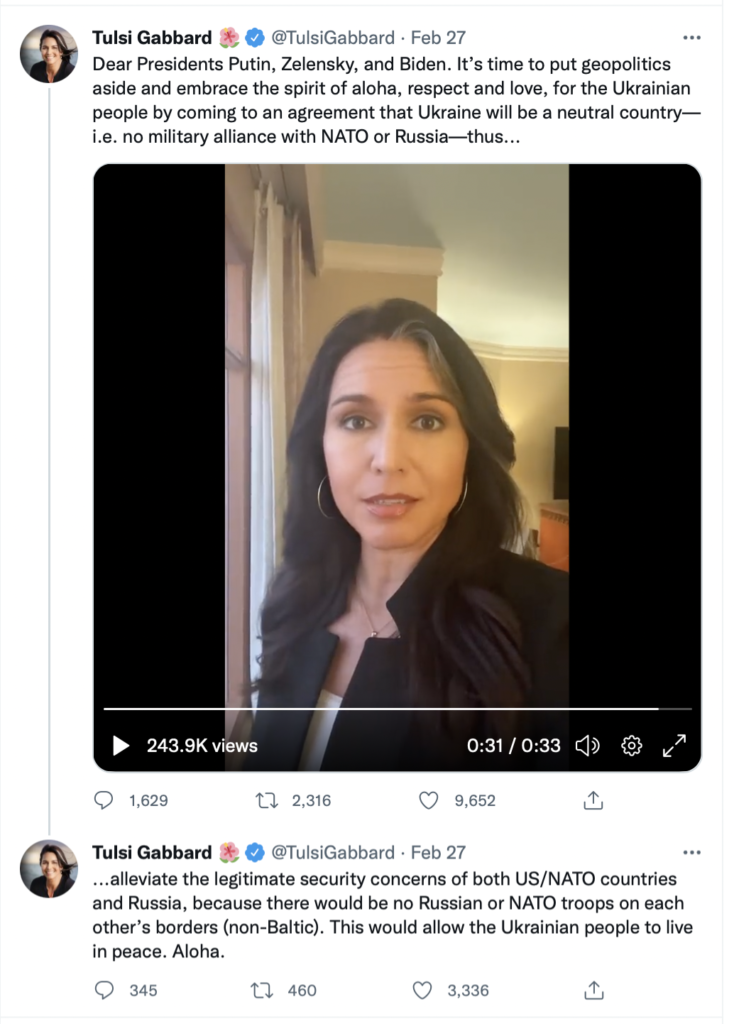
Second, Tulsi Gabbard tweeted this:

Third, Matt Taibbi reminds us that history matters:

I would like to point out that we already tried regime change in Russia. I remember, because I was there. And, thanks to a lot of lurid history that’s being scrubbed now with furious intensity, it ended with Vladimir Putin in power. Not as an accident, or as the face of a populist revolt against Western influence — that came later — but precisely because we made a long series of intentional decisions to help put him there.

Once, Putin’s KGB past, far from being seen as a negative, was viewed with relief by the American diplomatic community, which had been exhausted by the organizational incompetence of our vodka-soaked first partner, Boris Yeltsin. Putin by contrast was “a man we can do business with,” a “liberal, humane, and decent European” of “alert, controlled poise” and “well-briefed acuity,” who was open to anything, even Russia joining NATO. “I don’t see why not,” Putin said. “I would not rule out such a possibility.”

Fourth, this excerpt is from Glenn Greenwald's detailed analysis of our tribal dysfunction that mushroom when that exciting topic of war hits the tabletop:

In the weeks leading up to the Russian invasion of Ukraine, those warning of the possible dangers of U.S. involvement were assured that such concerns were baseless. The prevailing line insisted that nobody in Washington is even considering let alone advocating that the U.S. become militarily involved in a conflict with Russia. That the concern was based not on the belief that the U.S. would actively seek such a war, but rather on the oft-unintended consequences of being swamped with war propaganda and the high levels of tribalism, jingoism and emotionalism that accompany it, was ignored. It did not matter how many wars one could point to in history that began unintentionally, with unchecked, dangerous tensions spiraling out of control. Anyone warning of this obviously dangerous possibility was met with the “straw man” cliché: you are arguing against a position that literally nobody in D.C. is defending.

. . .

There is a reason I devoted the first fifteen minutes of my live video broadcast on Thursday about Ukraine not to the history that led us here and the substance of the conflict (I discussed that in the second half), but instead to the climate that arises whenever a new war erupts, instantly creating propaganda-driven, dissent-free consensus. There is no propaganda as potent or powerful as war propaganda. It seems that one must have lived through it at least once, as an engaged adult, to understand how it functions, how it manipulates and distorts, and how one can resist being consumed by it.

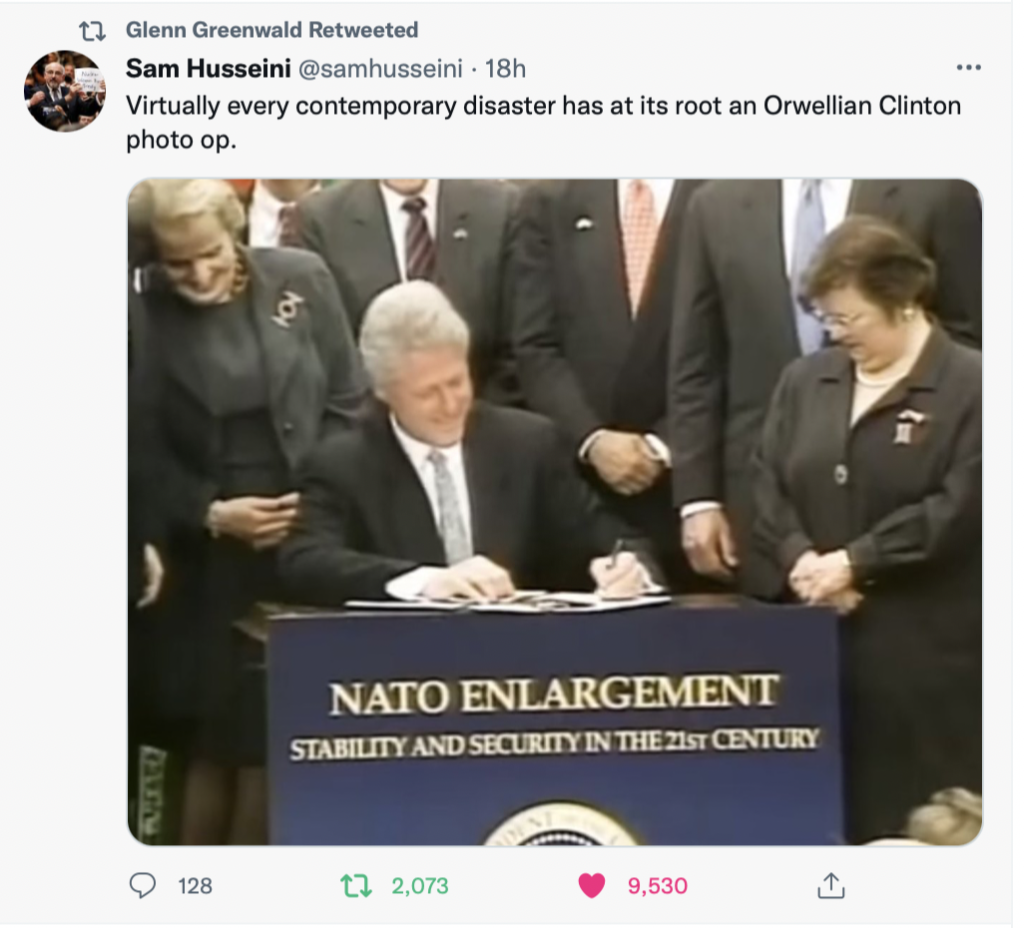
I will end with a photo:

Continue ReadingUkraine: Forbidden Discussions

“Race,” “News Media” and Shootings

I often use the word "race" in scare quotes because I don't believe that "race" is a useful phrase. In fact, it has caused nothing but mischief, violence and death ever since people began using the term. My position is that there are definitely some racists out there, but there is no such thing as "race." I have put the term "news media" in quotes because I have lost so much respect for so many of those organizations that claim to be bringing us the news based on numerous recent examples of a course of conduct that is more egregious than the negligence standard one might associate with journalism malpractice.

Political Scientist Wilfred Reilly is not afraid to step into the fray to state unvarnished truth. He is a former corporate executive and freedom rider, as well as author of the 2020 book Taboo: 10 Facts [You Can't Talk About].  In his introduction to that book, he states:

Tackling taboos is difficult, but necessary. Very often— MOST often— they are used not to shield strong and valid ideas from pointless attacks, but rather to protect weak ones from worthwhile criticism.

Reilly's statistics-rich discussion is now featured on FAIR's website: His article is titled, "The Broken Mirror: Media Narrative vs. Reality." The "news media" that leans politically to the Left is forcefully pushing a media is making people on the political Left unnecessarily angry (against police officers), but it should be making all of us angry (about the divisive narrative being pushed). Here is an excerpt:

In the representative year of 2018, inter-racial violent crime involving blacks and whites made up approximately 3 percent of all serious crime: there were only about 600,000 victim-reported incidents involving a black perpetrator and a white victim, or vice-versa, out of more than 20,000,000 total crimes. Further, of the violent inter-racial crime that does occur, more than 80 percent of reported incidents involved a black perpetrator and a white victim. The data tables in the 2018 Bureau of Justice Statistics Report include more than 500,000 black-on-white violent incidents, but well under 100,000 violent crimes that were white-on-black. While this finding is not necessarily surprising—there are far more whites than blacks, and whites, on average, have more money to be stolen—it would likely come as a shock to most upper-middle class Americans. As would another piece of data: according to the Washington Post, the total number of unarmed black men killed by police during the most recent year on record (2020) was not 10,000, or 1,000, but 17. That bears spelling out: in the year where America was supposedly inundated with white supremacist violence, where America was in the grips of a “racial reckoning” that included, in no small part, the acknowledgement of the “state-sanctioned murder” of young black men, only SEVENTEEN unarmed black men died at the hands of police officers.

This data leads us to an obvious question: why do so many smart people believe inter-ethnic violence is so much worse than it is? . . .Basic data about inter-racial violence often seem not merely ignored by mainstream media sources, but actively misrepresented.

In Taboo, I point out that about 75 percent of individuals fatally shot by police in a typical year are Caucasian whites or Hispanics. However, national media outlets devote less than 20 percent of their police violence coverage to these cases. A Google search for “well-known police shooting,” conducted in 2020 in connection with the book, turned up articles which covered two police shootings of Latinos, four police shootings of whites, and 36 police shootings of blacks. This level of over-representation of black victims in coverage (2,400 percent) could hardly be the result of anything but very conscious choice—and respected social scientists like John Lott have argued empirically that media treatment of a range of issues, from political extremism to mass shootings, follows a similar troubling pattern.

I'm not going to pretend that I could add anything to Reilly's detailed analysis, but reading his article did cause me to wonder whether part of the media strategy was to stir up conflict and hate, thereby selling ads and rewarding loyal followers. As I read Reilly's statistics, I can't help but think of Matt Taibbi's book, Hate, Inc., in which he argues "that what most people think of as 'the news' is, in fact, a twisted wing of the entertainment business.

At the conclusion of his article, Reilly argues that it's time for the new outlets to step up and do real journalism:

In order for our country to truly address the vestiges of racism that still exist, it’s essential that the media provide a clear and honest picture of racial relations in contemporary America.

Continue Reading“Race,” “News Media” and Shootings