Glenn Greenwald: Bradley Manning’s gift is a glimpse into America’s soul

Reality seems upside down in many ways, including the manner in which mainstream journalists have treated Wikileaks and Bradley Manning. Glenn Greenwald comments at The Guardian:

The repressive treatment of Bradley Manning is one of the disgraces of Obama's first term, and highlights many of the dynamics shaping his presidency. The president not only defended Manning's treatment but also, as commander-in-chief of the court martial judges, improperly decreed Manning's guilt when he asserted in an interview that he "broke the law". Worse, Manning is charged not only with disclosing classified information, but also the capital offence of "aiding the enemy", for which the death penalty can be imposed (military prosecutors are requesting "only" life in prison). The government's radical theory is that, although Manning had no intent to do so, the leaked information could have helped al-Qaida, a theory that essentially equates any disclosure of classified information – by any whistleblower, or a newspaper – with treason.

Continue ReadingGlenn Greenwald: Bradley Manning’s gift is a glimpse into America’s soul

Brookings Institute gets an “F” in describing the job of the media

Glenn Greenwald reports that Benjamin Wittes, a writer for the Brookings Institute wrote: "The [New York] Times is not an advocacy organization whose job it is to 'aggressively challenge' the government's claims of the rates of civilian casualties - except to the extent that those claims are untrue." Wittes was responding to an article by NYT suggesting that the NYT could do a better, more aggressive, job of scrutinizing the drone program of President Obama. Greenwald points out the problem with those who criticize those who dare to question the government:

It's amazing that someone not only believes - but is willing to say publicly - that it is not the job of a newspaper to "aggressively challenge" government claims on a highly controversial assassination program that is shrouded in secrecy and uncertainty. That, more than anything else, is the core purpose of journalism (at least in theory): the reason "freedom of the press" is protected in the First Amendment. And it's precisely the media's systematic failure - more accurately: its unwillingness - to engage in this function that has produced the last decade's most destructive outcomes . . . There really is no point in having media outlets that do anything other than "aggressively challenge" the claims of those in power. Actually, there is a point in having that: it allows government assertions to be glorified as true even when there is no evidence that they are. That is why so many power-serving Washington mavens are so eager to defend that model and demand adherence to it. And their success in that mission is why so many destructive government falsehoods are able to flourish without real scrutiny.

Continue ReadingBrookings Institute gets an “F” in describing the job of the media

Matt Taibbi excoriates the media coverage of the presidential election

Time to focus on the terrible "news coverage" of the election. Matt Taibbi nails it:

Banning poll numbers would force the media to actually cover the issues. As it stands now, the horse race is the entire story – I can think of a couple of cable networks that would have to go completely dark tomorrow, as in Dan-Rather-Dead-Fucking-Air dark, if they had to come up with even 10 seconds of news content that wasn't centered on who was winning. That's the dirtiest secret we in the media have kept from you over the years: Most of us [members of the news media] suck so badly at our jobs, and are so uninterested in delving into any polysyllabic subject, that we would literally have to put down our shovels and go home if we didn't have poll numbers we can use to terrify our audiences. . . . Mainly for grim commercial reasons, we in the media manipulate people to stay wired on hate and panic-focused on the race for every waking moment, indifferent to how much this depresses the hell out of everyone. In doing so, we rob people of their patriotism and their desire to vote.

Continue ReadingMatt Taibbi excoriates the media coverage of the presidential election

Where did all of those “journalists” come from?

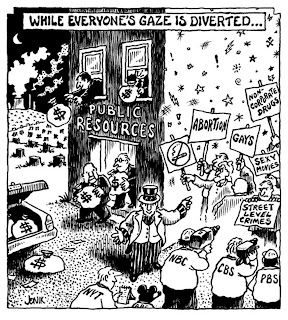
At Salon, David Sirota noticed 15,000 journalists coming of nowhere to cover the Republican National Convention, which is not difficult journalism, but only a big fat staged PR orgy:

More and more media markets in America have become news deserts — places where city council meetings go uncovered, corruption scandals goes unnoticed and huge social ills go unmentioned. Typically, this is explained as a crisis of journalism — more specifically, a crisis of journalism resources. According to media executives’ talking points, news organizations are losing audience share, which means advertisers won’t pay as much for ads, which consequently reduces the revenues that fund real reporting. Rooted in a self-reinforcing cycle, this tautology seems to make perfect sense. The “Dickensian aspect” of real news that affects real people’s lives simply can’t be covered because news outlets just don’t have the resources! There’s just one minor problem with this fable: It can’t be true when the same allegedly cash-strapped media is deploying 15,000 journalists to the non-news events known as the Republican and Democratic conventions.

Continue ReadingWhere did all of those “journalists” come from?