Joe Rogan and Glenn Greenwald Comment on Julian Assange
Update on Julian Assange. This is how the U.S. government treats people (Assange and Edward Snowden) who expose government wrongdoing:
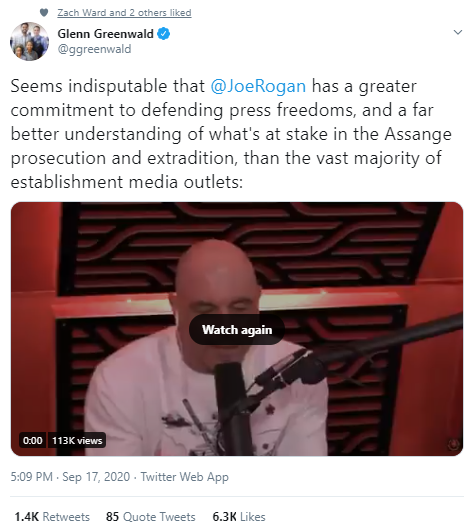
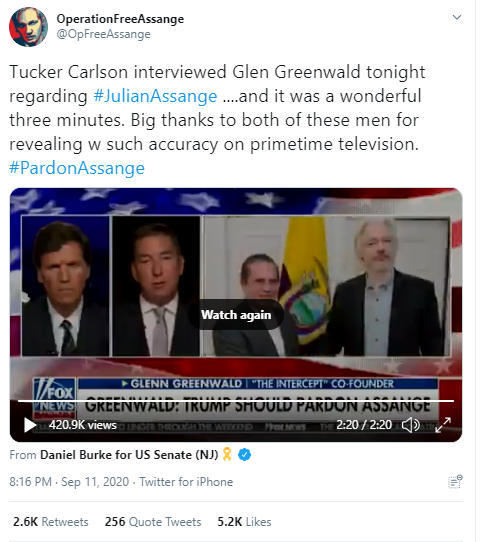

Update on Julian Assange. This is how the U.S. government treats people (Assange and Edward Snowden) who expose government wrongdoing:
Free speech is increasingly being attacked at colleges as university. It it claimed by many the vigorous and free speech is a bad idea in that it allegedly harms students and faculty. This is a critical time to push back hard on such claims. Muzzled speech and censorship conflict with the main purpose of colleges, which is to expose students to many diverse ideas and to train them to deal with the ideas they find objectionable by discussing them civilly.
Greg Lukianoff of FIRE (FOUNDATION FOR INDIVIDUAL RIGHTS IN EDUCATION) warns:
Threats to free speech and academic freedom on campus constantly change: One year, it’s speech codes and federal government overreach that present the greatest danger. The next, it could be speaker disinvitations and heckler’s vetoes.In this video, Lukianoff asserts that the presidents of colleges and universities need to hear these five things loud and clear:With the targets constantly shifting, what are some effective steps college presidents can take right now to fight censorship, regardless of where it originates? Presidents like to say they are in favor of free speech, but few have presented a plan of action that would improve the state of free speech for their students and faculty members.
1. Stop violating the law.
2. Pre-commit / recommit to free speech and inquiry.
3. Defend the free speech rights of your students and faculty loudly, clearly, and early.
4. Teach free speech from day one.
5. Be scholars: Collect data.
Lukianoff urges everyone concerned with these issues to take action today:
Share this list with your college or university president to let them know that you want them to lead the way in protecting free speech and academic freedom on campus.Lukianoff urges everyone concerned with these issues to take action today:
Share this list with your college or university president to let them know that you want them to lead the way in protecting free speech and academic freedom on campus.
FIRE’s mission is to defend and sustain the individual rights of students and faculty members at America’s colleges and universities. These rights include freedom of speech, freedom of association, due process, legal equality, religious liberty, and sanctity of conscience—the essential qualities of liberty. FIRE educates students, faculty, alumni, trustees, and the public about the threats to these rights on our campuses, and provides the means to preserve them.
On July 17, 1996, I was walking through downtown St. Louis when a reporter from a local TV newscast approached me. Her cameraman aimed his camera straight at me. In a loud voice, she asked, “What is your reaction to the fact that terrorists have shot down a TWA passenger plane over Long Island?”
My response to her: “How do we know that terrorists were involved? What is the evidence of that?”
Instead of answering me, the reporter and the cameraman walked away from me and started walking up to another person nearby. As we now know, no terrorists were involved. A short circuit caused fuel vapor in the center fuel tank to explode.
The news media is the only profession mentioned in the Constitution. When news media is done well, it is the lifeblood of democracy as well as our prime method for shedding light on government ineptitude and wrongdoing. Done badly, however, it amounts to what I have often termed “conflict pornography,” attempts to stir up anger through any means in order to sell commercials.
That TWA incident was my front row seat to seeing hack journalism in action. That “news” station knew that it would be financially valuable theater to provoke me blurt out some form of bigotry toward people from the Middle East, even if my outburst weren’t based on accurate information. Financial incentives and bigotry are two of the many ways for warping conversations, for making the exchange of words worse than useless. Today’s news is often distorted beyond recognition by the prominent ideologies of the day. Today’s “news” consumers can reliably choose the kinds of “facts” they want to hear by choosing particular news outlets.
Those of us who are conscientious consumers of the news media are in a difficult spot. Every news report comes from a point of view, but it’s often difficult to figure out what point of view is driving that news report. Whenever we consume a “news” report uncritically, it is the news equivalent of chomping down junk food. The more we do either of these things the less healthy we are.
I have studied journalism for years, including attending multiple conventions sponsored by a non-profit organization called Free Press. I have seen in detail that our news media is hit and miss, giving us some valuable news by heroic reporters, but also publishing shlock. How can most of us tell the difference? Many people set dangerous default when sizing up the industry, declaring that all news is fake news, which is a terrible position to take, though I can understand the frustration. Fuel on this fire is the fact that there are now four times as many PR specialists as news reporters (see the 4-minute video where I interviewed John Nichols of The Nation on this point. Things have gotten dramatically worse since this interview). Truly, how can a consumer of “news” know what to believe? It is difficult to know where to start.
One problem is the most people insist on getting free quality news. That’s weird, because we expect to pay for most other important things. We never go into the grocery store expecting free food, for instance. I’d suggest that each of us think about paying for those news sources you consider thoughtful and accurate. Many of the best sources are facing financially precarious times and they need you. It’s never fun to pay the money, of course, but it feels great in the long run to know that you are a partner to quality journalism. I currently support about ten magazines and newspapers.
Another thing on my wish list is that the news media needs to report much more often on the accuracy of the news media. We need a lot more information, based on careful analysis, about what factual claims made by the various news outlets are accurate. We need more news about the news. I know this sounds like a big task, but I have studied many ways to approach this. Journalism schools could be at the forefront of this movement. In this time of COVID-19, the stakes, including who lives and who dies, could not be higher.
Bill Maher points to sensationalistic headlines to make his point.
>p>
Now that we’re starting to see some hope in all this, don’t hope-shame me. The problem with nonstop gloom and doom is it gives Trump the chance to play the optimist, and optimists tend to win American elections. FDR said, ‘The only thing we have to fear is fear itself.’ You know, as full of s–t as he is, I could see Trump riding that into a second term.
What should be done about TV and Radio stations that have already endangered Americans by calling Coronavirus a hoax, claiming that it was simply like the flu, or the many other variations of these themes? The FCC licenses of such TV and Radio stations should not be renewed where such hoaxes and lies cause illness and death. Shouldn't we start taking the FCC standards seriously? FOX "News" should be concerned. Here is the FCC standard for denying a license renewal.
Broadcast Journalism
Introduction. As noted above, in light of the fundamental importance of the free flow of information to our democracy, the First Amendment and the Communications Act bar the FCC from telling station licensees how to select material for news programs or prohibiting the broadcast of an opinion on any subject. We also do not review anyone’s qualifications to gather, edit, announce, or comment on the news. These decisions are the station licensee’s responsibility. Nevertheless, there are two issues related to broadcast journalism that are subject to Commission regulation: hoaxes and news distortion.
Hoaxes.
The station licensee knew that the information was false; Broadcasting the false information directly causes substantial public harm; and It was foreseeable that broadcasting the false information would cause such harm.
In this context, a “crime” is an act or omission that makes the offender subject to criminal punishment by law, and a “catastrophe” is a disaster or an imminent disaster involving violent or sudden events affecting the public. The broadcast must cause direct and actual damage to property or to the health or safety of the general public, or diversion of law enforcement or other public health and safety authorities from their duties, and the public harm must begin immediately. If a station airs a disclaimer before the broadcast that clearly characterizes the program as fiction and the disclaimer is presented in a reasonable manner under the circumstances, the program is presumed not to pose foreseeable public harm.
News Distortion. The Commission often receives complaints concerning broadcast journalism, such as allegations that stations have aired inaccurate or one-sided news reports or comments, covered stories inadequately, or overly dramatized the events that they cover. For the reasons noted previously, the Commission generally will not intervene in these cases because it would be inconsistent with the First Amendment to replace the journalistic judgment of licensees with our own. However, as public trustees, broadcast licensees may not intentionally distort the news. The FCC has stated that “rigging or slanting the news is a most heinous act against the public interest.” The Commission will investigate a station for news distortion if it receives documented evidence of rigging or slanting, such as testimony or other documentation, from individuals with direct personal knowledge that a licensee or its management engaged in the intentional falsification of the news. Of particular concern would be evidence of the direction to employees from station management to falsify the news. However, absent such a compelling showing, the Commission will not intervene."