
ACLU Sues a Woman Seeking to Use Washington State’s Public Records Act to Determine Transgender Populations in Washington Prisons

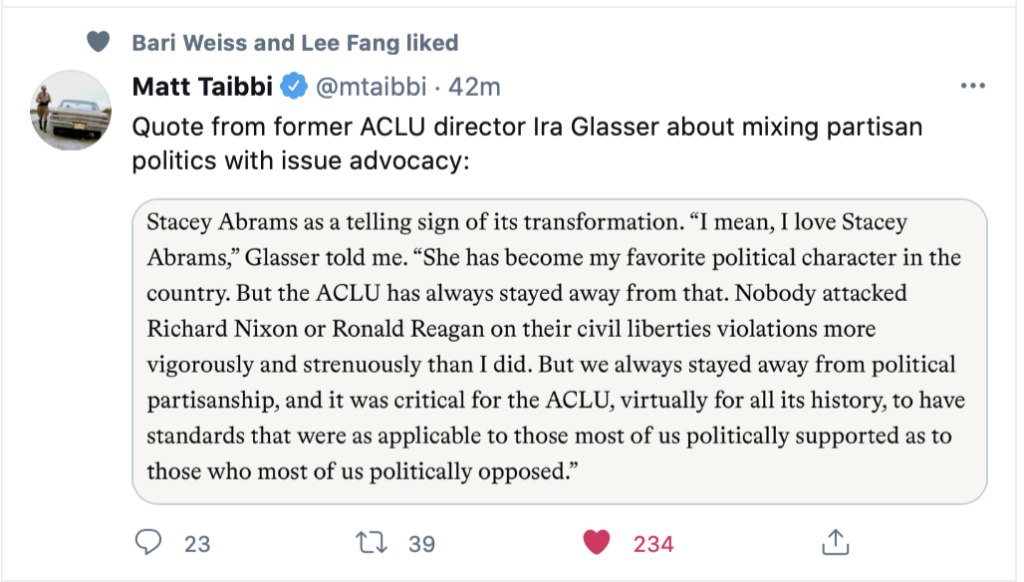
It is rather amazing that any organization would seek to block a citizen from obtaining access to public records. It is surreal that the ACLU is seeking to block citizen access, but this is not the principled ACLU of the Ira Glasser era. . Rather, this is the ACLU that hires attorneys that want to ban books. And now, the ACLU has reached a new low.

PM reports what happened in this case:

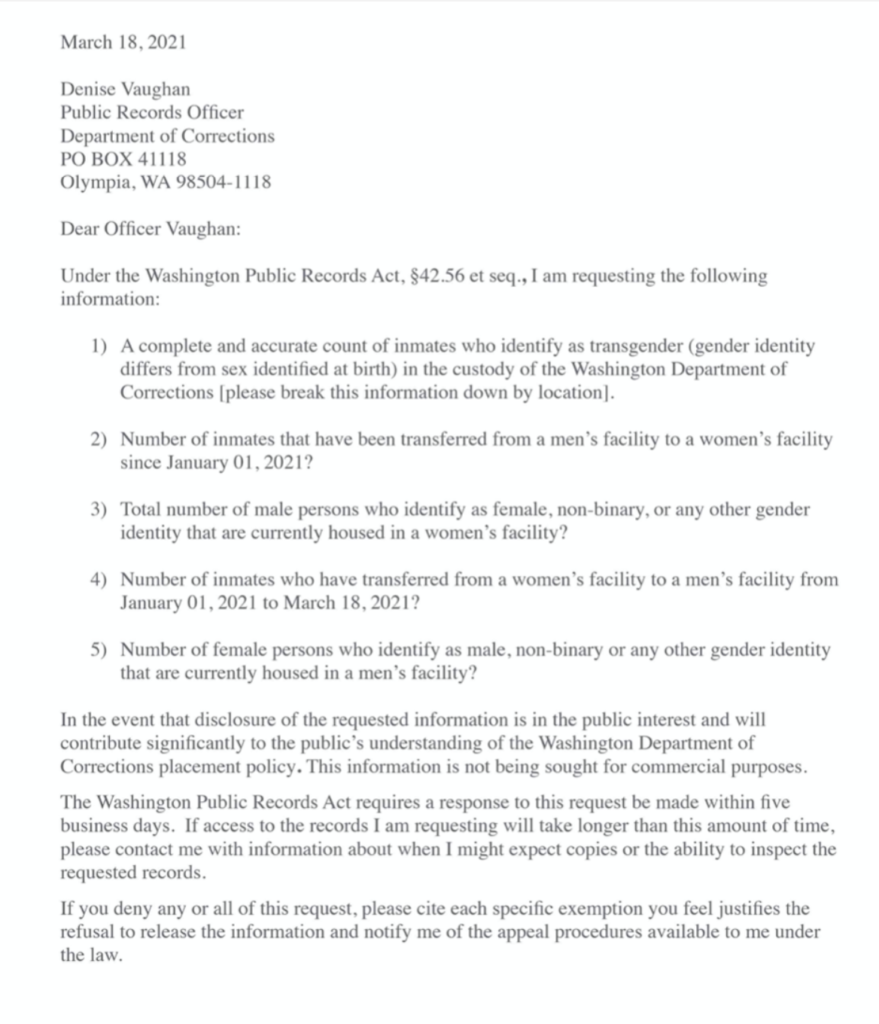
A woman was interested to know how many inmates in Washington state identify as transgender, and how many of those transgender identified inmates have been given transfers to go from men's prison to women's prison, and the reverse. To get this information, she filed a Freedom on Information Act request. Instead of getting the information she requested, she got sued by the ACLU.

Here's a copy of the public records request filed by the citizen:
Why did this woman seek this information?

"I started requesting information about what is happening in US prisons after learning about cases abroad where violent male offenders were housed in women's prisons," the woman who made the request told The Post Millennial, "including a case where a woman became pregnant as a result. Due to the shameful lack of impartial media reporting on this issue, the public can't trust the institutions we've come to rely on to get accurate information.

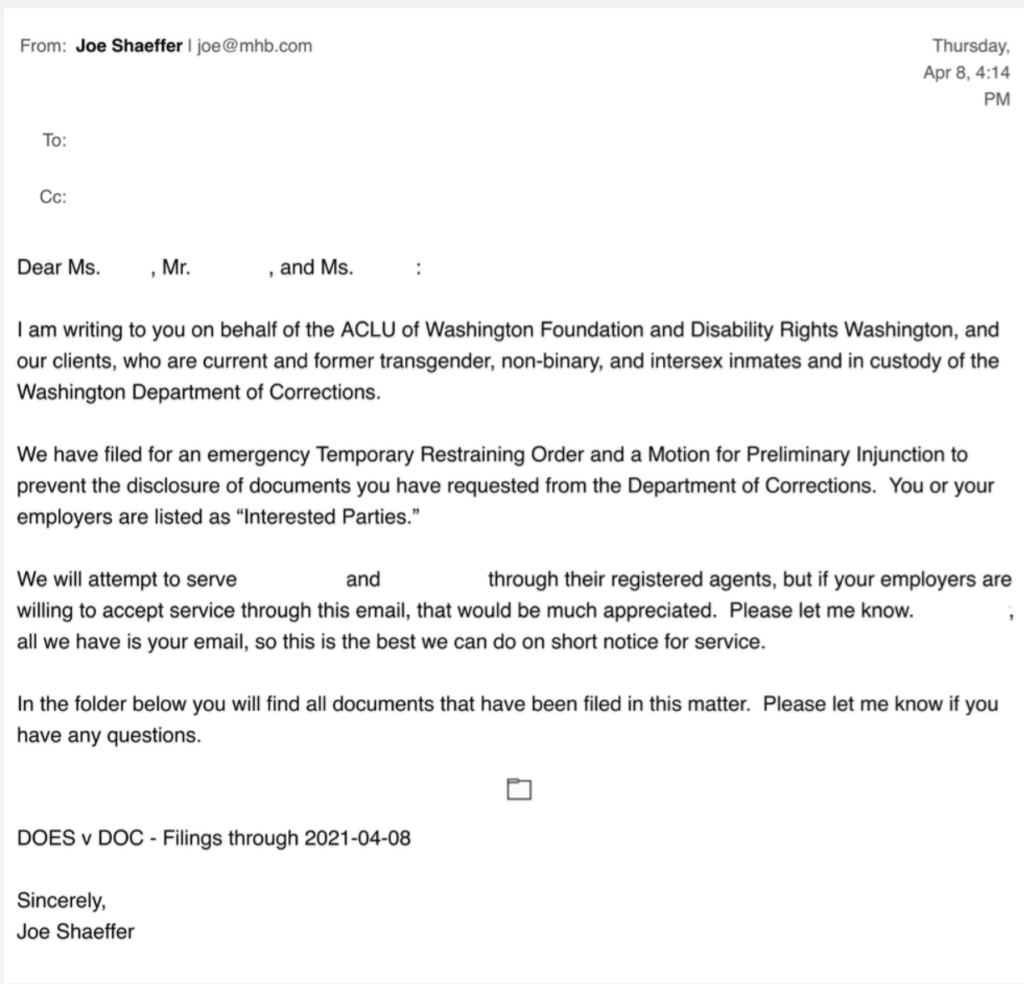
The ACLU responded by sending the woman this letter:
I'll end by reminding us all what the ACLU supposedly stands for:

We must seize every opportunity to protect and advance our civil rights and liberties — in legislatures, the courts, and our communities. Join us in holding our leaders and institutions accountable to fulfill the promise of democracy. With your support, we can lead freedom forward.
Continue ReadingACLU Sues a Woman Seeking to Use Washington State’s Public Records Act to Determine Transgender Populations in Washington Prisons

About Reclaiming Free Speech

Jonathan Zimmerman has noticed that progressives are starting to cringe at the idea of robust free speech.  He has this to say about that cringing at the Wall Street Journal:

When speech can be suppressed, the people with the least power are likely to lose the most. That’s why every great tribune of social justice in American history—including Frederick Douglass, Susan B. Anthony and Martin Luther King Jr. —was also a zealous advocate for free speech. Without it, they couldn’t critique the indignities and oppression that they suffered.

Continue ReadingAbout Reclaiming Free Speech

To What Extent Can the Government Prosecute Liars?

To what extent can the government prosecute lies? First Amendment Law Professor Eugene Volokh has written an excellent article considering many angles. Here's an excerpt:

Surprisingly, the Supreme Court has never resolved the question. It hasn’t resolved the big-picture question: When can the government punish lies? It hasn’t resolved the medium-size question: Can the government punish lies in election campaigns? And it hasn’t resolved the particular question: Can the government punish lies about the mechanisms of voting, and in particular about how to vote?

[T]he court considered the case of Xavier Alvarez, a local government official in an LA suburb; he had lied about getting the Congressional Medal of Honor, and was prosecuted under the Stolen Valor Act, a statute that bans such lies about military decorations. Unconstitutional, six justices said. There was broad agreement that “Laws restricting false statements about philosophy, religion, history, the social sciences, the arts, and other matters of public concern … would present a grave and unacceptable danger of suppressing truthful speech.” “The point is not that there is no such thing as truth or falsity in these areas or that the truth is always impossible to ascertain, but rather that it is perilous to permit the state to be the arbiter of truth.” (That’s from the dissent, but the concurrence endorsed it, and the plurality’s opinion was even more speech-protective than the others.)

Yet when it came to more specific lies, whether about one’s own medals or something else, there was no majority opinion.

Continue ReadingTo What Extent Can the Government Prosecute Liars?