In Whom I Don’t Trust

Would you believe that the U.S. House of Representatives is spending our time voting on a resolution to reaffirm the divisive McCartheism era phrase "In God We Trust" as our national motto, and to encourage its display in all public and government buildings? Yep. On March 17, the U.S. House Judiciary Committee approved House Concurrent Resolution 13 and now the Republican controlled House will vote on it. You can read the entire text of the resolution here, and use the form at this link to contact your representative in the House, and urge them not to vote for such nonsense. How does this shore up the promise of jobs? I've previously posted on this annoying phrase, specifically on the money: In God We Trust (2007) and The Dollar Got More Annoying (2010)

Continue ReadingIn Whom I Don’t Trust

A Note From Japan, a Lesson in Humility

In the aftermath of the record earthquake and tsunami, I received an email from one of my suppliers in Japan. MrTitanium gets his bulk chains from them because no one else makes them. I place a couple of orders a year, and know several of the staff by name. I am impressed that their communications infrastructure is so hardy. This country had its infrastructure designed for such calamities. The email in slightly fractured English advised me that one of their factories was flood damaged, and both are out of commission pending some repairs, and the grid and roads being rebuilt. Their warehouses are intact, but until the emergency passes they are unable to ship. Power is being rationed and is understandably intermittent, given the worst natural disaster to ever hit nuclear power plants. Lack of food, water, roads, fuel, and such is a hardship for them. But they abashedly apologize for any inconvenience this may be causing me, and beg for our understanding.

Continue ReadingA Note From Japan, a Lesson in Humility

Why Sensationalize an Already Sensational Event?

Scientific American reports, Radiation leaking from Japan's quake-hit nuclear plant as part of the devastation in Japan from the record setting earthquake. Sure, four out of five nuclear facilities immediately shut down safely. But of one unit at the fifth, they say

The blast raised fears of a meltdown at the facility north of Tokyo as officials scrambled to contain what could be the worst nuclear disaster since the Chernobyl explosion in 1986 that shocked the world.

Uh, yeah. Actually, this looks more like the Three Mile Island "disaster" to me. Chernobyl used a reactor technology that was considered too unstable outside of the Manhattan project or the U.S.S.R. that involved a big pile of carbon graphite to regulate the reaction. Graphite burns. Chernobyl burned. Chernobyl also exploded wide open. People stood miles away touristically looking directly into the reactor core, and then dying from the gamma ray exposure. The G.E. reactors in Japan are water filled steel containers. They don't burn.They didn't burst. The reactor was idled within hours. The quake broke the outer concrete containment structure (but not the inner steel one) and also interrupted all three safety backup systems. So the reactor overheated before they got it under control, and they had to vent some probably radioactive steam to prevent the inner containment from also rupturing. I say "probably radioactive" because the cooling water certainly contains tritium (Hydrogen-3) and traces of other isotopes. But so far there are no reports of measurable radiation beyond the reactor premises. I'm sure there will be. Personally, I take this as a sign that we really need to move beyond the 1970's style Cold War reactors to the 1990's style ones now being specified in Europe. These are designed to fail safe even if all the active safety systems fail. Sure, they cost a little more to build. But they are pretty much proof against flood, earthquake, and bomb attacks short of nuclear warheads releasing radiation. I have also advocated building next generation fast neutron reactors that can use depleted uranium, thorium, and most current generation reactors waste as fuel. A past post of mine: Whatever Became of Thorium? These reactors are also inherently safer, because they are using less volatile fuel. This should be an opportunity to discuss the future safer implementation of this inevitable successor to coal power, rather than to propagate, "Gee whiz, isn't noocular power dangerous?"

Continue ReadingWhy Sensationalize an Already Sensational Event?

How bad is the Gulf? How bad is American media?

Secretary of State Hillary Clinton has endorsed Arab news organization Al Jazeera as offering "real news", superior to ersatz U.S. news which is full of commercials, talking-heads and soundbites that are "not particularly informative to us." Perhaps that explains a part of the reason why U.S. audiences are largely unaware of the continuing ecological disaster in the Gulf of Mexico in the aftermath of BP's Deepwater Horizon blowout last year. Al Jazeera, on the other hand, brings us this story of sickness and death on the Gulf Coast.

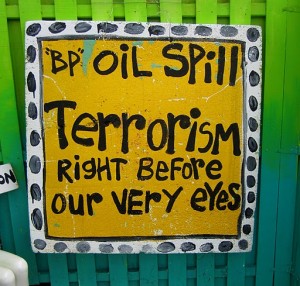
[caption id="attachment_16980" align="alignright" width="300" caption="Eco-terrorism in Gulf of Mexico. Image via Leoma Lovegrove (creative commons)"][/caption] "I have critically high levels of chemicals in my body," 33-year-old Steven Aguinaga of Hazlehurst, Mississippi told Al Jazeera. "Yesterday I went to see another doctor to get my blood test results and the nurse said she didn't know how I even got there." Aguinaga and his close friend Merrick Vallian went swimming at Fort Walton Beach, Florida, in July 2010. "I swam underwater, then found I had orange slick stuff all over me," Aguinaga said. "At that time I had no knowledge of what dispersants were, but within a few hours, we were drained of energy and not feeling good. I've been extremely sick ever since."
[More . . . ]

Continue ReadingHow bad is the Gulf? How bad is American media?

How We Got Here: The Debate II

To continue... The Whiskey Rebellion more or less blew up in Alexander Hamilton’s face. The tax he pushed through congress on whiskey that triggered the entire affair was shortly thereafter repealed and it was a while before the federal government tried to impose internal taxes. One of the stated goals of the revolution was to end taxation without representation, but in practical terms this meant an end to taxation, period. The federal government used tariffs and land sales to pay off the debt incurred by the revolutionary war. Jefferson’s purchase of Louisiana was still done by a combination of the two plus borrowing. Generally, tariffs were kept low, to encourage volume of trade. Some high tariffs were employed in the 1820s and 1830s as protectionist measures to level the field with Britain, which was in the midst of its “workshop of the world” period. The South hated these tariffs because it raised the price of manufactures and shipping, which impacted on their trade which was almost entirely agricultural. It was different in the states. Property taxes early became a source of state revenue. The definition of “property” for the purposes of such taxes stretched far beyond the bounds we would recognize or accept today and under Jackson came to include just about anything a person owned. Local reaction to such impositions varied by city and state, but rarely rose to the level of rebellion. Federal internal taxes did not come into play until the Civil War. The need to raise revenue in huge amounts and quickly necessitated the creation of the first income tax, among others, including a vast array of excise taxes and licensing. There were special corporate taxes, stamp taxes for legal documents, and inheritance taxes. Most of these were phased out after the Civil War. Interestingly, the Republicans—a new party formed just before the Civil War which became the second national party, supplanting the archaic Whigs—kept two elements of the new tax system: high tariffs and taxes on liquor and tobacco. High tariffs were protectionist measures. The excises on liquor and tobacco were not greatly challenged because they coincided with the growing Temperance Movement, which was becoming politically significant. [More . . . ]

Continue ReadingHow We Got Here: The Debate II